Cross-Border vs Local Fulfillment in Thailand: A Decision Model Under the 2026 Duty Regime
By ZhongTai Bridge Editorial · Last reviewed October 2026 · 5 min read
Photo: Unsplash
Short answer
After duty and VAT apply to low-value imports from the first baht, the choice between cross-border parcels and local stock depends on total landed cost, delivery speed, working capital and risk. Model both routes with real numbers and choose by product, not by habit.
What changed in 2025 and 2026?
Thailand applied VAT to low-value imported consignments from 18 February 2025 and, from 1 January 2026, import duty from the first baht, with platforms such as Shopee, Lazada, TikTok Shop, SHEIN and Temu agreeing to collect taxes at checkout. Thailand's VAT is currently 7% until 30 September 2027, against a statutory rate of 10%. These changes narrow the price advantage of parcels shipped directly from China.
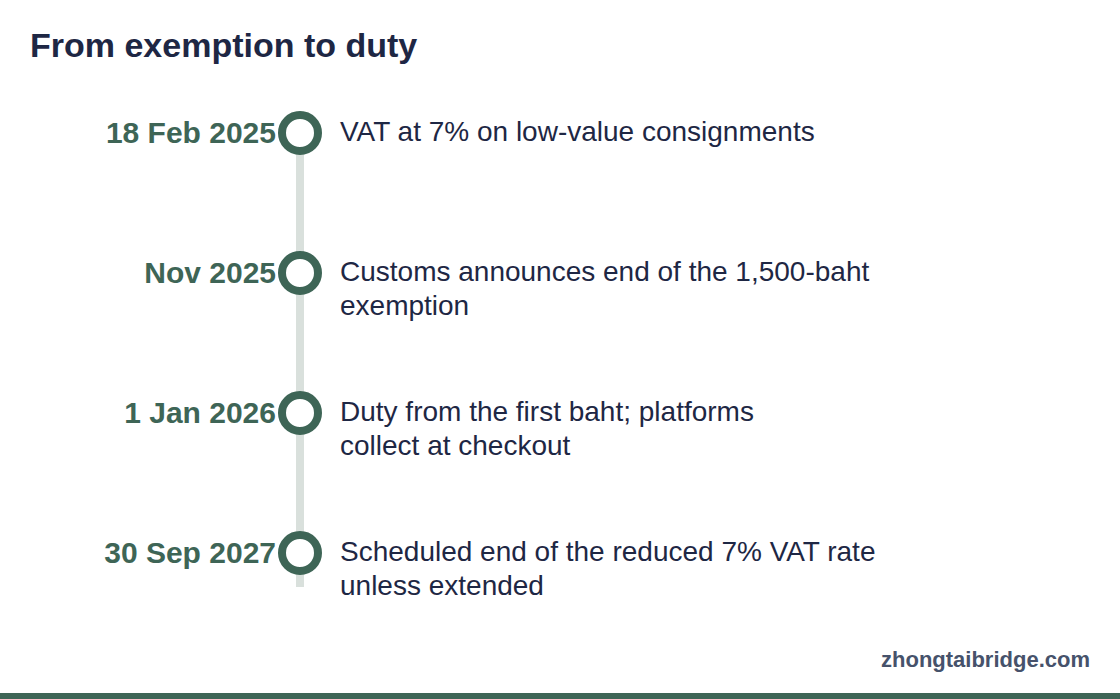
From exemption to duty
Timeline. 18 Feb 2025: VAT at 7% on low-value consignments. Nov 2025: Customs announces end of the 1,500-baht exemption. 1 Jan 2026: Duty from the first baht; platforms collect at checkout. 30 Sep 2027: Scheduled end of the reduced 7% VAT rate unless extended.
Source: VATcalc; Khaosod English; PwC Thailand.
What are the two models?
Cross-border direct: ship each order from China. Low inventory risk, longer delivery, higher per-parcel logistics cost and duty and VAT collected at checkout.
Local stock: import in bulk to a Thai warehouse or partner, then ship domestically. Faster delivery, easier returns, lower per-order shipping, but working capital, inventory risk and compliance obligations.
Cross-border direct versus local stock
Cross-border direct
Local stock
Delivery
Slower
Faster
Per-order logistics
Higher
Lower domestic leg
Inventory risk
Low
Higher
Working capital
Low
Higher
Returns
Hard and costly
Easier
Compliance
Duty and VAT at checkout
Importer of record, VAT registration, customs
How do you compare total landed cost?
Direct route: product cost + international parcel shipping + duty + VAT + platform fees + last-mile.
Local route: product cost + bulk freight + duty and import VAT (recoverable if VAT-registered) + warehousing + domestic shipping + platform fees + inventory carrying cost and write-offs.
Add returns: local stock handles returns more easily, while cross-border returns can be costly or abandoned.
Add advertising effect: faster delivery can improve conversion and ratings.
Use the landed cost and chargeable weight calculators to compare both routes per unit.
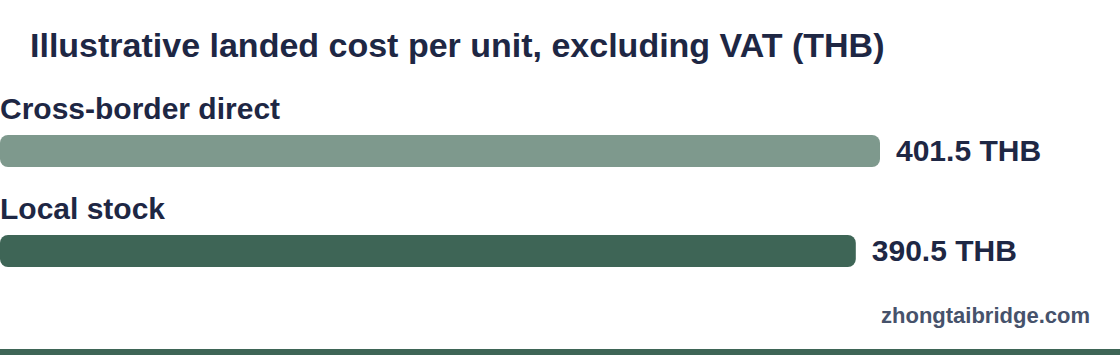
Illustrative landed cost per unit, excluding VAT (THB)
Horizontal bar chart. Cross-border direct: 401.5 THB; Local stock: 390.5 THB
Mid- to high-price items where duty is a smaller share of price.
Categories where delivery speed and returns drive conversion.
Brands building rating and repeat purchase.
When does cross-border still work?
Long-tail or low-volume products.
Test launches before committing inventory.
Products with high value-to-weight where shipping cost is small.
Items where the platform provides efficient cross-border programs.
What risks should you plan for?
Duty classification and declared value: ensure accuracy to avoid delays or penalties.
Inventory risk: overstock, expiry or obsolescence.
Regulatory requirements for imported goods: confirm with advisers.
Platform rule changes that alter fulfillment options.
A simple decision rule
Start with cross-border for the pilot to validate demand. When a product achieves stable monthly volume and its local-stock margin exceeds cross-border margin after carrying costs, move it to local stock in a small first batch. Revisit quarterly.
An illustrative comparison
The figures are hypothetical. Suppose a product costs THB 270 in the factory, with international parcel shipping of THB 95, 10% duty and 7% VAT collected at checkout for a cross-border order. The same product shipped in bulk costs THB 35 per unit in freight, THB 15 per unit in warehousing and THB 40 per order in domestic shipping, with VAT recoverable if the importer is VAT-registered. Even though the local route needs working capital, the lower per-order cost and faster delivery improve conversion and ratings. A seller with steady volume would likely move this product to local stock, while keeping slow-moving variants cross-border.
Run your own numbers with the landed cost and chargeable weight calculators before you decide.
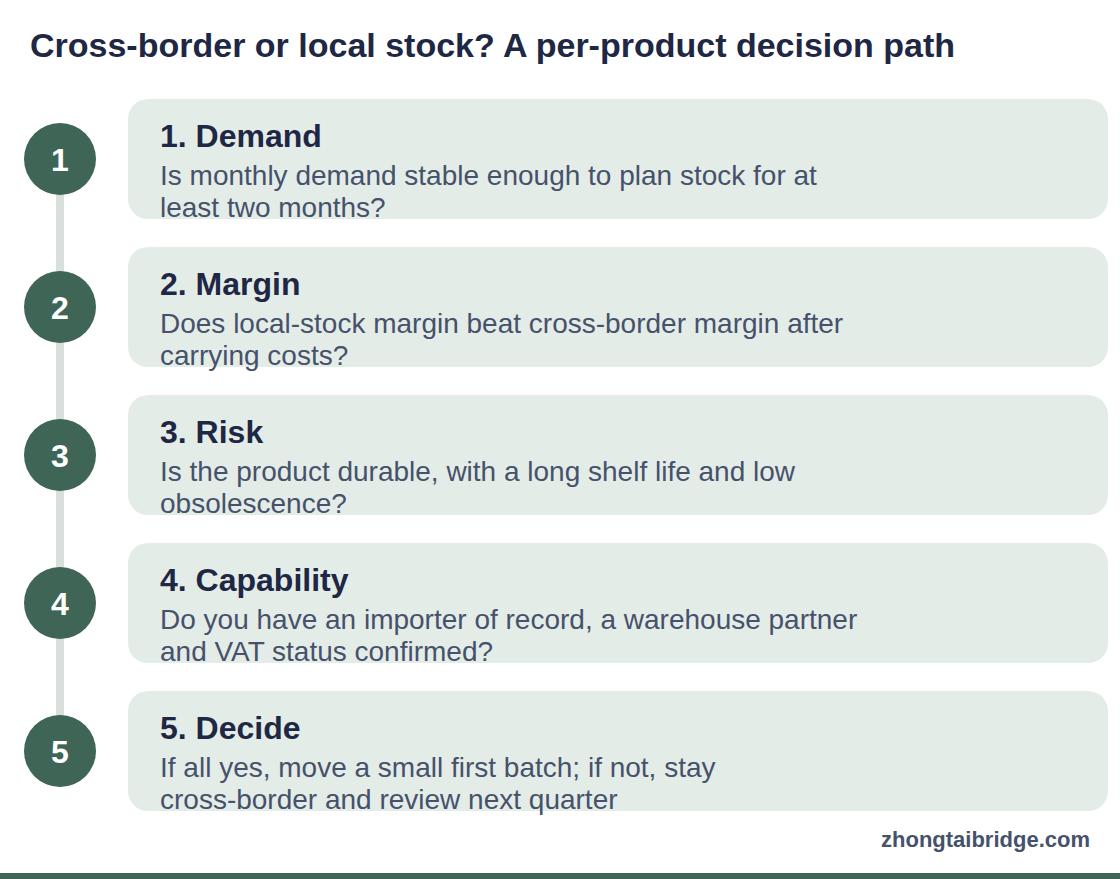
A decision tree for each product
Cross-border or local stock? A per-product decision path
Process diagram. 1. 1. Demand: Is monthly demand stable enough to plan stock for at least two months?. 2. 2. Margin: Does local-stock margin beat cross-border margin after carrying costs?. 3. 3. Risk: Is the product durable, with a long shelf life and low obsolescence?. 4. 4. Capability: Do you have an importer of record, a warehouse partner and VAT status confirmed?. 5. 5. Decide: If all yes, move a small first batch; if not, stay cross-border and review next quarter.
The tree prevents two common errors: moving the entire catalog to local stock because one product justifies it, and staying cross-border out of habit when a hero product has outgrown the model.
Working capital and cash timing
Local stock ties up cash between production payment and sale. A product with a 60-day production-to-shelf cycle and a 30-day sell-through requires financing for that period, plus buffer stock. Compare the cost of capital with the savings in shipping and the gain from conversion. Also consider returns: local stock lets you inspect and resell returned goods, while cross-border returns are often written off. Model both flows, then include a downside case in which sell-through is 30% slower. If the plan survives, the move is safer.
Executive questions on fulfillment
Will duty make cross-border selling impossible? No. It narrows the price advantage, but products with high value relative to weight, or long-tail items, can still work. Recalculate per product.
Do we need a Thai entity for local stock? You generally need a local importer of record or partner, and your VAT status affects costs. Take advice before you ship stock.
How much stock should we start with? Enough for six to eight weeks of expected demand on one or two best sellers, then adjust with data.
What if rules change again? Keep scenarios for the statutory 10% VAT rate after 30 September 2027 and for higher duty schedules, and review quarterly.
Frequently asked questions
Can I use a mixed model?
Yes. Many sellers keep best sellers in local stock and the long tail cross-border.
Do I need a Thai entity for local stock?
Typically you need a local importer of record or partner. Take advice on structure and tax.
Compare Shopee, Lazada and TikTok Shop in Thailand with 2025 market data, business models, fit by product type, fee layers, a 90-day pilot and a scoring sheet.
A TikTok Shop Thailand guide: why growth is fast, product fit, a weekly content system, creator and live-selling basics, metrics and risks, with 2025 platform data.