How to Sell on Shopee Thailand as a Chinese Brand: A Practical Launch Plan
By ZhongTai Bridge Editorial · Last reviewed October 2026 · 9 min read
Short answer
Launch on Shopee Thailand by choosing the right seller route, pricing from landed cost, writing Thai listings around real search terms, planning for campaign days, keeping chat fast and ratings strong, and reviewing a weekly dashboard. Start with a few products and advertise only listings that already convert.
Why start on Shopee?
Shopee holds more than half of Thai platform e-commerce, according to Momentum Works, in a market that grew 51.8% in 2025. Shoppers arrive with purchase intent and compare prices and reviews, which suits standard products with clear specifications. The platform also supplies traffic, payment, logistics and buyer protection, so a brand can reach customers within days of store approval. The cost is competition, fees and a need for discipline in service and pricing.
Step 1: which seller route should you use?
Shopee supports different routes for local and cross-border sellers. Requirements, fees and programs change, so check the current options in Shopee's seller center before you commit, and take advice on company, tax and import structure. Since 1 January 2026, online imports pay duty from the first baht and VAT, collected at checkout, so a cross-border route should be modeled with these costs and compared with a local-stock route.
Step 2: how do you set prices?
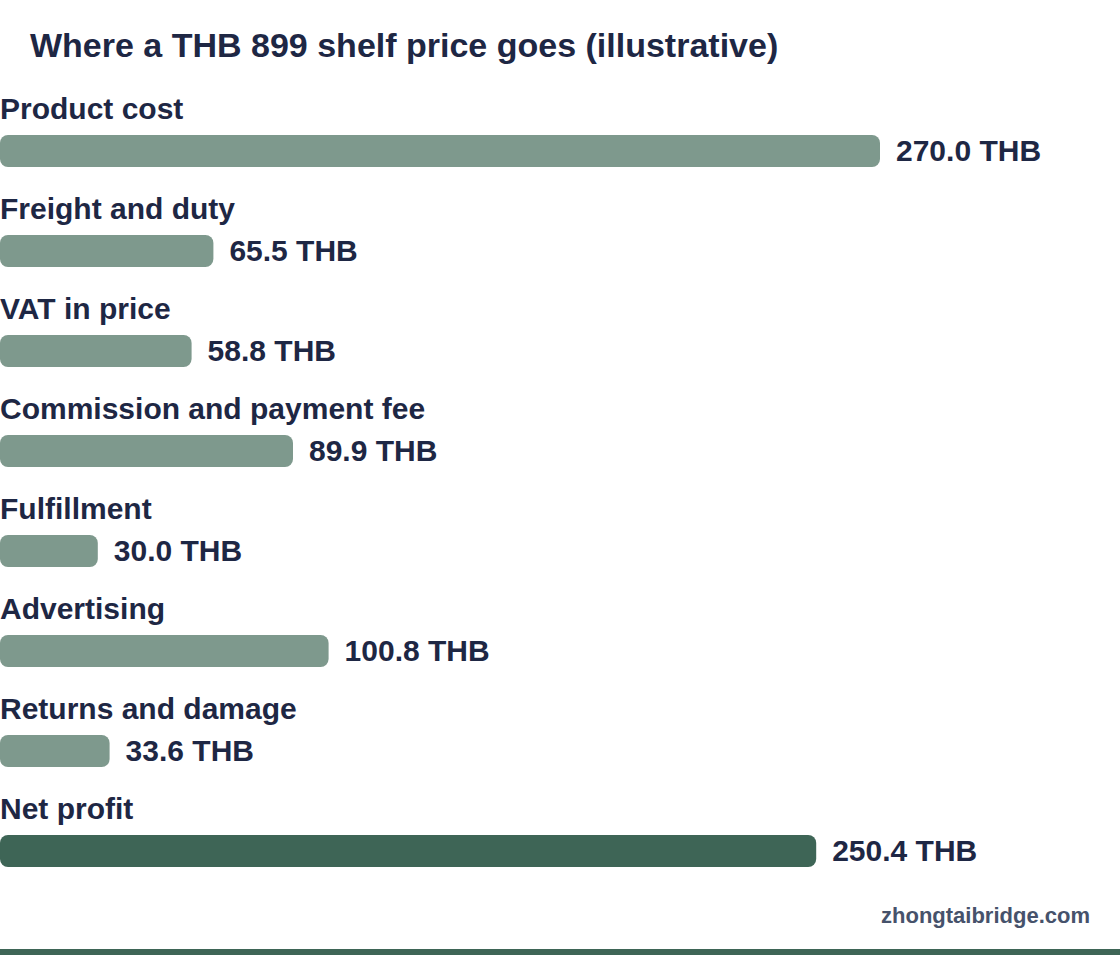
Where a THB 899 shelf price goes (illustrative)
Horizontal bar chart. Product cost: 270.0 THB; Freight and duty: 65.5 THB; VAT in price: 58.8 THB; Commission and payment fee: 89.9 THB; Fulfillment: 30.0 THB; Advertising: 100.8 THB; Returns and damage: 33.6 THB; Net profit: 250.4 THB
Illustrative example from the landed cost calculator. Source: ZhongTai Bridge calculator.
Price from landed cost, then compare with similar Thai listings. Include commission, payment fees, shipping subsidies, vouchers, advertising and returns, and leave room for campaign discounts. Our calculator shows the minimum shelf price that reaches your target margin and the break-even return on ad spend. A price that works only before vouchers and ads is not a price.
Step 3: how do you write Thai listings that convert?
Build titles around the Thai terms shoppers search, with the main term first, followed by key attributes such as size, material and quantity. Use clear photos that show scale, use and packaging, plus a short video where it helps. In the description, answer the questions that appear in competitor reviews. Read at least 100 reviews of the top listings and write down every question and complaint: each unanswered question is an opportunity. Have a native editor review every page, and avoid copying competitor photos or text, which risks removal and trust.
Listing checklist
Element
What good looks like
Title
Main Thai keyword first, then attributes; no stuffing
Images
Main image, lifestyle, scale, close-up, packaging
Video
Short clip showing use and quality
Description
Benefits, specifications, what is included, care, FAQ
Variants
Clear options, accurate stock, consistent photos
Price
Competitive, with room for vouchers
Step 4: how do you plan around campaign days?
Marketplaces run double-date sales such as 9.9, 11.11 and 12.12, and shoppers wait for them. With household debt at about THB 795,000 on average and credit tight, many households concentrate purchases on these days. Build a baseline of orders and reviews before the big events, then prepare stock, vouchers, bundles and ad budgets four to six weeks ahead. Decide in advance which products and what discount depth you will use, so that campaign volume does not erase margin. Our commercial calendar tool lists typical sale days and Thai and Chinese holidays that affect supply.
Step 5: how do you use ads and reviews?
Shopee automates much of its advertising, so listing quality, price and reviews decide results. Advertise only listings that already convert, set a daily budget you can afford to lose for two weeks and scale in 20% to 30% steps when return stays above break-even. Ask satisfied customers for photo reviews following platform rules, and never buy reviews, which platforms penalize and shoppers recognize. Early ratings strongly influence conversion for new shops.
Step 6: how do you manage service, fulfillment and returns?
Chat: reply in polite Thai within minutes during business hours, using templates for common questions.
Stock: keep inventory data accurate and avoid overselling.
Packaging: protect against humidity and rough handling.
Returns: set a clear process, a Thai-speaking contact and inspection rules.
Metrics: track late shipment and cancellation rates weekly.
What should you track every week?
Weekly Shopee dashboard
Metric
Why it matters
Views to cart, cart to order
Shows where conversion breaks
Cost per order and ROAS vs break-even
Tells you whether ads pay
Contribution margin by product
Protects profit
Chat response rate and time
Affects conversion and store score
Rating, review count, complaint themes
Predicts future conversion
Cancellations, returns, late shipments
Reveals operational problems
What mistakes slow new stores?
Listing too many products before any have reviews.
Identical titles across variants, which waste search visibility.
Ignoring chat for hours.
Setting prices that cannot survive vouchers on campaign days.
Scaling ads before the listing converts.
A worked example: the first 30 days of a Shopee store
The example is illustrative. A brand launches with three products. In week one it finalizes titles, images and descriptions, sets price floors and prepares chat templates. In week two it opens the store, collects first orders and sends a polite message inviting honest reviews. In week three it analyzes views and conversion, finds that one listing has views but few orders and updates the main image and the first lines of the description. In week four it tests a small ad budget on the best listing, joins a minor campaign and compares margin on discounted orders. By day 30, it has the first reviews, a clearer view of price sensitivity and a list of changes for the next month.
The brand has not scaled yet, but it has learned. That is the right output of the first month.
Documents and information to prepare before opening
Company or seller identification documents required by the platform.
Brand and authorization documents where needed.
Product specifications, certifications and safety information.
High-quality images and short videos.
Price list with landed cost, floors and campaign plans.
Returns policy and warranty terms in Thai.
Check current requirements in the seller center, since they change.
Operating routine, customer scripts and glossary
A store succeeds through a routine. Each morning: check new orders, chat messages and stock. Each afternoon: review ads, adjust vouchers and respond to reviews. Each week: update the dashboard, review competitor prices and plan content. Each month: review margin by product and campaign results. Write scripts in natural Thai for the ten most common questions about price, stock, delivery, authenticity, size and returns, and keep them short, polite and specific. Add an English version for your team, and avoid machine-translated replies.
Key terms explained
Term
Meaning
Why it matters
Shopee
Thailand's largest e-commerce marketplace
Marketplace platform
Listing
A product page on a marketplace
Product page on the store
Voucher
A discount code funded by the seller or platform
Discount code funded by seller or platform
Chat response rate
The share of customer messages answered promptly
Share of messages answered quickly
Cross-border seller
A seller that ships orders from outside Thailand
Seller shipping from outside Thailand
Local stock
Inventory held in Thailand for faster delivery
Inventory held in Thailand
Plain-language definitions for teams and partners.
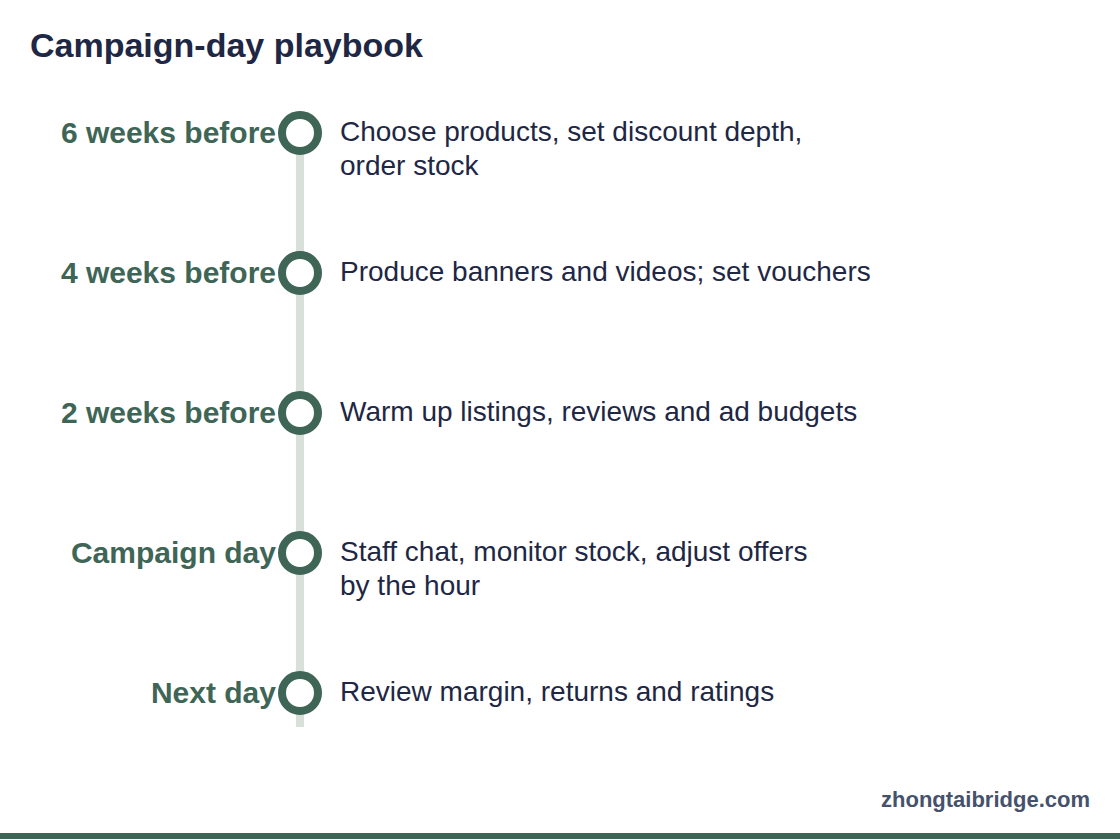
Campaign-day playbook
Timeline. 6 weeks before: Choose products, set discount depth, order stock. 4 weeks before: Produce banners and videos; set vouchers. 2 weeks before: Warm up listings, reviews and ad budgets. Campaign day: Staff chat, monitor stock, adjust offers by the hour. Next day: Review margin, returns and ratings.
A 90-day roadmap after the first 30 days
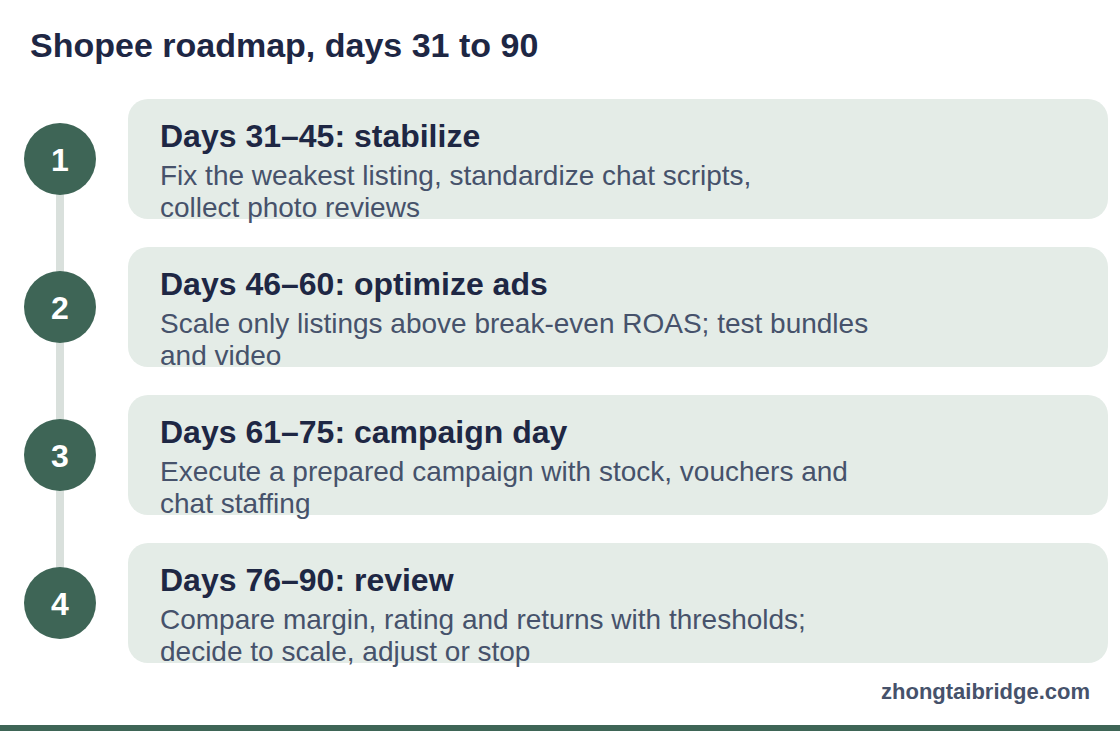
Shopee roadmap, days 31 to 90
Process diagram. 1. Days 31–45: stabilize: Fix the weakest listing, standardize chat scripts, collect photo reviews. 2. Days 46–60: optimize ads: Scale only listings above break-even ROAS; test bundles and video. 3. Days 61–75: campaign day: Execute a prepared campaign with stock, vouchers and chat staffing. 4. Days 76–90: review: Compare margin, rating and returns with thresholds; decide to scale, adjust or stop.
At day 90, the question is not whether the store has sales, but whether each product earns a contribution margin after ads, vouchers, returns and fulfillment. Keep the products that do, improve the borderline ones and retire the rest.
Common failure patterns and quick fixes
Shopee failure patterns and fixes
Pattern
What you see
Quick fix
Low conversion
Views without orders
Improve main image, title, price and first lines of description
High returns
Reasons mention size, fit or mismatch
Add size guide, compatibility notes and a short video
Ad overspend
ROAS below break-even
Pause, fix listing, test a smaller budget
Slow chat
Low response rate, lost orders
Add templates, schedule coverage, use quick replies
Stock-outs
Cancellations and penalties
Set safety stock; pause ads when low
Campaign-day loss
Volume up, margin down
Limit discount depth; use bundles
Review this table with your team each month and mark the pattern that currently costs you the most. Fix one pattern at a time, and record the effect so that the improvement is visible.
A price and voucher stack, worked through
The example is illustrative. A product lists at THB 899 with a landed cost of THB 335. The seller funds a THB 50 voucher on campaign days. Commission and payment fees take about 10% of the price after discounts, or about THB 85. Fulfillment is THB 30, returns allowance THB 34 and advertising 12% of net revenue, about THB 95. On an ordinary day, the unit earns roughly THB 899 less 335, 90, 30, 34 and 100, which is about THB 310 before VAT treatment. On a campaign day with the THB 50 voucher and a higher ad cost, contribution falls to about THB 200. If the discount is 20% instead, contribution falls near zero. The seller therefore caps campaign discounts at a level that preserves a minimum contribution and uses bundles to add value without cutting price further.
Inventory planning for sale days
Estimate sale-day demand from the previous campaign or from your baseline multiplied by an uplift factor you have observed, and add a safety buffer. For a new store without history, run a smaller campaign first. Order stock to cover expected sales plus the days before restock, and check supplier lead times and Chinese holidays that may delay production. Set a rule to pause ads when stock cover falls below a threshold, so that you do not sell what you cannot ship. After the event, record actual sales, stock-outs and returns, and use the data to improve the next forecast.
Sale-day inventory worksheet
Input
Example field
Baseline daily orders
Average of the last 30 ordinary days
Expected uplift
From past events or a conservative assumption
Event duration
Days of elevated demand
Safety buffer
Percentage above forecast
Lead time to restock
Days, including customs and delivery
Pause threshold
Days of stock cover that trigger an ads pause
Chat scripts: structure matters more than words
Scripts should follow a structure: greet and thank the customer, answer the question directly, add one helpful detail and propose a next step. For price questions, state the price, what is included and any current offer. For stock questions, state availability and delivery time. For complaints, apologize for the experience, ask for the order number and photos, and offer a specific resolution. Have a native Thai writer produce the final text, test replies on a phone and keep each reply short enough to read at a glance.
A weekly operating review agenda
A fixed meeting prevents drift. Spend 45 minutes each week with the same agenda. First, review the dashboard: views, conversion, cost per order, ROAS versus break-even, rating, returns and cancellations by product. Second, review chat quality: response times, unanswered questions and common complaints. Third, review stock and fulfillment: days of cover, late shipments and carrier issues. Fourth, review competitors: price changes, new listings and promotions in the top five competitors. Fifth, decide: which listing to improve, which ad to scale or pause, which price or bundle to test and what to prepare for the next campaign day. End with an action list with owners and dates, and start the next meeting by checking whether those actions were done.
Teams that keep this rhythm tend to find problems early and to compound small improvements. Teams that skip it discover problems when ratings fall or margin disappears.
A minimal tool stack for a new store
You do not need many tools. Use the seller center for orders, ads and analytics, a shared spreadsheet for the weekly dashboard and test log, a simple inventory sheet or the platform's stock tools, a shared folder for images and videos with consistent file names and a chat template library accessible to everyone who replies. Add a landed cost calculator for pricing decisions and a calendar for campaign days. As volume grows, consider an order management tool and a customer service helpdesk, but only when the manual process becomes the bottleneck. Simplicity keeps the team focused on listings, service and margin.
Frequently asked questions
Do I need a Thai company to sell on Shopee?
It depends on the route. Check current seller requirements and confirm company and tax structure with qualified advisers.
How long until sales start?
It varies by category and competition. Reviews, price and campaign timing all influence the pace.
How many products should I list first?
Start with three to five products with the clearest demand so you can optimize each one properly.
How do I get my first reviews?
Deliver as described, include a polite message inviting honest feedback within platform rules and respond quickly to problems.
Compare Shopee, Lazada and TikTok Shop in Thailand with 2025 market data, business models, fit by product type, fee layers, a 90-day pilot and a scoring sheet.
A TikTok Shop Thailand guide: why growth is fast, product fit, a weekly content system, creator and live-selling basics, metrics and risks, with 2025 platform data.