Shopee Ads Playbook for New Brands in Thailand: Budget Structure and Break-Even ROAS
By ZhongTai Bridge Editorial · Last reviewed October 2026 · 5 min read
Photo: Unsplash
Short answer
Advertise only listings that already convert. Set a budget ceiling, calculate break-even ROAS from your landed cost, start with a few hero products, and optimize weekly on conversion and margin. With platforms automating bidding, listing quality, price and reviews decide results.
What changed in marketplace advertising?
Momentum Works notes that both Shopee and TikTok Shop now automate advertising through products branded GMV Max. When bids are managed by the platform, your levers are the inputs: product selection, price, images, reviews, voucher funding and budget. The old craft of keyword-by-keyword bid management matters less than preparing listings that the algorithm can sell.
What must be ready before you spend?
Listing quality: Thai title with the main search terms, clear images, a short video and complete specifications.
Price: competitive, with room for vouchers and campaign days.
Reviews: a baseline of ratings, since ads on unrated products convert poorly.
Stock and fulfillment: enough inventory and reliable delivery.
Chat: staffed with fast Thai replies.
How do you calculate break-even ROAS?
Break-even ROAS equals net revenue divided by profit before advertising, or one divided by your margin before ads. If your net revenue per unit is THB 840 and profit before ads is THB 351, margin before ads is 41.8% and break-even ROAS is 2.39. Below that return, each order loses money. Calculate this per product with the landed cost calculator, because high-margin and low-margin products need different targets.
How should you structure the budget?
Start with a daily budget you can afford to lose for two weeks, divided across two or three hero products.
Allocate most of the budget to proven listings and a small share to tests.
Increase budget by 20% to 30% steps when ROAS stays above break-even for several days.
Reserve extra budget for campaign days, when traffic and competition peak.
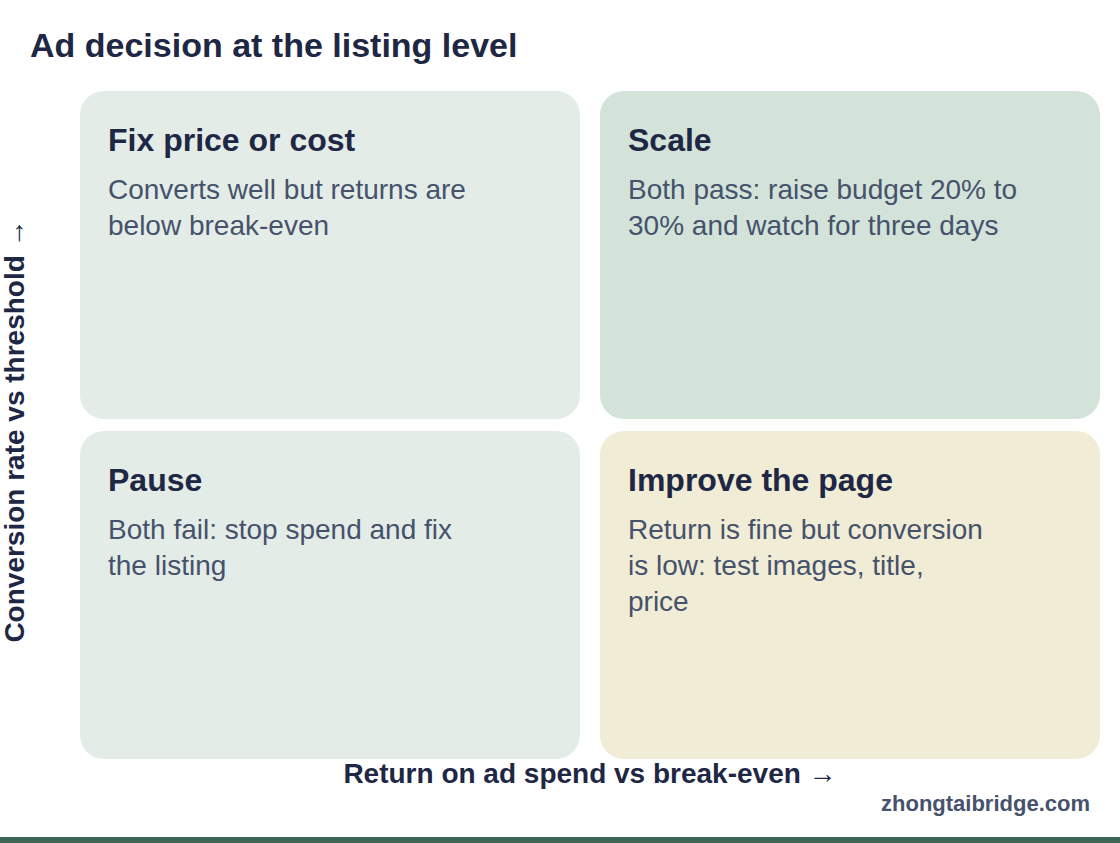
Ad decision at the listing level
Two-by-two matrix. Horizontal axis: Return on ad spend vs break-even. Vertical axis: Conversion rate vs threshold. Fix price or cost: Converts well but returns are below break-even. Scale: Both pass: raise budget 20% to 30% and watch for three days. Pause: Both fail: stop spend and fix the listing. Improve the page: Return is fine but conversion is low: test images, title, price.
What should you review each week?
ROAS and cost per order against break-even by product.
Conversion rate, add-to-cart rate and click-through rate.
Product rating, review count and recent complaints.
Stock levels and fulfillment time.
Competitor price and promotion changes.
Pause products with a conversion problem and fix the listing before you spend more.
Weekly ad review
Metric
Why it matters
Action if weak
ROAS vs break-even
Shows whether ads pay
Cut budget, test price or bundle
Conversion rate
Shows listing strength
Improve images, title, reviews
Rating and review themes
Predicts future conversion
Fix quality or expectations
Stock and delivery time
Prevents cancellations
Reduce budget until fixed
Competitor price moves
Signals pressure
Adjust vouchers or bundles
What mistakes waste budget?
Advertising before the listing converts.
Spreading budget across too many products.
Ignoring margin and chasing revenue.
Over-discounting to buy rank.
Ignoring negative reviews that suppress conversion.
A decision tree for scaling or pausing an ad
Is conversion above your threshold? If not, fix the listing before spending more.
Is ROAS above break-even? If not, test price, bundle or image changes for a week.
Is stock sufficient for a higher budget? If not, hold the budget.
Are ratings stable? If not, resolve the quality issue first.
If all four conditions are met, increase the budget by 20% to 30% and watch for three days.
Budget example for a first month
The numbers are illustrative. A seller with three hero products sets a daily budget of THB 600, allocates THB 250 to each of two proven listings and THB 100 to a new test. At the end of week two, one test listing reaches break-even ROAS and receives more budget, while another is paused for listing improvements. The seller keeps a log of every change so that learning accumulates.
Reading a creative and product feed test
Because bidding is automated, your tests should focus on what you control. Test one change at a time: main image, title, price, bundle, video. Run each test long enough to collect enough orders to compare, and avoid changing several things at once. Keep a log with the hypothesis, the change, the date and the result, and decide in advance how large a difference counts as real. A listing that improves conversion by a small amount on a few orders may be noise. Winners should be copied to other listings, losers retired and the learning added to your playbook.
A worked example: reading a week of ad data
The example is illustrative. A seller runs ads on three listings. Listing A has a ROAS of 3.1 against a break-even of 2.4 and a healthy rating, so the seller raises the budget by 25%. Listing B has a ROAS of 1.9 with conversion below threshold, and its reviews mention a size problem, so the seller pauses ads, updates the size guide and adds a fit video. Listing C has a ROAS of 2.6 but low stock, so the seller holds the budget until restock. At the end of the week, the seller writes down the changes and the reasons and sets a review date.
Notice that the decisions come from rules and not from mood. The seller does not chase revenue; it follows margin, conversion and operational readiness.
Common ad account mistakes
Running ads on unrated or poorly converting listings.
Ignoring voucher funding in margin calculations.
Changing too many settings in the same week.
Failing to reserve budget for campaign days.
Not recording learnings, so each month starts from zero.
Executive questions on marketplace ads
When should we start ads? When a listing converts at an acceptable rate, has some reviews and has stock and chat support. Before that, ads amplify weaknesses.
How do we set a budget? Choose an amount you can lose over two weeks, and let break-even ROAS and conversion decide increases.
Are vouchers better than ads? They serve different goals. Vouchers lift conversion for shoppers on the page, and ads bring them to the page. Model the margin impact of both.
What should we report? ROAS versus break-even, conversion, contribution margin and rating by product.
Frequently asked questions
How much should I spend on Shopee ads at the start?
Set a ceiling you can lose in the first two weeks and focus on two or three listings. Scale only when return exceeds break-even.
Do ads replace organic ranking work?
No. Strong titles, images, reviews and service improve both organic and paid performance.
Compare Shopee, Lazada and TikTok Shop in Thailand with 2025 market data, business models, fit by product type, fee layers, a 90-day pilot and a scoring sheet.
A TikTok Shop Thailand guide: why growth is fast, product fit, a weekly content system, creator and live-selling basics, metrics and risks, with 2025 platform data.