
How to Sell on Shopee Thailand as a Chinese Brand: A Practical Launch Plan
A step-by-step Shopee Thailand launch plan: seller route, pricing from landed cost, Thai listings, campaign days, ads, chat, returns and a weekly dashboard.
Read article →E-commerce
Graphic: ZhongTai Bridge
Short answer
Thailand's platform e-commerce grew 51.8% to US$35.5 billion in 2025. Shopee leads with more than half the market, TikTok Shop is the fastest-growing through video and live selling, and Lazada has moved toward brands and higher-value orders. Choose your first platform by category fit, margin after fees and content capacity, and treat the choice as a sequence.
E-commerce platform GMV growth in 2025
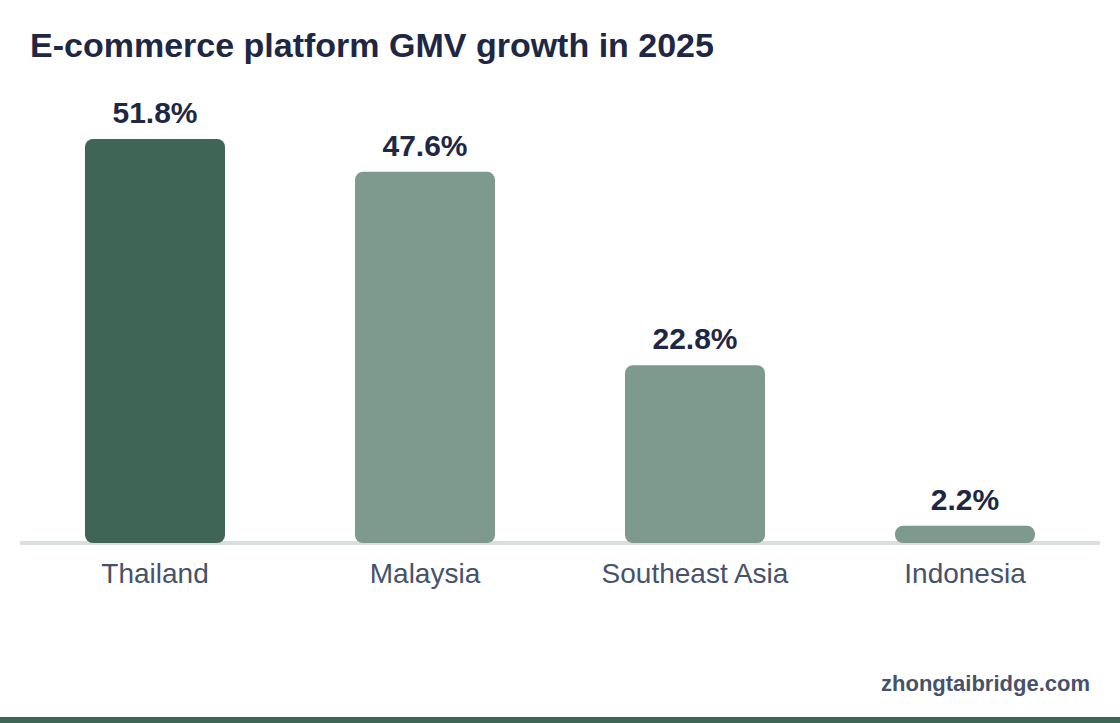
Column chart. Thailand: 51.8%; Malaysia: 47.6%; Southeast Asia: 22.8%; Indonesia: 2.2%
Momentum Works estimates that Thailand's platform e-commerce gross merchandise value rose 51.8% in 2025 to US$35.5 billion, ahead of every other Southeast Asian market. Across the region, Shopee, Lazada and TikTok Shop, including Tokopedia, held 98.8% of platform value in 2025. The previous edition, covering 2024, reported that the same three held more than 84% of platform value, and the difference reflects changes in coverage and definitions, so always cite the edition and scope when you quote a share.
Shopee keeps a share above 50% in most Southeast Asian markets, including Thailand. TikTok Shop more than doubled its GMV in 2025 and, with Tokopedia, reached 65.7% of Shopee's regional GMV. Lazada, after moving toward brands and higher-value goods, grew transactions in Singapore, Thailand and the Philippines and raised its average order value.
Platform comparison for brand owners
| Shopee | TikTok Shop | Lazada | |
|---|---|---|---|
| Core model | Search and compare marketplace | Discovery commerce through video and live | Brand-led marketplace |
| Shopper intent | High, price-aware | Impulse, entertainment-led | Considered, brand-aware |
| Strength | Scale, campaign culture | Content-driven reach, fast growth | Higher-value orders, brand presentation |
| Main demand on you | Listing quality, price, ratings | Video volume, creators, live hosting | Brand content, service standards |
| Best fit | Standard goods with clear specifications | Demonstrable, visual, impulse goods | Higher-priced or brand-sensitive goods |
Both Shopee and TikTok Shop now automate advertising through products branded GMV Max. When the platform manages bids, your levers shift to inputs: product selection, price, images, reviews, voucher funding and budget. The craft of manual keyword bidding matters less than preparing listings the algorithm can sell.
Standardized products with clear specifications and many comparable listings, such as accessories, household items and electronics add-ons, tend to fit Shopee's search-and-compare behavior. Visually demonstrable, impulse-friendly products such as beauty, fashion accessories, gadgets and food tend to fit TikTok Shop, where a video can show the benefit in seconds. Higher-priced, brand-sensitive products, for example premium appliances or personal care brands, can fit Lazada's brand-led environment. Products that need explanation or after-sales service may use a platform for discovery and move to chat commerce to close.
Treat these as hypotheses. Check the category's best sellers on each platform, note price bands and review counts, and test with a limited range. A product that dominates one platform may be invisible on another because the audience and the format reward different things.
Costs come in layers: commission, payment processing, shipping programs, voucher funding, advertising and fulfillment. Each platform sets rates by category and seller type and changes them often, so use your seller center for current figures and model them before you set a price. Our landed cost calculator shows net margin, break-even return on ad spend and the minimum shelf price for your target margin.
The duty regime matters for cross-border sellers. Thailand has taxed online imports from the first baht since January 2026, with the platforms collecting at checkout, so parcels shipped directly from China no longer enjoy the former exemption. Compare the total landed cost of direct shipping with local stock before choosing your fulfillment model.
90-day single-platform pilot
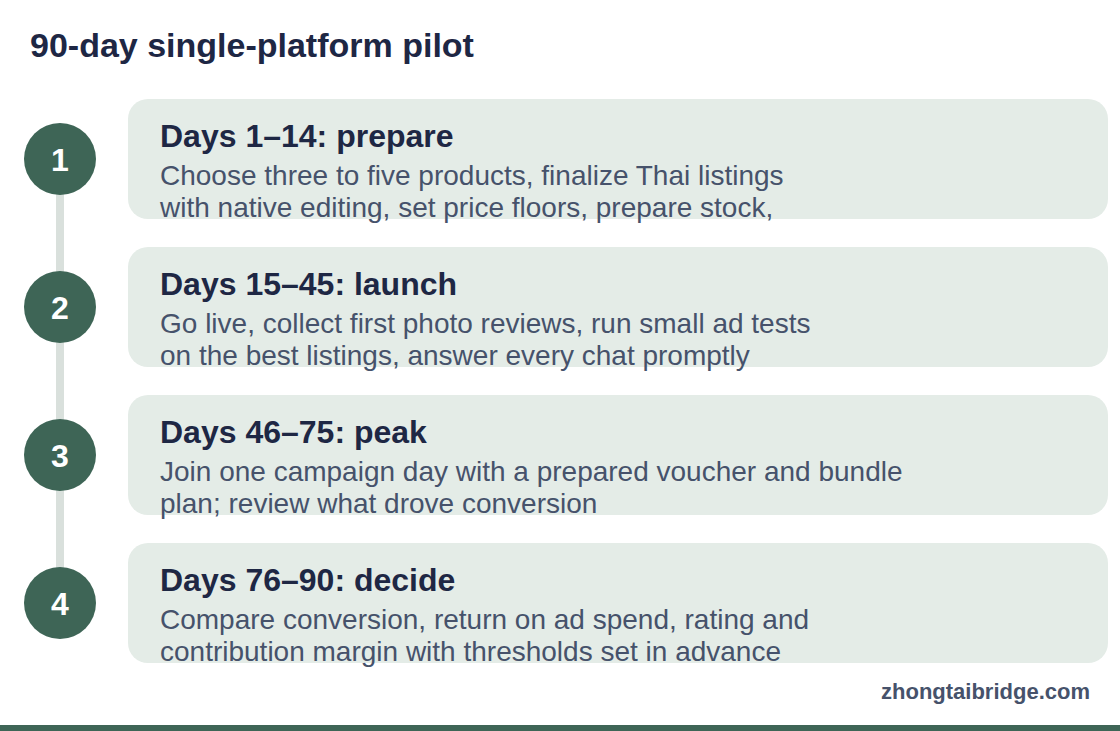
Process diagram. 1. Days 1–14: prepare: Choose three to five products, finalize Thai listings with native editing, set price floors, prepare stock, returns and chat. 2. Days 15–45: launch: Go live, collect first photo reviews, run small ad tests on the best listings, answer every chat promptly. 3. Days 46–75: peak: Join one campaign day with a prepared voucher and bundle plan; review what drove conversion. 4. Days 76–90: decide: Compare conversion, return on ad spend, rating and contribution margin with thresholds set in advance.
Set the decision rule before launch. Without thresholds, the pilot turns into a justification for continued spending.
Use platforms for discovery and volume, and owned channels for relationships. Invite buyers to follow your LINE Official Account where platform rules allow, publish search content that ranks for your category terms, and build a brand page that holds your story and warranties. Platforms account for roughly 85% of Southeast Asian e-commerce, but the remaining 15%, covering brand websites, retailers and social commerce, is where you keep customer data and build repeat purchase.
Where Southeast Asian e-commerce happens
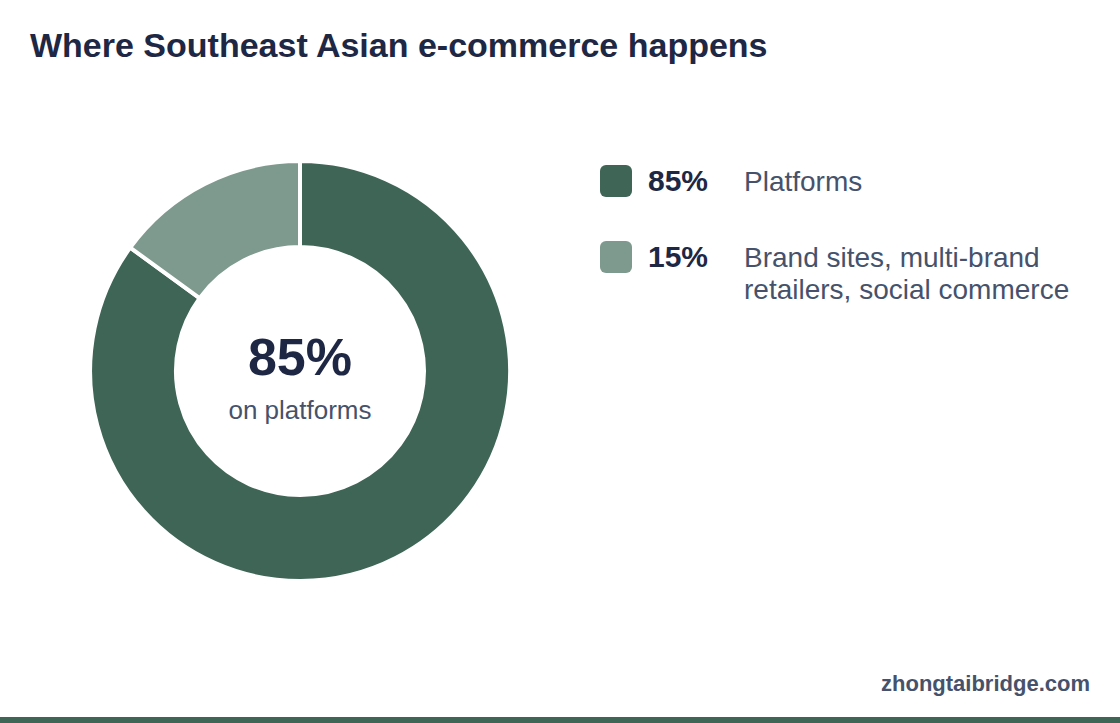
Donut chart. Platforms: 85%; Brand sites, multi-brand retailers, social commerce: 15%
Plan a response to each risk before launch and assign an owner.
Score each platform from 1 to 5 on category fit and best-seller evidence, margin after fees and advertising, content capacity needed and available, fulfillment readiness, brand fit and price positioning, ability to differentiate and speed of learning. Weigh the criteria by importance, and choose the top-scoring platform as your pilot. The second-scoring platform becomes the next step once the first is stable.
The numbers below are illustrative and show how the same product can have different economics by platform. A product with a landed cost of THB 340 and a shelf price of THB 899 might carry similar commission across platforms, but advertising and content costs differ. On a search-led marketplace, the main variable is advertising cost per order. On a content-led platform, the main variable is the cost of video production and creator commission. On a brand-led platform, the main variable is service and campaign funding. Always model all three: fees, ads and content.
Where the cost sits by platform (qualitative)
| Cost | Search-led marketplace | Content-led platform | Brand-led platform |
|---|---|---|---|
| Platform commission | Yes | Yes | Yes |
| Advertising | High, automated bidding | Moderate, plus creator commission | Moderate, brand campaigns |
| Content production | Moderate | High | High, brand store assets |
| Service and returns | High, ratings matter | High, live and chat | High, brand standards |
| Campaign funding | Vouchers and sale days | Offers in live sessions | Brand campaigns |
Key terms explained
| Term | Meaning | Why it matters |
|---|---|---|
| Shopee | Thailand's largest e-commerce marketplace | Largest Thai marketplace |
| Lazada | A marketplace that has moved toward brands and higher-value goods | Brand-led marketplace |
| TikTok Shop | Shopping built into TikTok's short videos and live streams | Content-led shop |
| GMV | Gross merchandise value, the total value of goods sold | Gross merchandise value |
| Live commerce | Selling through live video sessions | Selling through live video |
| Creator / KOL | A content creator whose recommendations influence buyers | Content partners who drive sales |
Assign one owner to read seller-center announcements weekly and to update the margin model when a rule changes.
Brands that cannot decide between platforms can run a controlled test. Choose the same two products for two platforms, set price floors and equal advertising ceilings, and use platform-specific content. Run for 60 days, track conversion, cost per order, contribution margin, rating, return rate and effort in hours per week. Declare in advance what difference would count as meaningful, for example a 20% higher contribution margin or a 30% lower effort for the same revenue. At day 60, choose the platform that wins on margin per hour of effort, not on revenue alone.
Scorecard for a dual-platform test
| Metric | Platform A | Platform B | Decision rule |
|---|---|---|---|
| Conversion rate | Higher wins if margin holds | ||
| Cost per order | Lower wins | ||
| Contribution margin | Higher wins | ||
| Rating and returns | Lower returns, higher rating wins | ||
| Team hours per week | Lower wins at equal margin |
The examples are illustrative. A home organization product with clear specifications and many comparable listings may do best where shoppers search and compare. A beauty tool with a visible result in seconds may do best where video drives discovery. A premium small appliance with a strong brand story and warranty may do best where brand presentation and service matter. A consumable with repeat purchase may use any platform to acquire the first order and then move customers to LINE for reorder reminders. Notice that the right platform depends on the product's job, the buyer's decision process and the margin available to pay for traffic.
Review the category's top sellers on each platform for price, rating, review count and content style, and ask what a new entrant would need to do differently to win. If the honest answer is nothing, choose another category or platform.
Platform setup checklist
| Area | Task | Done when |
|---|---|---|
| Account | Complete seller verification and brand documents | Store approved |
| Catalog | Three to five Thai listings with images and video | Listings live and checked on a phone |
| Pricing | Set price floors, vouchers and bundles | Margin verified in the calculator |
| Service | Chat templates, response hours, returns policy | Replies tested end to end |
| Fulfillment | Packing standard, courier, stock count | Two test orders delivered |
| Tracking | Dashboard for conversion, ads, margin, rating | Baseline recorded |
Run this checklist before you spend on advertising. Most early losses come from skipped basics, not from advanced tactics.
Set exit rules in advance. Pause a platform if contribution margin after ads stays below zero for six weeks despite listing and price fixes, if rating cannot be held above your threshold, if fee or policy changes make the economics unworkable or if the platform consumes more team hours than it returns. Pausing does not mean abandoning: keep the store live with minimal spend, preserve reviews and revisit when conditions change. Document the decision and the evidence so that the next review starts from facts.
If your brand qualifies for an account manager, treat the relationship as a source of evidence. Ask which categories are growing fastest, which price bands receive the most traffic, which campaigns suit your category and what funding is expected. Request search term reports and category benchmarks, and ask how ranking, ads and vouchers interact on the current version of the platform. Record the answers with dates, because programs and algorithms change. Compare what you hear with your own dashboard: if a recommended campaign would push your contribution margin below your threshold, decline it and ask for an alternative. Account managers are paid to grow the platform's volume, so your job is to grow your profit.
If you must decide quickly, take five steps. List your top three products and their landed cost. Check the best sellers for each on all three platforms and note price, rating and review count. Choose the platform where your product's job matches the shopper's behavior and where margin after fees and ads is positive at the going price. Run a 90-day pilot with pre-agreed thresholds. Add a second platform only when the first is stable. This sequence takes days, not months, and it produces evidence that you can show to leadership and use to improve the next decision.
There is no universal answer. Shopee suits search-led, comparison-driven products, TikTok Shop suits content-led impulse products and Lazada suits brand-led, higher-value products. Pilot where your category's demand is visible.
Momentum Works describes Shopee as holding more than 50% share in most Southeast Asian markets, including Thailand. Shares shift quickly, so check the latest edition.
No. Most brands learn faster by starting with one and adding a second when the first is stable.
Sellers shipping parcels directly from China face duty and VAT at checkout. Compare the landed cost of direct shipping with local stock before you choose a fulfillment model.
Sources
Sell where Thai shoppers buy, from Shopee, Lazada and TikTok Shop to your own store.
 E-commerce
A step-by-step Shopee Thailand launch plan: seller route, pricing from landed cost, Thai listings, campaign days, ads, chat, returns and a weekly dashboard.
Read article → E-commerce
A TikTok Shop Thailand guide: why growth is fast, product fit, a weekly content system, creator and live-selling basics, metrics and risks, with 2025 platform data.
Read article → E-commerce
How to structure Shopee advertising for a new brand in Thailand: campaign types, budgets, break-even ROAS, listing readiness and weekly optimization.
Read article →Tell us about your business and goals.
We'll reply within 1–2 business days with next steps.