KOL and Influencer Marketing in Thailand: How to Choose, Brief, Pay and Measure
By ZhongTai Bridge Editorial · Last reviewed October 2026 · 9 min read
Photo: Unsplash
Short answer
Choose Thai KOLs by audience fit and engagement quality, not follower count. Brief them clearly, let them use their own voice, pay on a model that matches the goal and track sales with unique links or codes. Compare creators on cost per order and keep the best performers in a long-term program.
What makes Thai KOL marketing different?
Thai audiences spend about two hours 35 minutes a day on social platforms and more than eight in ten internet users use TikTok monthly. Creators on TikTok, Facebook, Instagram, YouTube and LINE-linked communities translate your product into a context Thai buyers understand. For a foreign brand, working with Thai creators is as much a localization decision as a media decision.
Commerce integration raises the stakes. With TikTok Shop and marketplace affiliate programs, creator content can lead straight to purchase, so measurement can be tied to orders and not only to views.
How do you build a KOL strategy in five steps?
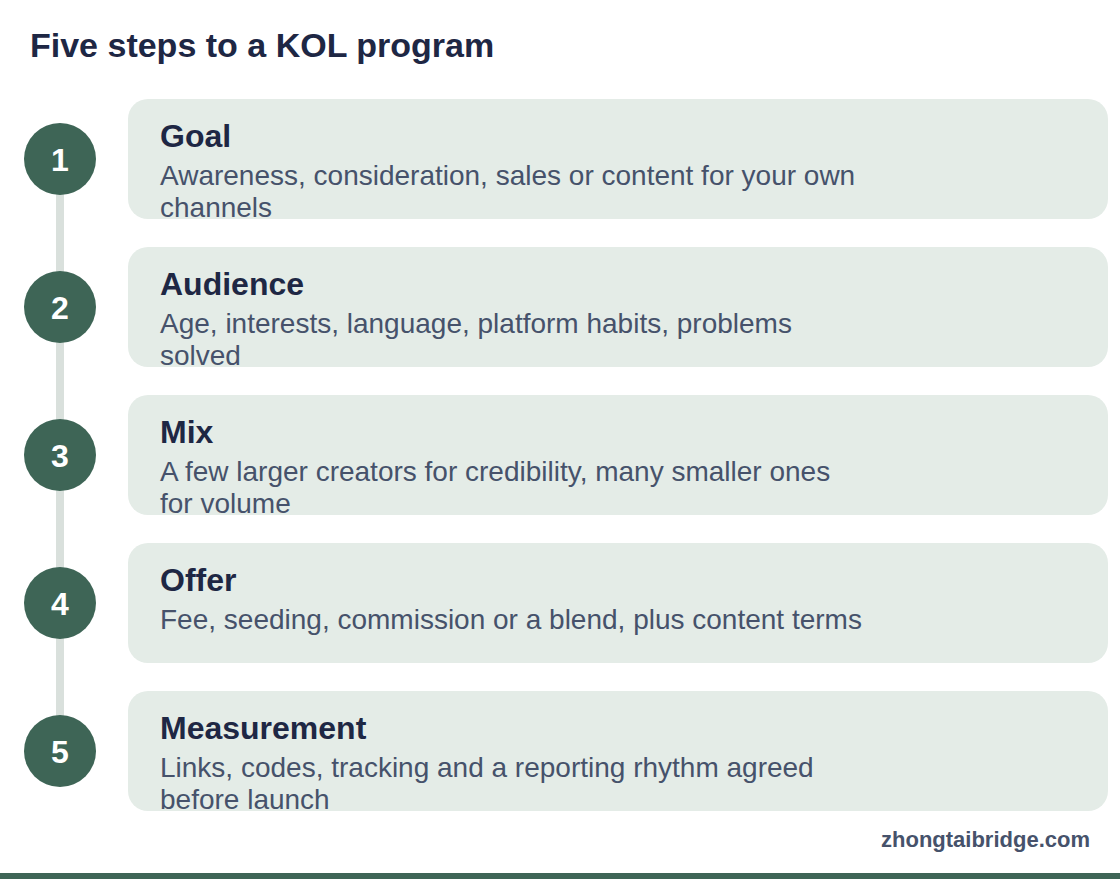
Five steps to a KOL program
Process diagram. 1. Goal: Awareness, consideration, sales or content for your own channels. 2. Audience: Age, interests, language, platform habits, problems solved. 3. Mix: A few larger creators for credibility, many smaller ones for volume. 4. Offer: Fee, seeding, commission or a blend, plus content terms. 5. Measurement: Links, codes, tracking and a reporting rhythm agreed before launch.
Which creator tiers exist, and when does each work?
Creator tiers
Tier
Typical strength
Typical use
Nano and micro
High engagement, affordable, niche trust
Seeding, reviews, testing hooks
Mid-tier
Consistent production and wider reach
Core campaigns, product launches
Large and celebrity
Mass awareness, status
Brand moments, with a larger budget
Most launches combine many smaller creators with a few larger ones.
Follower counts are the weakest signal. Use audience data, engagement quality and fit as the basis for selection.
How do you vet a creator properly?
Confirm that the audience is Thai and matches your buyer: request screenshots of audience insights showing country, age and gender.
Review engagement quality: real conversation, saves and shares, not generic comments.
Check consistency across recent posts, not one viral hit.
Look at past brand collaborations and how the audience responded.
Check advertising load: too many sponsored posts in a row reduce trust.
Assess professionalism: response speed, clarity about deliverables and willingness to follow disclosure rules.
Red flags include sudden follower spikes, repeated generic comments, an audience mostly outside Thailand and mismatched content style.
What should a good brief include?
Give background on who you are and what the product does in three sentences, the objective, two or three key messages with product facts that must be correct, must-haves and must-avoids including claims and platform rules, format and timing, the creative freedom you allow, and the tracking link or code. Keep the brief to one or two pages. Rigid briefs produce stiff content, and vague briefs produce off-message content.
How are KOL campaigns priced?
Fees depend on platform, audience, format and usage rights and vary widely, so structure negotiations around models, not quotes. A flat fee gives predictability for awareness. Product seeding keeps cash cost low but gives less control. Commission or affiliate pay aligns incentives with sales and suits TikTok Shop and marketplace programs. A hybrid of smaller fee plus commission often balances reach and conversion. Pay extra for usage rights if you plan to reuse content in advertising or on your own channels.
How do you measure creator performance?
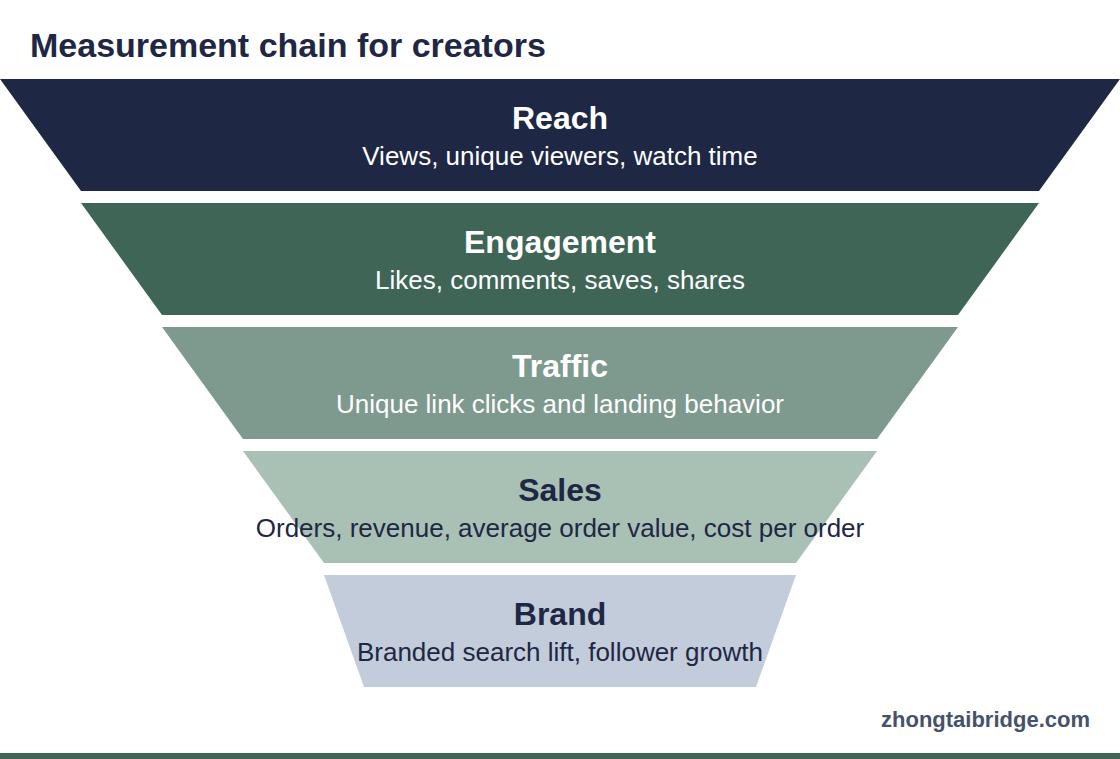
Measurement chain for creators
Funnel diagram. 1. Reach: Views, unique viewers, watch time. 2. Engagement: Likes, comments, saves, shares. 3. Traffic: Unique link clicks and landing behavior. 4. Sales: Orders, revenue, average order value, cost per order. 5. Brand: Branded search lift, follower growth.
Give each creator a unique link or code and compare cost per order and customer quality. Cheap reach that does not convert is not cheap.
What legal and ethical guardrails apply?
Make sure creators disclose paid relationships clearly in line with platform rules and local advertising requirements. Do not ask for claims you cannot substantiate. Keep written agreements covering deliverables, payment, usage rights, approvals and exclusivity, and take advice from qualified counsel for contract templates and regulated categories. See our guide to creator contracts.
A sample first-month plan
Week 1: define goal and audience; build a longlist of 40 to 60 creators.
Week 2: vet down to 15 to 20, request audience data and agree terms.
Week 3: ship products, send briefs and approve content.
Week 4: publish, monitor daily, respond to comments and record results.
Afterward: rank creators by cost per order and content quality, and scale the top performers.
A worked example: a creator test for a skincare launch
The example is illustrative. A skincare brand selects 18 creators: 12 micro, five mid-tier and one larger. It vets audience data, engagement and prior brand posts, then sends samples with a clear brief that includes safe claims and a link for each creator. It sets a hybrid payment: a small fee plus commission. After two weeks, it ranks creators by cost per order and content quality. Four micro creators deliver the lowest cost per order, one mid-tier creator delivers strong reach but few orders and the larger creator produces awareness with limited sales. The brand renews the top performers, shifts budget to micro creators and uses the larger creator's content in advertising with agreed usage rights.
The brand also notices that comments from some audiences ask about ingredients, so it adds an ingredient explainer to its listing. Creator tests improve more than media performance: they reveal customer questions.
Building a long-term creator program
Keep a database with audience data, rates, performance and notes.
Give top creators early access and feedback loops.
Run a monthly content brief that aligns with campaigns.
Agree a code of conduct and disclosure checklist.
Review the program quarterly and retire creators who no longer fit.
Executive questions on KOL programs
How do we avoid paying for fake followers? Request audience data, check engagement quality and use tracked links or codes so that payment ties to results.
Should we work with agencies or direct with creators? Agencies add scale and process, and direct relationships add flexibility and lower cost. Many brands combine both.
How do we protect the brand? Brief on claims, review before publication and keep a record of approvals and disclosure.
How do we scale? Retain the best creators, give them feedback and early access, and test new creators in small batches.
A creator brief template and measurement example
A one-page brief reduces revisions. Include: the brand and product in three sentences; the audience; the single message you want remembered; two or three product facts that must be accurate; claims to avoid; format, length and platform; dates for draft and publication; the tracking link or code; and the disclosure wording. Provide a few examples of content you like, and invite the creator to propose a hook. For measurement, give each creator a unique code, compare orders, cost per order and return rate, and ask for audience insight screenshots within seven days of publication.
Key terms explained
Term
Meaning
Why it matters
KOL (key opinion leader)
An influential creator or expert
Creators with influence over buyers
Micro-influencer
A smaller creator with a highly engaged audience
Smaller creators with high engagement
Seeding
Sending free products to creators to try and review
Sending products for creators to try
Affiliate commission
Payment to a creator for each order generated
Pay per order generated
Usage rights
Permission to reuse creator content in ads or owned channels
Permission to reuse content in ads
Disclosure
Clear labeling that a post is paid
Labeling paid partnerships
Plain-language definitions for teams and partners.
Negotiation scenarios
Situation
Typical approach
Creator asks for a high fixed fee
Offer a smaller fee plus commission tied to orders
Creator refuses commission
Use a flat fee for awareness and measure with unique links
You want reuse in ads
Negotiate usage rights separately, with duration and channels
Creator wants exclusivity
Limit to a narrow category and short period
A campaign calendar built around Thai sale days and holidays
Creator campaigns work best when they align with when shoppers buy. Plan content four to six weeks ahead of major marketplace sale days such as 9.9, 11.11 and 12.12, and brief creators early so that they can prepare. Take account of Thai public holidays and Songkran in April, when audiences travel and posting patterns change, and of Chinese supply interruptions such as Spring Festival, which can delay stock. Avoid launching a major campaign in a week when your fulfillment capacity is constrained. Use our commercial calendar tool to place sale days, Thai holidays and Chinese holidays on one timeline.
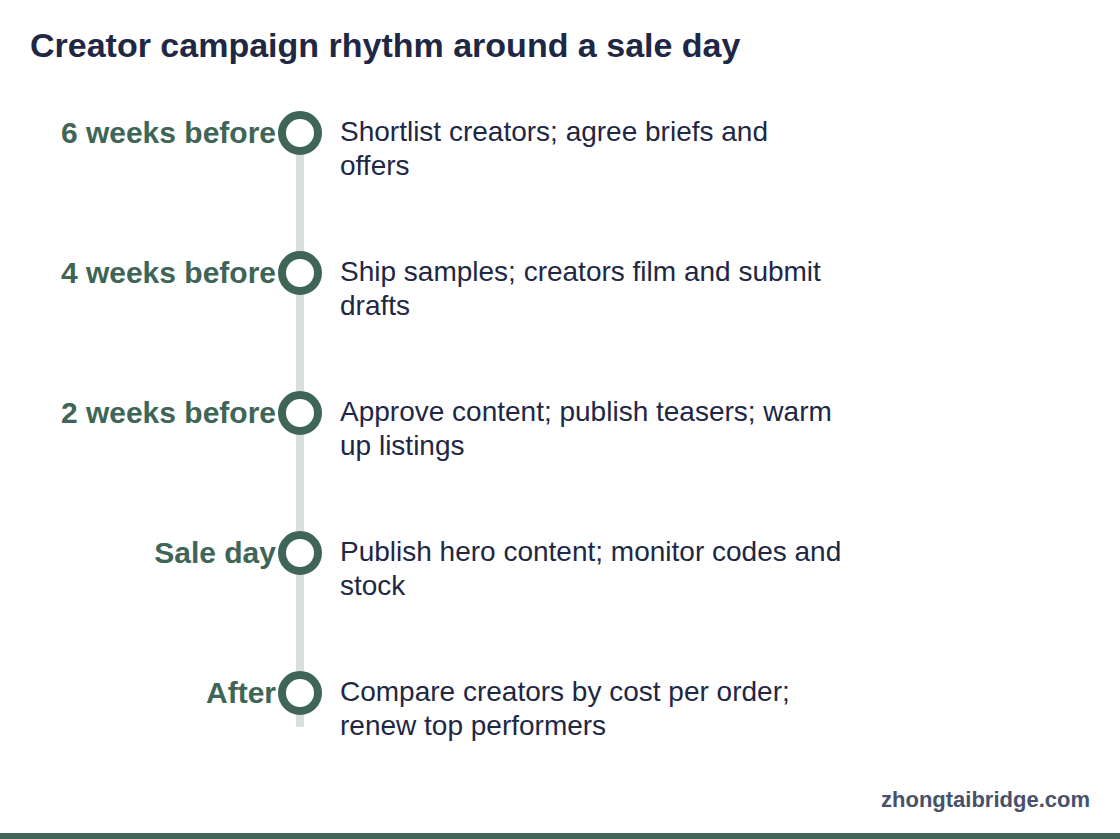
Creator campaign rhythm around a sale day
Timeline. 6 weeks before: Shortlist creators; agree briefs and offers. 4 weeks before: Ship samples; creators film and submit drafts. 2 weeks before: Approve content; publish teasers; warm up listings. Sale day: Publish hero content; monitor codes and stock. After: Compare creators by cost per order; renew top performers.
Attribution and fraud safeguards
Attribution is imperfect, because viewers may see a creator's video and buy later through search or a marketplace. Use unique codes and links to capture direct response, add a post-purchase question asking where the buyer heard about the product and watch branded search and marketplace views during campaigns to see halo effects. Safeguard against fraud by comparing a creator's audience data with their claims, watching for abnormal spikes in followers or comments, checking that orders attributed to a code come from real customers with consistent delivery details and holding payment of commissions until the return window closes. Where a creator's results look implausible, ask for evidence and stop payment if it cannot be provided.
These safeguards protect your budget and your relationships. Honest creators welcome transparent measurement, because it rewards their real results.
Benchmarking creator fees without chasing quotes
Fee levels vary widely by platform, audience and format, so published averages mislead. A practical approach is to benchmark internally. Run a small test batch with a flat fee for several creators of similar size and compare cost per order and cost per thousand views. Record what each creator asked, what you paid and what they delivered. Over time you will learn your own price-to-performance ratio and can negotiate from evidence. Ask creators to explain what is included, such as number of posts, revisions, usage rights and posting time, and compare like with like.
Sample KPI targets and decision rules
Decision rules for a creator program
Metric
Keep or scale if
Pause or stop if
Cost per order
Below your contribution margin before ads
Above margin for two campaigns
Return rate
At or below the product average
Clearly above average
Content quality
Meets brief and brand standards
Repeated off-brief content
Reliability
On time and responsive
Late or unresponsive
Audience fit
Orders from target regions and segments
Orders from unrelated audiences
Set your own thresholds from your feasibility model.
Review the table monthly, and let the data, not enthusiasm, decide which creators stay in the program.
Case-style example: scaling from 10 to 40 creators
The example is illustrative. A brand starts with ten micro creators and measures cost per order, return rate and content quality. Four creators clearly outperform: they follow the brief, show the product in use and generate orders at a cost below the margin threshold. The brand renews these four with a higher commission and early access to new products, and it asks them for introductions to similar creators. It also builds a simple brief library with examples of strong clips, a checklist of claims to avoid and a short video explaining the product's benefits. In the next wave it adds 30 creators, selected by the same criteria, and keeps a weekly review that retires inactive creators. By the end of the quarter, 40 creators are active, the top ten generate most orders and the brand's cost per order has fallen because it concentrates on proven partners.
The example shows that scaling is selection, not volume. A creator program improves when it learns who performs and gives them reasons to stay.
Rules for long-term creator relationships
Treat top creators as partners. Pay on time, share product updates early, ask for feedback and credit their ideas. Give them clear boundaries for claims and a fast route to a person who can answer questions. Avoid sudden changes in terms, and be transparent when a campaign's results are below expectation so that you can adjust together. Encourage creators to disclose partnerships clearly, and support them if they face criticism that is unrelated to the content. Over time, creators who feel respected produce better content, recommend your brand to peers and tolerate the inevitable slow periods.
Frequently asked questions
How many creators should I start with?
Start with a test group large enough to compare approaches, usually a mix of micro and mid-tier creators, then scale after you see results.
Should I choose a creator who speaks Chinese?
Choose the creator whose audience matches your buyers. For Thai consumers that is usually a Thai-speaking creator, with Chinese-speaking coordination on your side.
What if a creator's video underperforms?
Review the hook, demonstration and call to action, then test a new angle with another creator instead of boosting weak content.
Is KOL marketing only for B2C?
Mostly, but B2B brands can use industry experts and thought leaders on LinkedIn and Facebook.
A complete LINE Official Account guide for Thailand: 56 million users, setup, rich menu, chat scripts, content, growth, segmentation, measurement and privacy.
How to structure Meta advertising in Thailand: audience size, funnel budget split, creative testing, Thai copy, LINE handoff and measurement for new brands.
How to structure creator agreements in Thailand: deliverables, approvals, usage rights, exclusivity, payment, disclosure and records. Not legal advice.