Thai Creator Contracts and Disclosure: A Practical Guide for Brand Managers
By ZhongTai Bridge Editorial · Last reviewed October 2026 · 5 min read
Photo: Unsplash
Short answer
A clear creator agreement lists deliverables, timelines, approvals, usage rights, exclusivity, payment terms and disclosure duties, in Thai and in the language your team works in. It protects both sides and makes performance measurable. Have qualified counsel review your template.
Why do you need a written agreement?
Informal creator deals cause disputes over content, timing and payment. A short written agreement reduces ambiguity, sets expectations on quality and compliance, and gives you a basis for measuring results. It also helps agencies and creators align quickly. This guide is a practical overview and not legal advice.
What should the agreement include?
Parties and roles.
Deliverables: platform, format, number of posts, length and key messages.
Timeline: submission, approval and publication dates.
Approval process: who reviews content and how many rounds.
Payment: fee, commission and schedule, with conditions.
Usage rights: where and for how long you may reuse content, and whether paid amplification is allowed.
Exclusivity: category and duration, if any.
Disclosure: how the creator will label sponsored content.
Performance data: metrics the creator will share, such as screenshots of insights.
Termination, remedies and confidentiality.
Clause checklist for creator agreements
Clause
Why it matters
Deliverables and dates
Prevents disputes over scope and timing
Approvals and revisions
Protects factual accuracy and brand
Payment and commission
Aligns incentives and cash flow
Usage rights
Defines reuse in ads and on owned channels
Exclusivity
Limits competing promotions
Disclosure
Compliance with platform and local rules
Reporting
Evidence for performance and payment
How should disclosure work?
Require clear, visible labeling of paid partnerships in line with platform rules and local advertising requirements. Provide guidance on wording and placement, and review a draft before publication. Avoid asking creators to make claims you cannot substantiate. Keep records of approvals and sources for claims.
How should you handle usage rights?
Be explicit about whether you can use the content in ads, on your site or in retail displays, for how long and in which regions. Rights that extend beyond the creator's own channel typically carry an additional fee. Agree on credit and the ability to withdraw content if there is a problem.
What should you check before signing?
Audience data and previous brand collaborations.
Payment terms and tax documentation.
Ability to meet deadlines.
Content that fits your brand values.
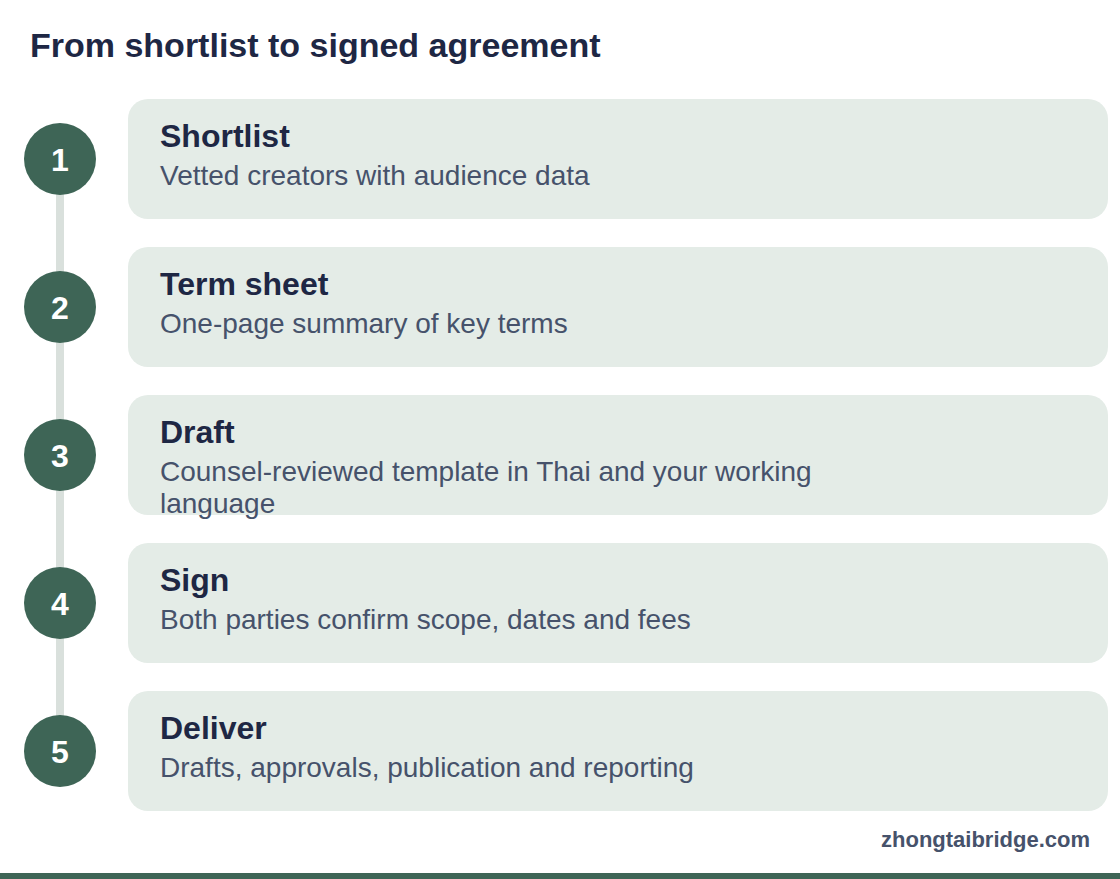
From shortlist to signed agreement
Process diagram. 1. Shortlist: Vetted creators with audience data. 2. Term sheet: One-page summary of key terms. 3. Draft: Counsel-reviewed template in Thai and your working language. 4. Sign: Both parties confirm scope, dates and fees. 5. Deliver: Drafts, approvals, publication and reporting.
What are common issues?
Vague deliverables.
No approval step for factual claims.
Unclear ownership of raw footage.
Late or incomplete disclosure.
No metrics reporting obligation.
A one-page term sheet you can adapt
Campaign name, platform and number of deliverables.
Dates for draft, approval and publication.
Fee, payment date and commission details.
Usage rights period and channels.
Exclusivity category and duration.
Disclosure wording and placement.
Reporting: insight screenshots within seven days of posting.
Revision rounds and takedown conditions.
A simple term sheet reduces friction and gives your counsel a clean starting point.
Handling unexpected situations
The creator misses a deadline: agree a revised date or a fee adjustment according to the contract.
A claim in the video is inaccurate: request an edit immediately and keep the correction on record.
The content underperforms: use the agreed metrics to discuss options, but avoid blaming individuals publicly.
A controversy arises around the creator: pause paid amplification and follow your crisis protocol.
Common negotiation points and how to handle them
Creators and brands negotiate the same few topics. On exclusivity, brands want category protection while creators want freedom to work with others, so limit exclusivity to a narrow category and a short period. On usage rights, creators may charge more for reuse in advertising, so decide before signing whether you need paid amplification. On approvals, brands want control of factual claims while creators want creative freedom, so agree that you review facts and compliance and the creator controls style. On payment, agree a schedule that protects both sides, such as part on signing and part on publication, with a clear rule for late delivery.
Keep a record of each negotiation and the final agreed terms, and use a standard addendum for changes. Where the deal is large, use qualified counsel and keep personal data of creators protected.
Records and compliance after publication
After publication, save the final content, the approved drafts, the disclosure wording and the performance screenshots. If a claim is challenged, you need evidence that it was substantiated. Monitor comments for misunderstandings and respond promptly. If you plan to repost or boost content, check that the agreement allows it and that the disclosure is still visible. Review the campaign after 30 days and update your template with what you learned.
Executive questions on creator agreements
Who owns the content a creator makes? By default the creator usually keeps rights unless the agreement grants you a license. State whether you receive a license for your own channels, for paid advertising or for retail displays, and for how long.
Can we require approval of every post? You can require review of facts, claims and compliance, and agree a limited number of revision rounds. Over-controlling style tends to hurt performance, so protect accuracy and leave voice to the creator.
What if a creator is involved in a controversy? Include a morals or reputation clause that allows you to pause or end the campaign, agree what happens to unpaid fees and stop paid amplification at once. Review the clause with counsel.
How should we pay? Split payment between signing and delivery, and link commissions to tracked orders. Keep tax and payment documents in order for both parties.
Use these answers to prepare a one-page term sheet before any legal drafting.
Frequently asked questions
Do I need a lawyer for creator contracts?
Use a lawyer to review your template and to advise on regulated categories. Day-to-day agreements can then follow the template.
Should contracts be in Thai?
Provide a Thai version that the creator can read comfortably, and keep a bilingual copy for your team.
Need help with social media & kol management?
Build an audience and trust on the platforms Thai consumers use.
A complete LINE Official Account guide for Thailand: 56 million users, setup, rich menu, chat scripts, content, growth, segmentation, measurement and privacy.
A complete Thailand KOL guide: creator tiers, vetting criteria, red flags, briefs, payment models, measurement by cost per order and a first-month plan.
How to structure Meta advertising in Thailand: audience size, funnel budget split, creative testing, Thai copy, LINE handoff and measurement for new brands.