Returns, Reviews and Ratings: Managing Marketplace Reputation in Thailand
By ZhongTai Bridge Editorial · Last reviewed October 2026 · 5 min read
Photo: Unsplash
Short answer
On marketplaces, reputation is a ranking input and a conversion driver. Build it with product quality, fast chat, clear delivery promises and a fair returns process, ask for honest reviews at the right time, and respond to complaints in Thai within hours.
Why does reputation drive results?
Shoppers compare listings quickly and rely on ratings, photo reviews and seller scores to reduce risk, especially for unfamiliar brands. Platforms use these signals in ranking and eligibility for campaigns. A small difference in rating can change conversion materially, so reputation work belongs in the core plan, not as an afterthought.
What are the service metrics to manage?
Chat response rate and speed.
Shipping time and late shipment rate.
Cancellation and return rates.
Product rating and review volume.
Dispute and complaint rates.
Reputation dashboard
Metric
Target direction
Product rating and review volume
Rating stable or rising; photo reviews growing
Chat response rate and time
Fast, consistent
Late shipment and cancellation
Low and falling
Return rate and reasons
Falling; reasons fixed at source
Disputes open and aged
Few, resolved quickly
How do you generate honest reviews?
Deliver the product as described, with clear unboxing and instructions.
Send a polite message after delivery that invites feedback, within platform rules.
Include a QR card with support contact so that problems reach you before they reach a review page.
Encourage photo reviews with clear, honest prompts and no manipulation.
Do not buy reviews or offer prohibited incentives. Platforms penalize it, and shoppers recognize it.
How do you handle complaints?
Reply within hours, in Thai, with empathy and a specific solution.
Take sensitive discussions to private chat.
Offer replacement, refund or repair according to a clear policy.
Log the root cause and fix product, packaging or listing issues.
How should you design the returns policy?
Make the policy clear and fair. Specify conditions, timelines and who pays shipping. A generous policy can raise conversion but increases costs, so model return rates. Track reasons for returns and reduce them with better descriptions, size guides and packaging.
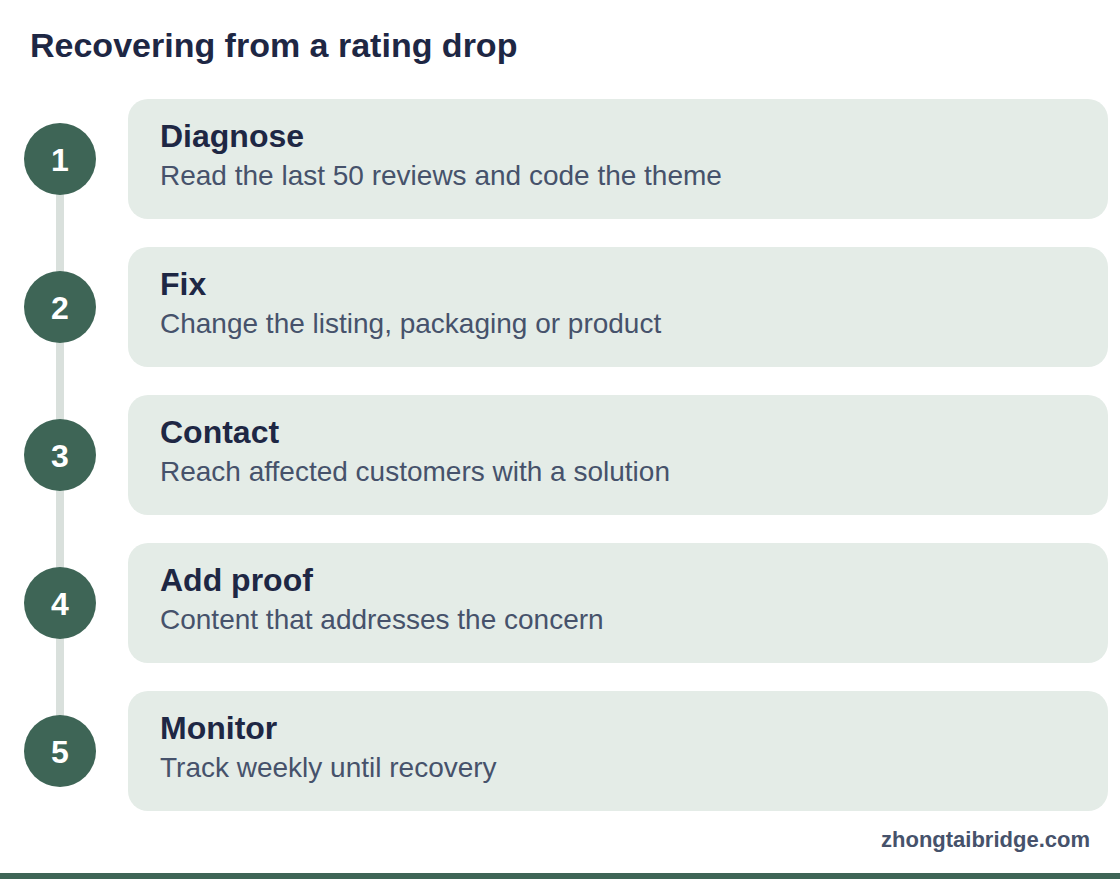
How do you recover from a bad review pattern?
Identify the theme: quality, delivery, mismatch or service.
Fix the cause and update the listing.
Contact affected customers with solutions.
Add content that addresses the concern.
Monitor ratings weekly until they recover.
Recovering from a rating drop
Process diagram. 1. Diagnose: Read the last 50 reviews and code the theme. 2. Fix: Change the listing, packaging or product. 3. Contact: Reach affected customers with a solution. 4. Add proof: Content that addresses the concern. 5. Monitor: Track weekly until recovery.
A reputation dashboard you can run weekly
Rating by product and by shop, with a seven-day and thirty-day trend.
Share of reviews with photos and the top three complaint themes.
Chat response rate and median response time.
Late shipment rate, cancellation rate and return rate.
Open disputes, with age and owner.
Competitor ratings for the five closest listings.
Review the dashboard every Monday and assign each red item to a named person. Reputation recovers when problems have owners, not when they have meetings.
A worked example: rating falls from 4.8 to 4.5
The example is illustrative. A seller notices that a hero product's rating has fallen and conversion has dropped. Reading the last fifty reviews, the team finds that most low scores mention a lid that does not seal in hot weather, not the product's core function. The team updates the listing to state the temperature range, adds a short care video, adjusts the packaging insert with a QR code to support chat and offers replacements to affected customers. Within several weeks, new reviews mention the support experience positively and the rating recovers. The lesson is to read the reviews as a free product research report.
Rules to protect long-term credibility
Never incentivize reviews in ways that break platform rules.
Do not respond defensively. Thank the customer and offer a specific action.
Keep product claims within what you can prove.
Document recurring defects and escalate to the factory quickly.
A worked example: handling a spike in negative reviews
The example is illustrative. A seller of travel mugs sees a run of three-star reviews that mention leaks in hot weather. The team reads the last fifty reviews and finds that most complaints involve one batch with a loose seal. It pauses ads on that listing, contacts affected customers with a replacement offer, asks the factory to inspect the batch and updates the listing with usage guidance and a short video. It also adds an insert with a support QR code. Over the next weeks, new reviews mention the fast replacement, ratings recover and the team resumes ads.
The pattern is detect, contain, fix and communicate. A seller who treats reviews as product feedback turns a reputation problem into a quality improvement.
Defending against unfair reviews and fake accounts
Competitors and unauthorized resellers can distort reputation. Monitor reviews for patterns such as many similar low scores in a short time, mentions of products you do not sell or accounts with no purchase history. Use platform reporting and dispute channels with evidence, keep records of customer service interactions, and register your brand in platform programs where available. Respond to unfair reviews politely, without accusation, so that readers see your professionalism.
Executive questions on marketplace reputation
How fast should we respond to a negative review? Within hours, in Thai, with an apology where appropriate and a specific fix. Speed signals care to both the reviewer and future readers.
Is it acceptable to offer a discount for a review? Platforms restrict incentives for reviews. Follow current rules and avoid anything that looks like buying positive reviews.
Who should own reputation? A named operations lead who reviews the dashboard weekly and escalates product and supplier issues.
How do we reduce returns? Improve listing accuracy, size and compatibility guides, packaging and unboxing instructions, and fix recurring defects with the factory.
Frequently asked questions
How many reviews do I need to convert well?
There is no universal number, but a baseline of ratings and photo reviews on hero products improves conversion significantly.
Can I remove unfair reviews?
Platforms have dispute processes for reviews that break rules. Use them with evidence, and focus on improving the experience.
Need help with e-commerce & marketplace management?
Sell where Thai shoppers buy, from Shopee, Lazada and TikTok Shop to your own store.
Compare Shopee, Lazada and TikTok Shop in Thailand with 2025 market data, business models, fit by product type, fee layers, a 90-day pilot and a scoring sheet.
A TikTok Shop Thailand guide: why growth is fast, product fit, a weekly content system, creator and live-selling basics, metrics and risks, with 2025 platform data.