TikTok Shop Live Commerce Operations in Thailand: Run Sheets, Hosts and Metrics
By ZhongTai Bridge Editorial · Last reviewed October 2026 · 5 min read
Photo: Unsplash
Short answer
Live commerce is an operations discipline. Choose a native Thai host, prepare a run sheet and offers, staff moderation and fulfillment, and review each session on viewers, conversion and margin. Short video feeds the live session, and the session feeds the next video.
Why does live commerce matter in Thailand?
Momentum Works reports that live and video commerce reached critical mass in Southeast Asia, and that TikTok Shop more than doubled its GMV in 2025. The e-Conomy SEA report found that video commerce accounts for about a quarter of regional e-commerce value. For brands with demonstrable products, live sessions convert curiosity into orders through real-time answers and limited-time offers.
What do you need in the studio?
A quiet space with good lighting and a clean background showing the products.
A stable internet connection, a backup device and a power backup.
Two cameras or angles for product close-ups.
A clear sound setup, since audio quality drives retention.
A tablet or screen for monitoring chat and orders.
How do you choose and train a host?
Native Thai speaker with natural, trustworthy delivery.
Product knowledge: specifications, usage, comparisons and objections.
Ability to improvise answers while following the run sheet.
Training on compliance: no misleading claims, accurate prices and warranty terms.
What does a run sheet contain?
Opening hook and the day's offer.
Product order with timing for each segment.
Demonstration scripts and answers to likely questions.
Offer reveals and countdowns.
Interaction moments: polls, questions and giveaways.
Closing summary and a pointer to the next session.
What team roles are required?
Host.
Moderator for chat and questions.
Operations lead for orders, stock and customer service.
Click-through to product, add-to-cart and conversion.
Orders, average order value and revenue per hour.
Contribution margin after offers and fees.
Return rate and customer messages after the session.
Review the recording, identify the segments with the highest conversion, and turn them into short clips.
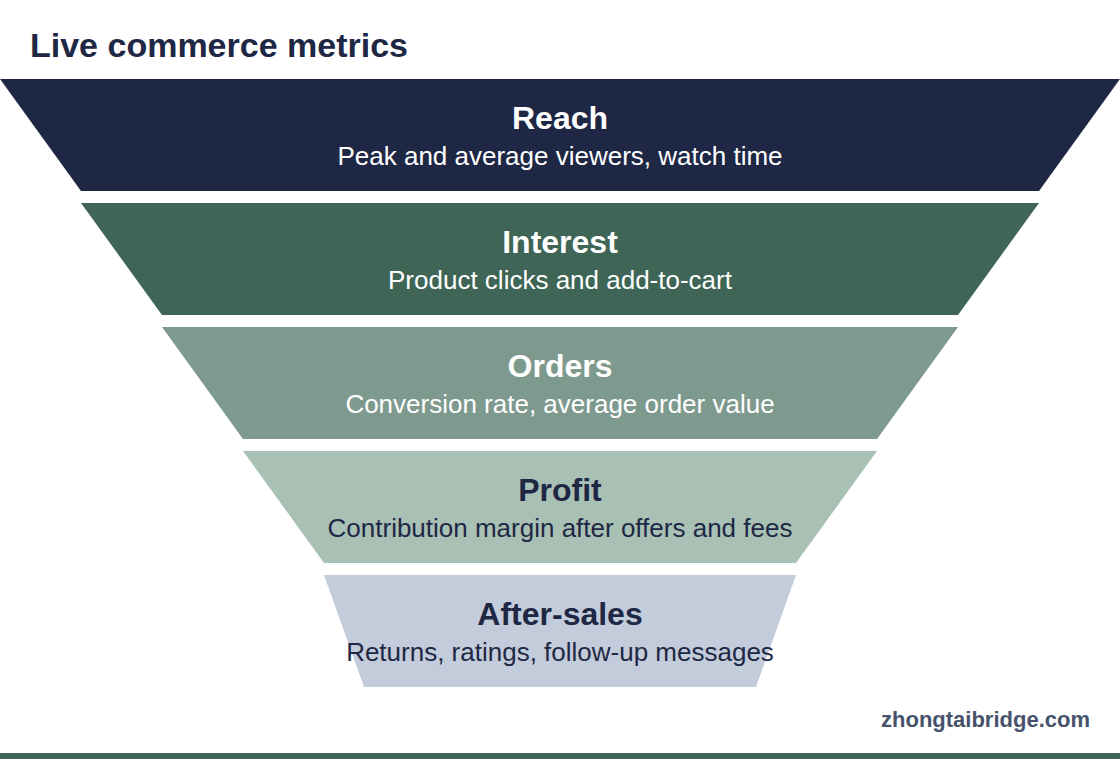
Live commerce metrics
Funnel diagram. 1. Reach: Peak and average viewers, watch time. 2. Interest: Product clicks and add-to-cart. 3. Orders: Conversion rate, average order value. 4. Profit: Contribution margin after offers and fees. 5. After-sales: Returns, ratings, follow-up messages.
A 90-minute run sheet example
0 to 5 minutes: welcome, today's offers and a teaser of the best deal.
5 to 25 minutes: hero product demonstration, questions and first offer.
25 to 45 minutes: second product, bundle explanation and a short giveaway.
45 to 65 minutes: third product, social proof clips and live testing.
65 to 80 minutes: flash offer on the hero product with a countdown.
80 to 90 minutes: summary, thanks and a preview of the next session.
After-live review checklist
Download the performance report and mark the minutes with peak viewers.
Identify the questions that were asked most often and add the answers to your listing.
Cut three short clips from the best moments and publish them within 24 hours.
Check order quality: cancellations, address errors and stock issues.
Decide what to change in the next run sheet.
A worked example: planning a first live session for a home gadget brand
The example is illustrative. The brand has three products: a hero gadget, a bundle and an accessory. Two weeks before the session it records six short clips that show the gadget solving a daily annoyance, publishes them on its shop account and invites ten micro creators to post their own versions with samples. One week before, it fixes the offer: a launch price on the bundle for the first 30 minutes and a gift with every order above a set value. The producer builds the run sheet, the moderator prepares pinned messages for price, delivery and warranty, and the operations lead checks stock and packing capacity for twice the expected orders.
During the session the host demonstrates the gadget in real conditions, answers questions read from chat and returns to the offer at fixed intervals. After the session the team downloads the report, finds the minutes with peak viewers, cuts three clips and publishes them within 24 hours. In the next planning meeting, it compares conversion by segment and decides whether to repeat the format, change the offer or test a different host. The value of the example is the loop: clips feed the live session, and the live session feeds new clips.
Compliance and customer-care points for live selling
Live selling compresses promises into spoken words, so rules matter. Prices, warranty terms and delivery times stated on air must match the listing. Avoid claims that cannot be substantiated, such as medical or performance claims, and follow platform advertising rules. Keep a record of the session and of any offer details, because customers may refer to them later. After the session, reply quickly to questions and handle address and stock issues, since cancellations after a live sale damage ratings. Treat the host as a representative of your brand: brief on tone, prohibited topics and escalation of complaints.
Executive questions on live commerce
How many live sessions do we need to know if it works? Run enough sessions to compare formats, such as two or three a week for a month, and judge by contribution margin, not by viewer counts.
Should we use an influencer as host? Test both. A trained brand host who knows the product often converts well, and a known creator can add reach. Compare cost per order.
What should we avoid saying live? Unverifiable claims, price promises that differ from the listing and comparisons that disparage competitors without evidence.
What is the biggest operational risk? Fulfillment surprises after a successful session. Prepare stock, packing capacity and customer service before you go live.
Frequently asked questions
How often should I go live?
Start with a consistent schedule, such as two or three sessions a week, and adjust by results.
Do I need a celebrity host?
No. Many brands succeed with trained hosts and strong offers. Test before you invest in a larger name.
Compare Shopee, Lazada and TikTok Shop in Thailand with 2025 market data, business models, fit by product type, fee layers, a 90-day pilot and a scoring sheet.
A TikTok Shop Thailand guide: why growth is fast, product fit, a weekly content system, creator and live-selling basics, metrics and risks, with 2025 platform data.