AI Answers in Thai Search: What Changes for Brands
By ZhongTai Bridge Editorial · Last reviewed October 2026 · 5 min read
Photo: Unsplash
Short answer
AI answers inside search and in assistants reduce clicks on simple informational queries and reward sources that are clear, specific and corroborated. In Thailand, where reported generative AI use is high among younger cohorts, brands should publish answer-first Thai content, strengthen entity signals and track citations alongside rankings.
What is changing in search?
Search engines and assistants increasingly generate summaries that answer a question directly, often with a few cited sources. This reduces the need to click for simple questions, and increases the importance of being part of the answer. A presentation by True Corporation in August 2026 described a shift toward agentic search and platform-based discovery on YouTube and TikTok alongside traditional search engines.
How widely are Thais using AI?
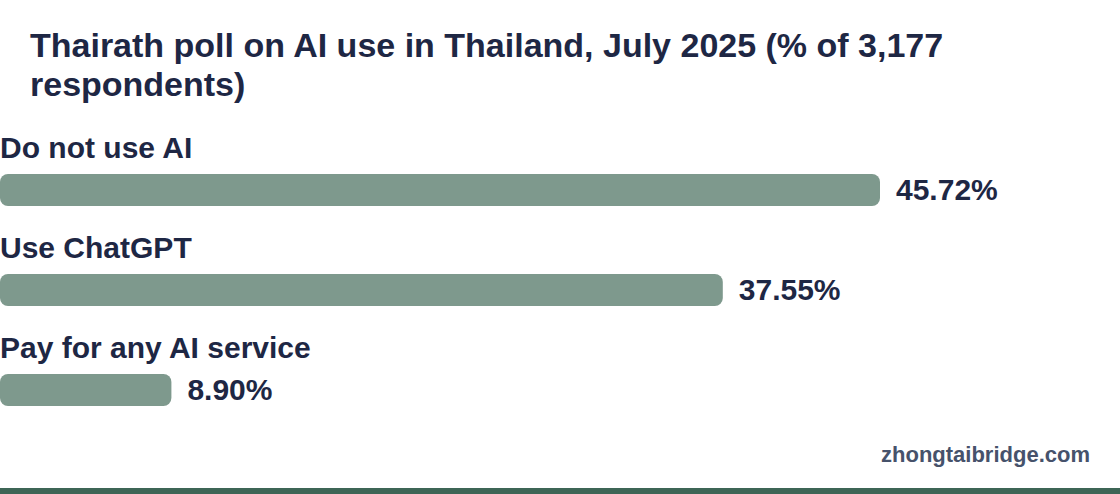
Reported adoption varies: one source cites 75% of Thai consumers, with about 50% among Gen X and 80% to 85% among younger cohorts, while a July 2025 Thairath poll of its own audience found about 54% using AI, with ChatGPT used by 37.55% of respondents and only 8.9% paying. Treat these as a range, and plan for rising use.
Thairath poll on AI use in Thailand, July 2025 (% of 3,177 respondents)
Horizontal bar chart. Do not use AI: 45.72%; Use ChatGPT: 37.55%; Pay for any AI service: 8.90%
Self-selected sample from the publisher's own sites; not a national survey. Source: Thairath.
Which queries are most affected?
Definition and how-to queries, which AI can answer quickly.
Comparisons and recommendations, where assistants synthesize multiple sources.
Local and transactional queries, where maps, shopping and platform results remain important.
Commercial queries with strong intent still lead to clicks, but brands that are not mentioned in AI summaries may not enter the consideration set.
How should content change?
Lead with a direct answer in the first lines.
Use clear definitions, steps and tables.
Cite sources and dates for every figure.
Publish Thai-language versions of key pages.
Add original evidence that is hard to replicate.
Keep pages updated and show a last-reviewed date.
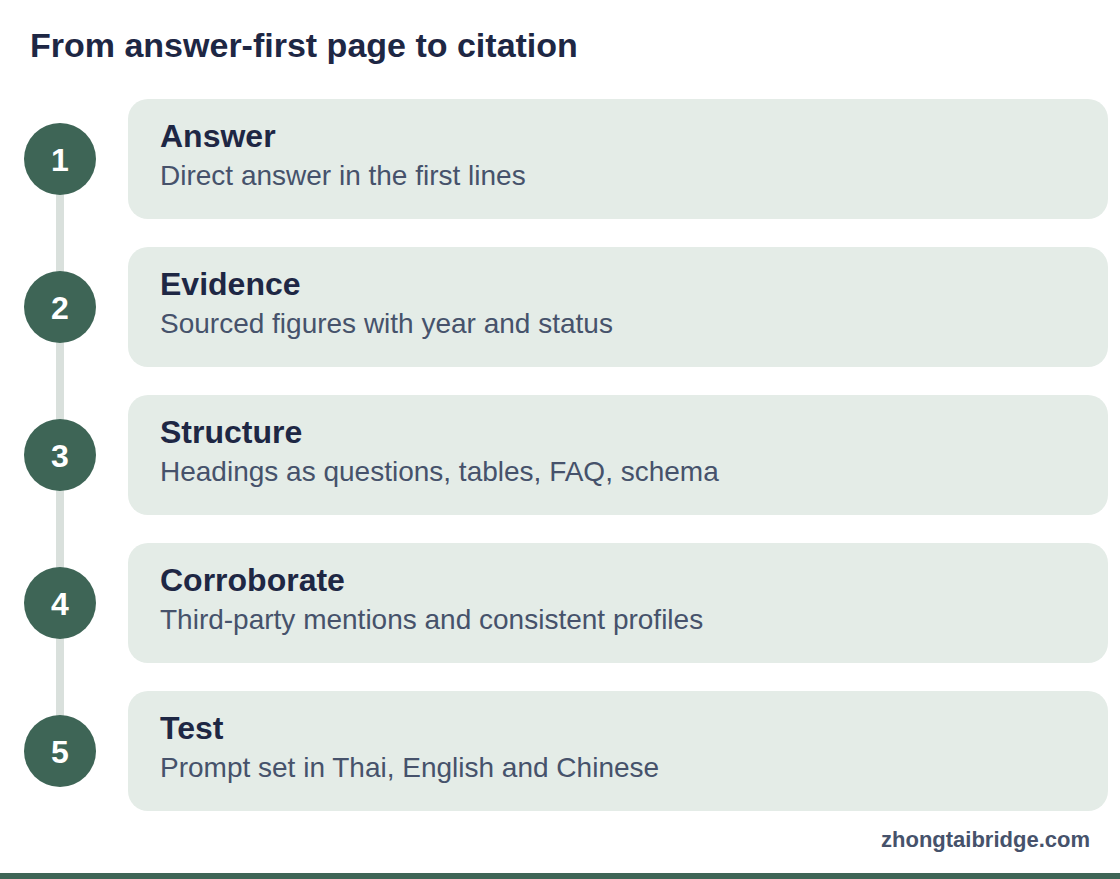
From answer-first page to citation
Process diagram. 1. Answer: Direct answer in the first lines. 2. Evidence: Sourced figures with year and status. 3. Structure: Headings as questions, tables, FAQ, schema. 4. Corroborate: Third-party mentions and consistent profiles. 5. Test: Prompt set in Thai, English and Chinese.
How do you build entity and authority signals?
Make your organization easy to identify: consistent name and description across channels, a clear About page, structured data and mentions from credible Thai and Chinese sources. Earn coverage through PR and partnerships. Assistants favor entities that multiple sources describe in similar terms.
How do you measure the impact?
Track impressions, clicks and click-through rate for informational queries; expect some decline in clicks with stable impressions.
Run a monthly prompt test and score mentions and citations.
Monitor branded search and direct traffic.
Track enquiries that mention an AI assistant as the source.
A page checklist for answer-first content
The first paragraph answers the question directly in one or two sentences.
The page defines key terms, in plain language.
Numbers have a source, a year and a note on whether they are projections.
Headings match questions that people ask.
The FAQ answers follow-up questions.
The page names its publisher and shows a last-reviewed date.
Adapting your reporting
Add AI visibility to your monthly SEO report alongside rankings and traffic. Show the prompt set, mentions and citations, and explain which pages were updated to improve them. If clicks fall on informational queries while impressions hold, report it as a structural change in the results page, and focus on conversions and branded demand.
A six-week content update plan for AI answers
Start with your ten most important pages. In week one, rewrite each opening to answer the page's main question in two or three sentences. In week two, add sourced facts with the year and mark projections. In week three, add or tighten an FAQ with the questions customers actually ask, written in natural Thai. In week four, add structured data and check it against visible text. In week five, align your company description across site, LinkedIn, Xiaohongshu and directories. In week six, run your baseline prompt test and record scores. Then repeat monthly, adding new pages for gaps. This plan improves human reading as much as machine retrieval, which is why it is low-risk even if AI behavior changes.
A worked example: a comparison page built for AI answers
The example is illustrative. A company wants to be part of answers to the question how to choose a Thailand market entry partner. It publishes a page with a two-sentence answer at the top, a table of selection criteria, a short list of red flags and an FAQ. Every statistic is sourced and dated. It adds Article and FAQ structured data, links to related guides and states the author organization and last-reviewed date. It then shares the page with industry bodies and pitches an expert commentary to a business outlet.
When the company runs its prompt set, the page begins to appear as a cited source for the selection prompts in Thai and English. The company then translates the page into Chinese for headquarters and uses it in sales conversations. The page serves readers, search engines and assistants at once.
Signals that you are not ready for AI answers
Your key pages open with brand slogans instead of direct answers.
Facts on your site differ from facts on your profiles.
You have no Thai pages for your main topics.
Your claims have no sources or dates.
You cannot name an author or organization behind your content.
Executive questions on AI answers
Should we write for machines or for people? For people first. Clear answers, sources and structure help both, and pages that read well also tend to be cited.
Will AI answers reduce our traffic? They may reduce clicks for simple informational queries. Compensate with brand presence, deeper content and conversion-focused pages for commercial queries.
Can we pay to be included? Inclusion in organic AI answers cannot be bought directly, although advertising formats exist on some platforms. Focus on earning citations.
How do we know if it works? Run a monthly prompt test and compare scores and citations over time.
Frequently asked questions
Will AI answers eliminate organic traffic?
They reduce clicks on some queries, but many commercial and navigational queries still produce visits. Focus on being cited and being the best answer.
Should I block AI crawlers?
This is a business decision. Blocking limits visibility in AI answers, so weigh the trade-off and follow each provider's documentation.
A complete Thai SEO guide: Google's 99.5% share, Thai keyword research, site architecture, content, technical checks, local signals, AI search and a 90-day roadmap.
A step-by-step Thai keyword research method: seed terms, segmentation, transliteration, intent mapping, marketplace suggestions, templates and a worked example.
A practical GEO guide for Thailand: AI adoption data, how assistants choose sources, answer-first pages, entity signals, prompt testing and a 90-day plan.