GEO and AI Search in Thailand: How Brands Get Cited by ChatGPT, Gemini and Perplexity
By ZhongTai Bridge Editorial · Last reviewed October 2026 · 5 min read
Photo: Unsplash
Short answer
Generative engine optimization makes your content easy for AI assistants to find, trust and cite. Thai AI adoption is high but measured inconsistently, from about 54% in a 2025 poll to a reported 75% of consumers. Win citations with answer-first Thai pages, structured data, original evidence and third-party mentions, and measure with a repeatable prompt set.
How widely do Thais use generative AI?
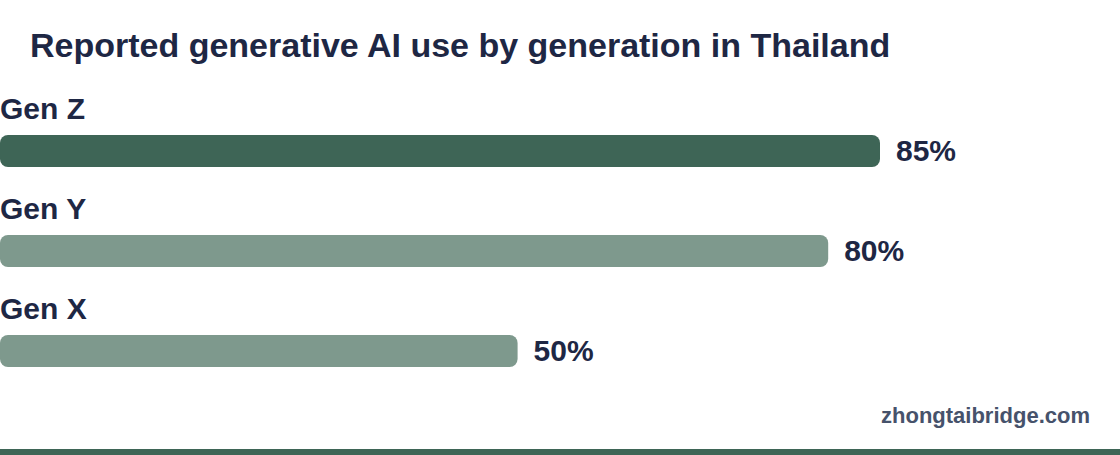
Reported generative AI use by generation in Thailand
Horizontal bar chart. Gen Z: 85%; Gen Y: 80%; Gen X: 50%
Presentation claim reported in August 2026; not a representative national survey. Source: Relevant Audience, reporting a True Corporation presentation.
Estimates vary, which is itself a finding. The presentation behind the chart stated that 75% of Thai consumers have started using generative AI while organizational AI maturity sits near 10%. A Thairath poll of 3,177 respondents in July 2025, drawn from the publisher's own sites, found that 45.72% did not use AI, that ChatGPT was used by 37.55% of respondents and that only 8.9% paid for an AI service. An earlier Publicis Sapient survey reported that 86% of Thai generative AI users were excited about its impact on shopping, compared with 63% globally. Neither the presentation nor the poll is a national probability survey, so read them as a range: a majority of online Thais have tried generative AI, and paid use is small.
How is discovery changing?
The same presentation argued that search is moving toward agentic search, in which an assistant researches and recommends on a user's behalf, and toward platform discovery on YouTube and TikTok. The e-Conomy SEA 2025 research found that video commerce accounts for about a quarter of regional e-commerce value, which supports the point. A shopper may meet your brand in a video, ask an assistant to compare options, read marketplace reviews and then ask a question on LINE. Being visible on only one of these surfaces leaves gaps in the journey.
What is GEO, and how does it relate to SEO?
Generative engine optimization (GEO), also called answer engine optimization or AI search optimization, is the practice of making content easy for AI systems to retrieve, understand, trust and cite. It builds on SEO. Assistants that browse the web rely on search indexes, and Google handles about 99.5% of Thai searches, so crawlable, fast and authoritative pages remain the base. GEO adds requirements around answer structure, entity clarity, evidence and corroboration.
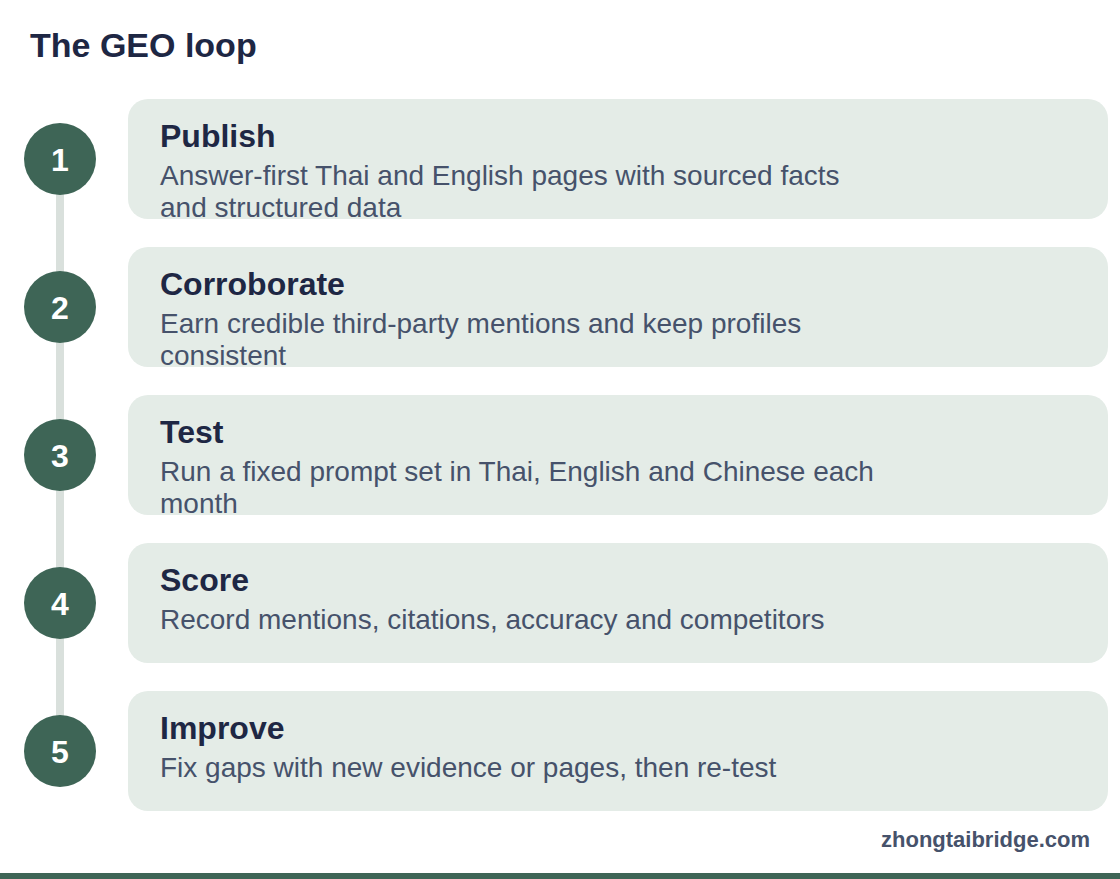
The GEO loop
Process diagram. 1. Publish: Answer-first Thai and English pages with sourced facts and structured data. 2. Corroborate: Earn credible third-party mentions and keep profiles consistent. 3. Test: Run a fixed prompt set in Thai, English and Chinese each month. 4. Score: Record mentions, citations, accuracy and competitors. 5. Improve: Fix gaps with new evidence or pages, then re-test.
Repeat monthly; treat results as directional.
What do AI systems tend to cite?
Providers do not publish their source selection rules, and the rules change often. From observation and from how retrieval works, cited pages tend to share traits: they answer a specific question directly in the opening lines, contain verifiable facts with named sources and dates, use clear headings, lists and tables, agree with other credible sources, come from sites with a clear identity and topical focus, and exist in the language of the question.
Why does Thai-language content matter?
If a Thai buyer asks an assistant in Thai, the assistant looks for Thai sources first. A brand with only English or Chinese pages may be absent from the answer, or described through third-party Thai content that it does not control. Thai pages for your core questions give you a chance to shape the answer. Native editing matters because clarity is rewarded and awkward machine translation reads as low quality. For Chinese entrants, a three-language approach works: Thai for Thai buyers, English for regional decision-makers and Chinese for home-market stakeholders, with identical facts across all three.
How do you build a citable page?
State the answer in a short block at the top, in plain language.
Use question-style headings that mirror real prompts.
Support each claim with a named source and a date, and say whether a figure is an actual or a projection.
Add original material others cannot copy easily: a calculator, dataset, framework or worked example.
Add Article, FAQPage, Organization and BreadcrumbList structured data that matches visible content.
Show who stands behind the page with an organization name, about page, contact details and a last-reviewed date.
Link to related pages so that the topic cluster is clear.
How do you build entity strength and corroboration?
An assistant is more willing to name a brand when several independent sources describe it in consistent terms. Make the company name, description, services and location identical on your website, LinkedIn, Xiaohongshu, directories and press mentions. Earn independent mentions through credible Thai and Chinese media, industry associations, partner pages and research citations. One well-placed article in a respected outlet can matter more than many low-quality listings. Be wary of paid link schemes, fake reviews and mass-produced pages: they harm reputation and do not build the consistent evidence that assistants look for.
How do you measure AI visibility?
Prompt scoring rubric
Score
Meaning
0
Brand not mentioned
1
Mentioned without link or recommendation
2
Cited with a link or described accurately as an option
3
Recommended or listed first with an accurate description
Flag
Inaccurate statement about your brand, and competitors that appear
Build a prompt set of 30 to 40 questions across category, selection and brand groups, each in Thai, English and Chinese where relevant. Run it monthly on the assistants your audience uses, in clean sessions, two or three times each, and log the answer and cited sources. Look for stable patterns, not single answers.
What does a 90-day GEO plan look like?
Days 1–30: audit pages for answer-first structure, add FAQs and structured data, align company descriptions and run the baseline test.
Days 31–60: publish a Thai and English pillar guide with sourced data, two supporting articles and one original tool or dataset.
Days 61–90: pitch the original data to Thai media and industry bodies, update pages from test results and plan the next cluster.
Frequently asked questions
Is GEO replacing SEO?
No. Strong SEO foundations feed AI search, and GEO adds answer structure, entity clarity and corroboration.
How reliable are the Thai AI adoption figures?
They are indicative. One is a presentation claim and another a self-selected poll, so treat them as a range and look for a representative survey before citing one number.
How long does GEO take?
Structural fixes take weeks, while citations and mentions typically build over months, like SEO.
Which languages should I prioritize?
Start with the language of your buyers' questions: Thai for Thai consumers, supported by English and Chinese for regional and home-market audiences.
A complete Thai SEO guide: Google's 99.5% share, Thai keyword research, site architecture, content, technical checks, local signals, AI search and a 90-day roadmap.
A step-by-step Thai keyword research method: seed terms, segmentation, transliteration, intent mapping, marketplace suggestions, templates and a worked example.
How Google SEO in Thailand differs from Baidu SEO in China, with a comparison table, a migration checklist and the habits Chinese teams need to adjust.