Google SEO vs Baidu SEO: What Chinese Teams Must Change in Thailand
By ZhongTai Bridge Editorial · Last reviewed October 2026 · 5 min read
Photo: Wikimedia Commons
Short answer
Useful content and clean technical setup carry over from Baidu to Google, but the engine, language handling, tools, authority sources and surrounding platforms change. Google handles about 99.5% of Thai searches, so Chinese teams should rebuild keyword research in Thai, adopt Google tools and earn Thai-language mentions.
What stays the same when you move from Baidu to Google?
Search engines on both sides reward helpful, original and well-organized content, a technically sound site and signals of authority. Matching content to search intent works everywhere, and structured, fast and mobile-friendly pages perform better. A Chinese SEO team therefore starts with real strengths. The adjustments are specific, and they affect tools, language, authority and measurement.
What changes? A side-by-side comparison
Baidu SEO versus Google SEO in Thailand
Area
Baidu in China
Google in Thailand
Market position
Leading engine in China
About 99.5% of Thai searches
Webmaster tools
Baidu Webmaster tools
Google Search Console, Analytics
Language
Chinese text, character-based
Thai script without spaces, mixed with English
Authority sources
Chinese sites and platforms
Thai-language media, associations, communities
Hosting and filings
China filings for China hosting
No China filing for a Thai-facing site; page speed from Thailand matters
Structured data
Used in parts
Widely used for rich results and entity clarity
Neighboring discovery
Xiaohongshu, Douyin, WeChat
Marketplaces, TikTok, Facebook, YouTube, LINE
Source: StatCounter; platform documentation.
How should you rebuild keyword research?
Start from Thai queries. Direct translation of Chinese keywords misses spelling variants, colloquial forms and transliterations, and tools segment Thai text differently from Chinese. Use Google autosuggest, related searches, Keyword Planner and Search Console, then add marketplace suggestions for product vocabulary. Review the Thai results page for each target term to see what format wins.
How do you structure Thai and Chinese versions?
Use separate, properly tagged pages for each language, linked with hreflang, not automatic translation of one page. Our free hreflang generator creates tags for Thai, Chinese and English versions. Keep one canonical URL per page, write unique titles and descriptions for each language, and avoid duplicate content across versions. A language folder on your main domain concentrates authority, while a country domain can signal local presence.
How should link building change?
Backlinks from Chinese sites may carry limited weight for Thai rankings. Build links and mentions from Thai and international sources: business media, trade associations, partners, events and original research that others cite. A single credible Thai article often does more than dozens of low-quality links, and it also strengthens AI search visibility.
Where does search happen outside Google?
As in China, platform search is a major discovery layer. Shoppers search inside Shopee, Lazada and TikTok, and many ask questions in chat before they buy. Add marketplace listing optimization and social search to the SEO plan. Reported generative AI use is rising, with a 2025 poll finding about 54% of respondents using AI, so also test whether assistants cite your pages.
A migration checklist for Chinese SEO teams
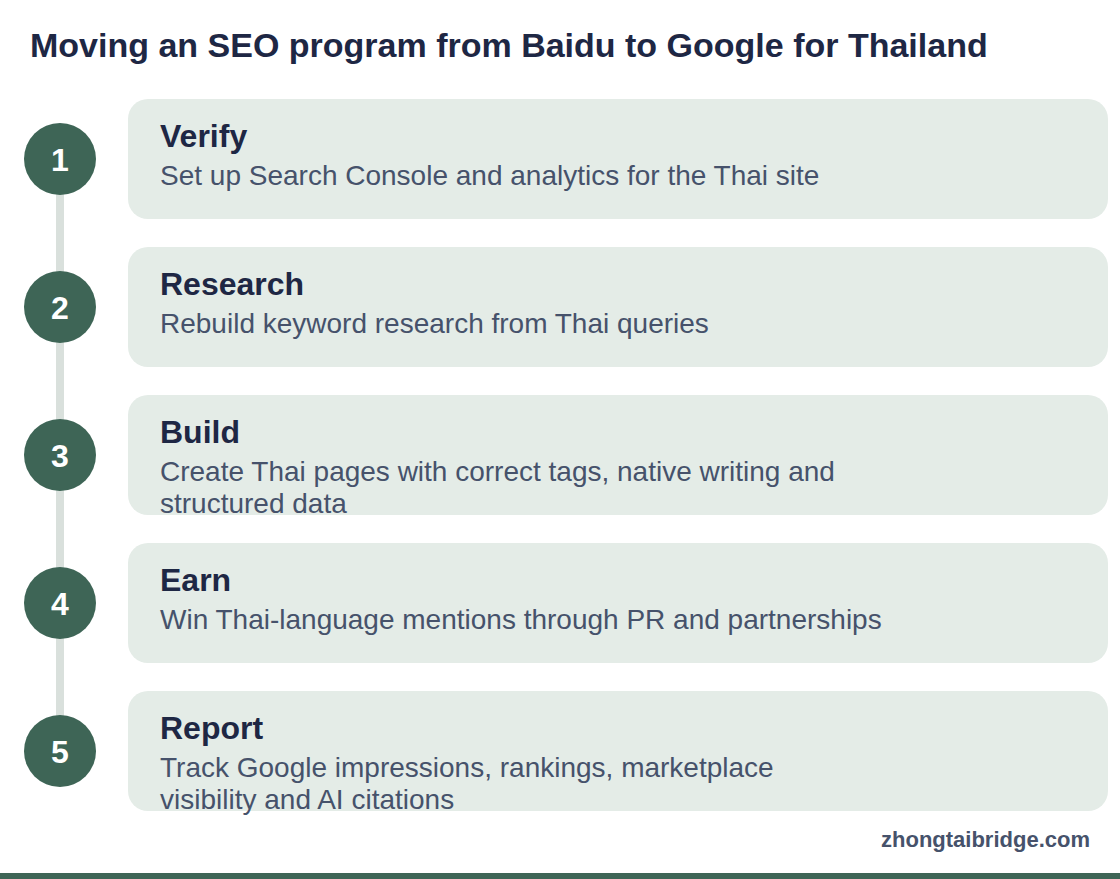
Moving an SEO program from Baidu to Google for Thailand
Process diagram. 1. Verify: Set up Search Console and analytics for the Thai site. 2. Research: Rebuild keyword research from Thai queries. 3. Build: Create Thai pages with correct tags, native writing and structured data. 4. Earn: Win Thai-language mentions through PR and partnerships. 5. Report: Track Google impressions, rankings, marketplace visibility and AI citations.
Frequently misunderstood points
An ICP filing applies to China hosting, not to a Thai-facing site hosted elsewhere, but check your own setup.
Meta keywords are largely ignored. Titles, descriptions and content carry the weight.
Chinese content reused with machine translation tends to perform poorly. Reuse the ideas and research, then write Thai pages from scratch.
A worked example: moving a Chinese company's SEO plan to Thailand
The example is illustrative. A Chinese industrial supplier has an experienced Baidu SEO team and a Chinese-language website. For Thailand it creates a Thai section with its own URL structure and language tags, hires a Thai editor and rebuilds keyword research from Thai queries and distributor feedback. It finds that buyers search for the product in a mixture of Thai and English terms and that several Thai spellings of the brand circulate. It chooses one canonical spelling, writes Thai pages that answer buyer questions, adds structured data and publishes a case study with a Thai partner. It sets up Search Console, tracks impressions and enquiries and reports separately from China.
Within a few months, the team sees impressions for long-tail queries and enquiries from Thai manufacturers. The key change was not a new tactic but a new foundation: Thai keywords, Thai writers and Thai authority.
What to tell executives who expect Baidu-style results
Explain that the search ecosystem is different, that Google processes almost all searches in Thailand and rewards helpful, original and well-structured pages, and that links and mentions must come from Thai and international sources. Set expectations on timelines: technical fixes take weeks, content takes months and authority builds gradually. Agree on reporting measures that fit the market: impressions, rankings and enquiries in Google, marketplace visibility and AI citations.
Executive questions from Chinese leadership
Why can't we rely on our China SEO agency? Because language handling, tools and authority sources differ. A Thai-capable team with Google experience is needed for Thai content and measurement.
How long before Thai SEO pays back? Technical and content foundations take weeks to months, and measurable enquiries usually build over several months. Plan a six to twelve month horizon.
Should we translate our Chinese site? Reuse research and structure, but write Thai pages from Thai keyword research and have them edited by natives.
What should we report to headquarters? Impressions, rankings, enquiries, marketplace visibility and AI citations, with Thai benchmarks and explanatory notes.
Frequently asked questions
Can I reuse my Chinese content in Thailand?
Reuse the research and ideas, but write Thai pages for Thai search intent with native editors.
Do I need a separate website for Thailand?
Often a Thai-language section or domain works best, with language tags and local content.
Is Baidu available to Thai users?
Baidu does not register in Thai search statistics, and Google handles nearly all searches.
How should I report SEO to Chinese headquarters?
Explain that results come from a different ecosystem, and report Google metrics, marketplace visibility and AI citations with Thai-specific benchmarks.
A complete Thai SEO guide: Google's 99.5% share, Thai keyword research, site architecture, content, technical checks, local signals, AI search and a 90-day roadmap.
A step-by-step Thai keyword research method: seed terms, segmentation, transliteration, intent mapping, marketplace suggestions, templates and a worked example.
A practical GEO guide for Thailand: AI adoption data, how assistants choose sources, answer-first pages, entity signals, prompt testing and a 90-day plan.