How to Do Thai Keyword Research: A Method for a Language Without Spaces
By ZhongTai Bridge Editorial · Last reviewed October 2026 · 5 min read
Graphic: ZhongTai Bridge
Short answer
Thai keyword research starts from real Thai queries, not translated lists. Thai has no spaces between words and shoppers mix Thai, English and transliterated terms, so collect variants, map each term to intent, check the Thai results page and assign one page per intent.
Why is Thai keyword research different?
Thai script has no spaces between words, so tools and search engines segment text algorithmically, and one phrase can be split in different ways. Shoppers also mix scripts: a query may combine Thai words, an English product term and a Thai spelling of a brand. Because Google handles about 99.5% of Thai web searches, its tools describe real demand, but they need interpretation by a native speaker.
A seven-step Thai keyword research method
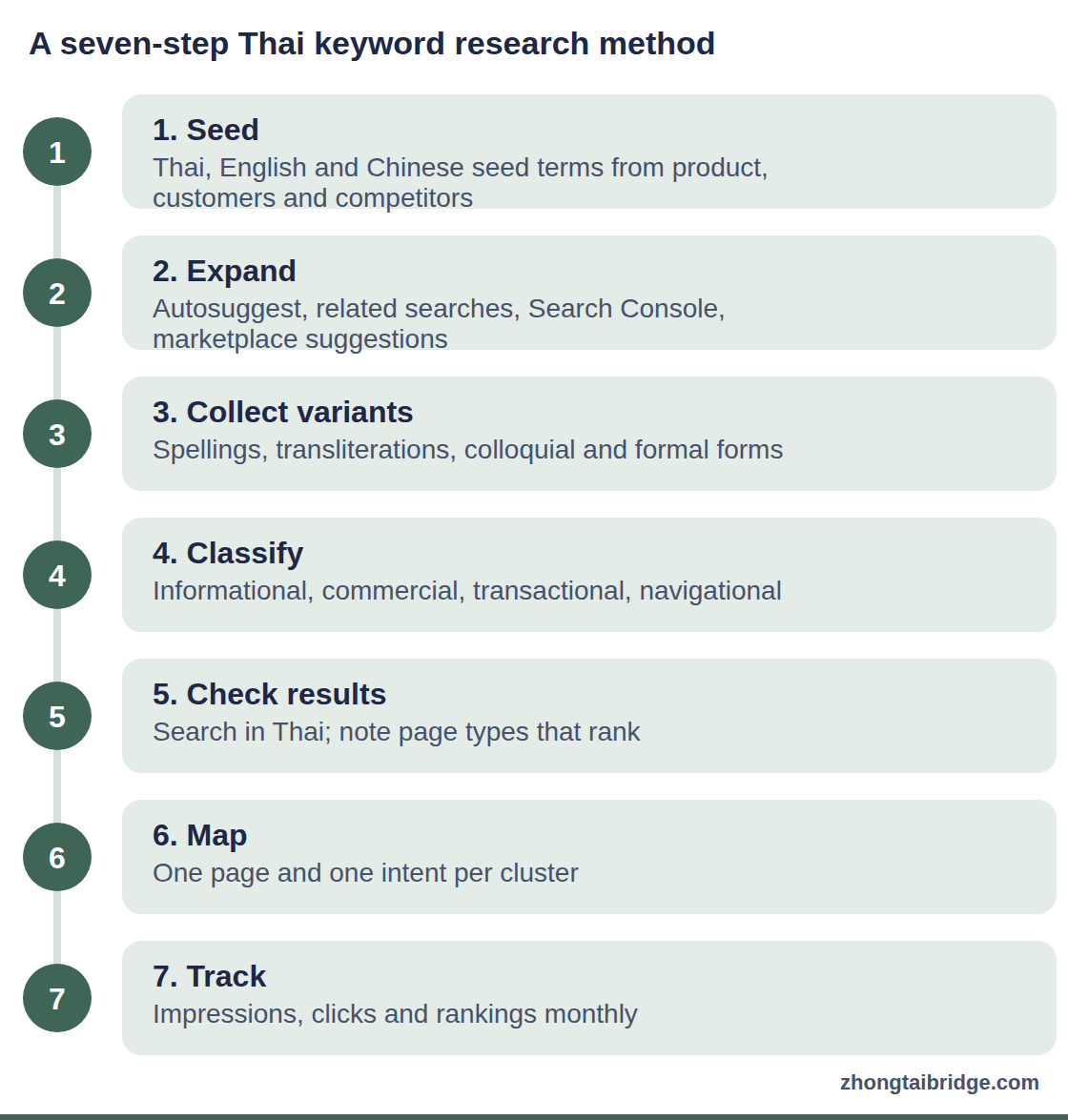
Process diagram. 1. 1. Seed: Thai, English and Chinese seed terms from product, customers and competitors. 2. 2. Expand: Autosuggest, related searches, Search Console, marketplace suggestions. 3. 3. Collect variants: Spellings, transliterations, colloquial and formal forms. 4. 4. Classify: Informational, commercial, transactional, navigational. 5. 5. Check results: Search in Thai; note page types that rank. 6. 6. Map: One page and one intent per cluster. 7. 7. Track: Impressions, clicks and rankings monthly.
How do you build the seed list?
Begin with the words customers use, not the words your factory uses. Interview Thai buyers, read reviews and chat logs, and list the problems your product solves. Add competitor product names and category terms in Thai and English. Ask a native speaker to add colloquial forms and abbreviations. A seed list of 30 to 60 terms is enough to start expansion.
How do you expand and collect variants?
Google autosuggest and related searches for each seed term, in Thai and English.
Google Keyword Planner and Trends for volume ranges and seasonality.
Search Console queries for impressions you already earn.
Marketplace search suggestions on Shopee and Lazada for product attributes and sizes.
Reviews, Pantip threads and Facebook groups for problem language and objections.
Record every spelling variant. Brand names and product terms are often written in Thai in more than one way, and each variant has its own search volume. Choose one canonical spelling for your own pages and mention common variants naturally where they help readers.
How do you map keywords to intent and page type?
Intent map
Intent
Example form
Page type
Informational
how to, what is, comparison
Guide or article
Commercial
best, review, price
Comparison or category page
Transactional
buy, order, promotion
Product or service page
Navigational
brand and store names
Home, brand and contact pages
Assign each cluster to one page. If two pages target the same intent, they compete against each other, so merge or differentiate them.
How do you verify a keyword before you write?
Search it in Thai on a mobile phone and read the first page. If marketplaces and shopping results dominate, a blog post may not compete and a product listing might. If guides and videos rank, a guide can compete. Note what the best result does well and where it falls short. This step prevents writing pages for queries that cannot be won with your format.
A worked example for a reusable water bottle
The example is illustrative. A brand starts with seed terms for reusable bottle, insulated bottle and gym bottle in Thai and English. Autosuggest adds problem-led phrases about keeping drinks cold, bottle size for the gym and materials. Marketplace suggestions add capacity and color terms. The terms fall into four clusters: product type, use case, material and brand comparison. The brand assigns a category page to the product-type cluster, a guide to the use case, a safety explainer to material questions and a comparison page to the brand cluster. Each page has a Thai title, answer-first intro, FAQ and structured data.
A keyword tracking template
Keyword in Thai, with English or Chinese equivalent.
Variant spellings.
Intent and funnel stage.
Estimated demand and trend.
Competing results and format.
Mapped page and priority.
Notes confirmed by a native speaker.
Review Search Console monthly. Queries with many impressions and low click-through deserve better titles and descriptions. New queries that appear in the data belong in the list.
Common mistakes
Translating English keyword lists word for word.
Using one formal register for every query.
Ignoring slang, abbreviations and transliterated brand names.
Targeting high-volume head terms before winnable long-tail terms.
Not rechecking the results page each quarter.
A worked example: a B2B keyword cluster for industrial automation
The example is illustrative. A supplier of industrial automation parts begins with seed terms for sensors, controllers and maintenance in Thai and English. Search Console shows impressions for a few English terms, and autosuggest reveals Thai phrases about downtime, spare parts and troubleshooting. Distributors report that buyers often search by part number or by the Thai name of the problem. The supplier groups terms into clusters: product categories, part numbers, troubleshooting guides and supplier selection. It creates category pages, a part-number lookup page, troubleshooting articles and a selection guide, with Thai titles and answer-first openings.
The cluster reflects buyer language, not the factory catalog. Rankings and enquiries can be tracked cluster by cluster, which shows where to invest more content.
Quality checks before publishing keyword-based pages
A native reader confirms that the Thai reads naturally and the target term appears where a human would write it.
The page answers the question behind the keyword better than the current top results.
Internal links connect the page to related clusters.
Titles and descriptions fit Google's display lengths on mobile.
Structured data and FAQs match visible content.
Executive questions on keyword research
Is keyword research still relevant with AI search? Yes. It reveals the language and questions of buyers, which also shape prompts. Use it to plan content that answers those questions.
How many keywords should we plan? Plan clusters, not lists. A few hundred terms grouped into 20 to 40 clusters is typical for a focused site.
Do we need paid tools? Not at the start. Google's free tools, Search Console and manual review are enough, and paid tools can add efficiency later.
Who should review the final list? A native Thai speaker with category knowledge.
Frequently asked questions
Which tools work for Thai keywords?
Google Keyword Planner, Google Trends and Search Console are a good base. Add marketplace suggestions and manual review of Thai results.
How many keywords should each page target?
Focus each page on one main topic and a handful of close variants.
Should I target Thai or English keywords?
Mostly Thai, plus English terms that Thai users commonly type for your category.
How often should I refresh the list?
Review monthly in Search Console and rebuild the map each quarter.
A complete Thai SEO guide: Google's 99.5% share, Thai keyword research, site architecture, content, technical checks, local signals, AI search and a 90-day roadmap.
A practical GEO guide for Thailand: AI adoption data, how assistants choose sources, answer-first pages, entity signals, prompt testing and a 90-day plan.
How Google SEO in Thailand differs from Baidu SEO in China, with a comparison table, a migration checklist and the habits Chinese teams need to adjust.