
How to Do Thai Keyword Research: A Method for a Language Without Spaces
A step-by-step Thai keyword research method: seed terms, segmentation, transliteration, intent mapping, marketplace suggestions, templates and a worked example.
Read article →SEO & AI Search

Photo: Unsplash
Short answer
Google handles about 99.5% of Thai web searches, so Thai SEO is Google SEO in the Thai language. Win with original Thai content built on Thai keyword research, a clean language-tagged site structure, fast mobile pages, local authority and measurement in Search Console, and expect results to build over months.
Search engine share in Thailand, June 2026
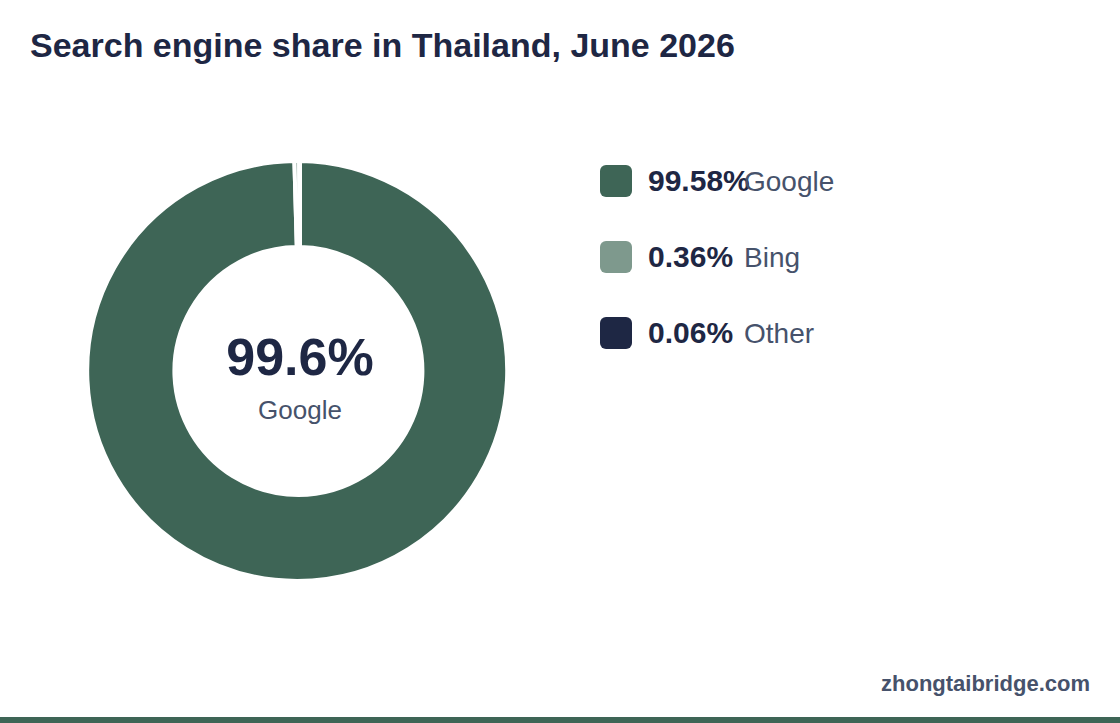
Donut chart. Google: 99.58%; Bing: 0.36%; Other: 0.06%
StatCounter data for mid-2026 puts Google at about 99.5% of searches in Thailand, with Bing below half a percent. Search also happens inside marketplaces, TikTok and Facebook, and in AI assistants, so visibility needs a wider view than one engine. But for web search, optimizing for Google is optimizing for the market.
Thai script has no spaces between words, so search systems segment text and the same phrase can be split differently. Queries mix Thai words, English product terms and Thai spellings of brand names. Colloquial and formal registers coexist. These features make literal translation of keyword lists unreliable and explain why Thai keyword research starts from real Thai queries: autosuggest, related searches, Search Console data, marketplace suggestions and community language.
Searchers also behave differently by device. Mobile dominates, with 96.6 million mobile connections at the end of 2025, so mobile speed and layout drive both rankings and conversion.
Site architecture checklist for a Thai section
| Element | Recommendation | Why |
|---|---|---|
| URL structure | /th/ folder or a country domain; short, readable paths | Clear language targeting, consolidated authority |
| Language tags | html lang=th, hreflang between th, zh and en | Serves the right version to the right user |
| Canonicals | One canonical per page | Avoids duplicate content between versions |
| Hierarchy | Category, subcategory, product or article | Helps crawlers and readers |
| Internal links | Descriptive Thai anchor text between related pages | Passes authority, clarifies topics |
| Sitemap | XML sitemap submitted in Search Console | Speeds discovery |
Treat Thai as a full language version, not an add-on. Give it unique content, unique titles and descriptions and its own internal link structure.
Start from the results page. Search your target Thai keyword and note which page types rank, which questions they answer and how deep they go. Then plan a page that is clearly more useful. Put a direct answer of two or three sentences at the top, support it with detail, use question-style headings and add specifics only you can provide: tested data, checklists, examples and comparisons. Include images with descriptive Thai alt text and end with a clear next step.
Have a native editor review tone, spelling and register. Avoid keyword stuffing and spun translations; search systems are good at spotting thin, repetitive pages, and readers are better still.
Authority comes from being referenced by credible Thai sources. Pursue PR in business, technology or lifestyle media tied to genuine news, partnerships with associations and suppliers, original data or tools that others cite, and expert contributions on Thai-language sites. Keep business profiles consistent and complete a Google Business Profile where you have a physical presence. Avoid bulk link buying, which risks the site and rarely brings qualified visitors.
A presentation by a senior True Corporation executive in August 2026 reported that 75% of Thai consumers use generative AI, with higher use among younger cohorts, while a July 2025 Thairath poll of its own audience found about 54% using AI. Treat the numbers as a range, but plan for assistants that summarize and cite sources. Answer-first Thai pages, clear entity signals and structured data serve both search engines and assistants. See our GEO guide for a measurement method.
90-day Thai SEO roadmap
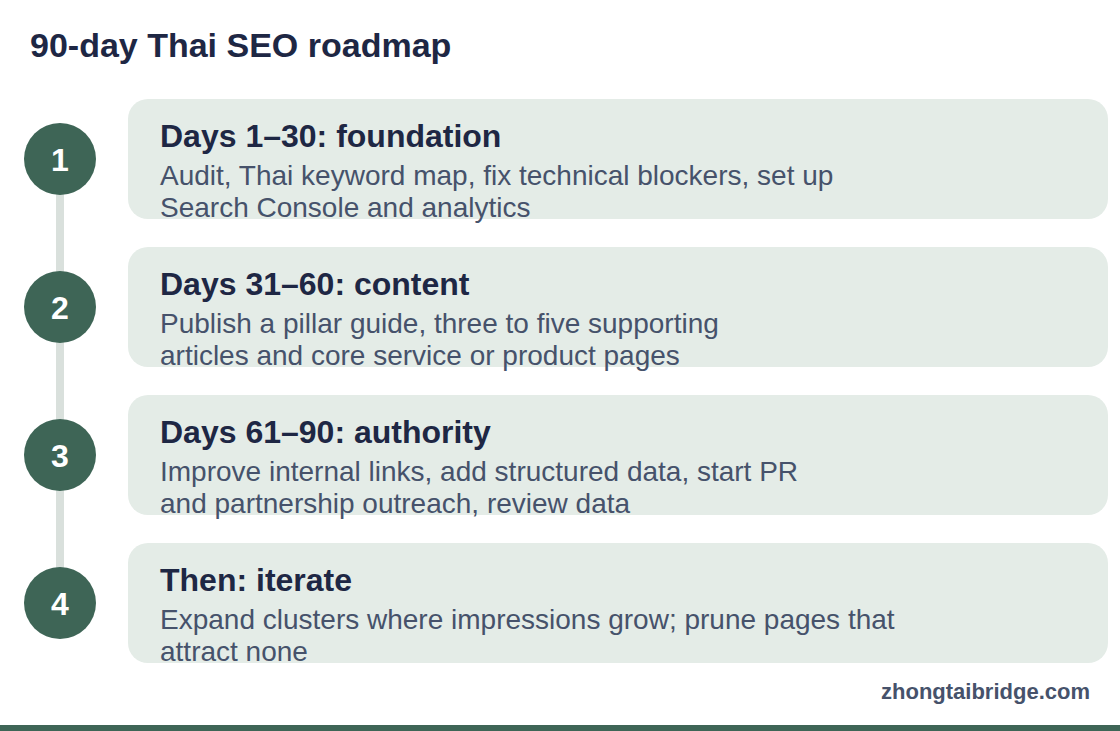
Process diagram. 1. Days 1–30: foundation: Audit, Thai keyword map, fix technical blockers, set up Search Console and analytics. 2. Days 31–60: content: Publish a pillar guide, three to five supporting articles and core service or product pages. 3. Days 61–90: authority: Improve internal links, add structured data, start PR and partnership outreach, review data. 4. Then: iterate: Expand clusters where impressions grow; prune pages that attract none.
Track impressions, clicks and average position for target Thai queries, then organic enquiries or orders, and split branded from non-branded traffic. SEO compounds, so judge the trend, not single weeks.
The example is illustrative. A brand selling pet products builds a Thai section with a language folder, hreflang and canonical tags. It runs Thai keyword research, finds clusters around pet comfort, feeding and travel, and maps each to a page type. Over 90 days it publishes a pillar guide on choosing a pet water fountain, four supporting articles, two category pages and a Thai FAQ, all written by native editors and edited for accuracy by a veterinary adviser. It adds structured data, improves mobile speed and starts outreach to pet blogs and Thai media. By day 90, Search Console shows impressions for long-tail queries, and the first organic orders arrive.
The brand then expands to adjacent topics, improves pages with high impressions and low clicks and builds links with a data-based pet ownership survey. It does not expect overnight results, but the compounding effect begins.
Can we rank top three for competitive terms? Possibly over time, but no one can guarantee it. Focus on winnable long-tail queries, build authority and measure progress.
How do we choose between SEO and ads? Ads buy speed and SEO builds compounding assets. Use both, and move budget based on cost per order.
What team do we need? A Thai editor, an SEO specialist, a developer for technical issues and a PR or partnership lead for authority.
How do we know SEO is working before sales appear? Track impressions and rankings for target queries and growth in branded search.
Meaningful results usually build over three to six months, depending on competition and site authority, and continue to compound.
Not necessarily. A language folder or subdomain can work if tagged correctly. Choose based on your resources and consistency.
Useful, accurate content edited by native speakers can perform. Unedited machine output usually reads poorly and carries factual risk.
The fundamentals of useful content and technical hygiene carry over, but tools, language handling and authority sources differ. Rebuild keyword research and reporting for Google.
Sources
Get found by Thai customers where they actually search, including in AI answers.
 SEO & AI Search
A step-by-step Thai keyword research method: seed terms, segmentation, transliteration, intent mapping, marketplace suggestions, templates and a worked example.
Read article → SEO & AI Search
A practical GEO guide for Thailand: AI adoption data, how assistants choose sources, answer-first pages, entity signals, prompt testing and a 90-day plan.
Read article → SEO & AI Search
How Google SEO in Thailand differs from Baidu SEO in China, with a comparison table, a migration checklist and the habits Chinese teams need to adjust.
Read article →Tell us about your business and goals.
We'll reply within 1–2 business days with next steps.