What Chinese EV Makers' Thailand Playbook Teaches Every Chinese Brand
By ZhongTai Bridge Editorial · Last reviewed October 2026 · 10 min read
Photo: Unsplash
Short answer
Chinese brands hold about 89% of Thailand's EV market, yet the sector shows why scale, local commitments and policy foresight decide outcomes. Successive price cuts of roughly 10% and 13%, incentives tied to local production, and the struggles of second-tier brands are lessons for any category.
Why is the Thai EV market a useful case study?
Thailand's electric vehicle market is the most visible example of Chinese companies entering Thailand at scale. It combines a high-stakes industry, a government incentive program with explicit obligations, aggressive pricing and a fast change in market structure. Whatever your category, the pattern of opportunity, competition and policy response offers a preview of what can happen when many Chinese companies pursue the same market.
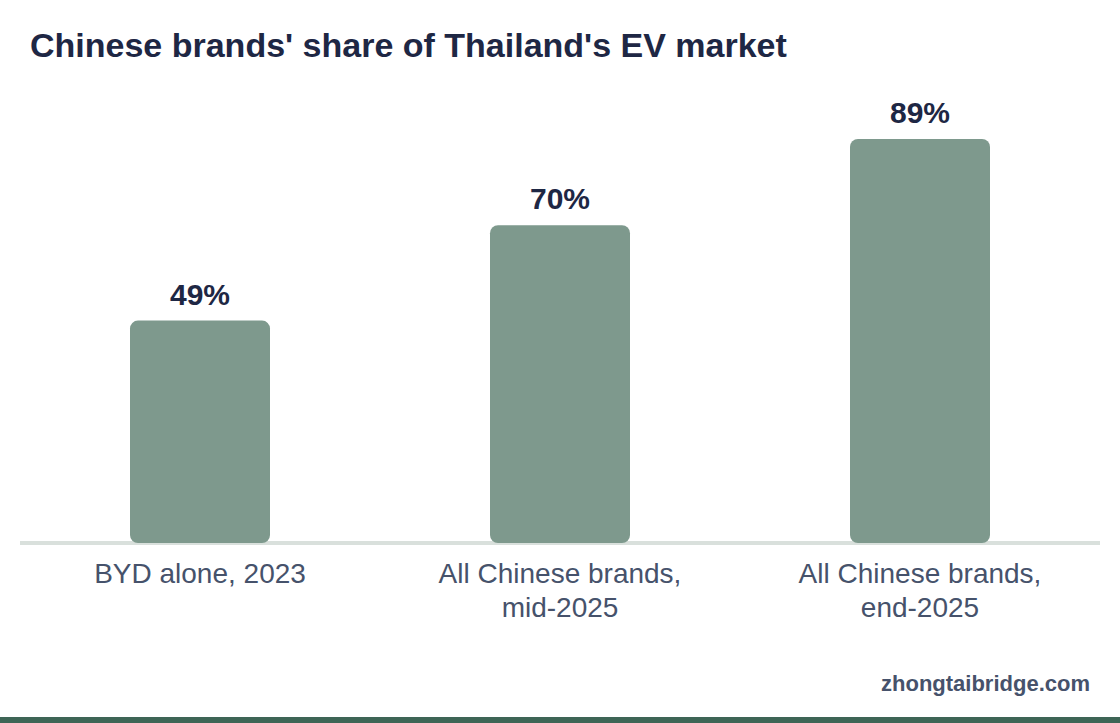
The facts are striking. BYD held about 49% of Thai EV sales in 2023 according to Counterpoint Research. By mid-2025 Chinese brands held more than 70% of the market, and Automotive World, citing market analysis, reported that Chinese brands reached 89% by the end of 2025. The number of Chinese EV brands in Thailand doubled to 18 in one year, and eight Chinese automakers have set up manufacturing in the country. Chinese EV makers have invested more than US$3 billion, drawn by Thailand's goal of making EVs 30% of auto production by 2030.
Chinese brands' share of Thailand's EV market
Column chart. BYD alone, 2023: 49%; All Chinese brands, mid-2025: 70%; All Chinese brands, end-2025: 89%
Mid-2025 is a floor: reports said more than 70%. Source: Counterpoint via Reuters; Automotive World.
How did incentives create obligations?
Thailand's incentive program gave Chinese automakers early access with reduced taxes, in exchange for commitments to build vehicles locally within set timelines. Automotive World notes that this gave roughly two years of effectively subsidized, tariff-free access before local production requirements applied.
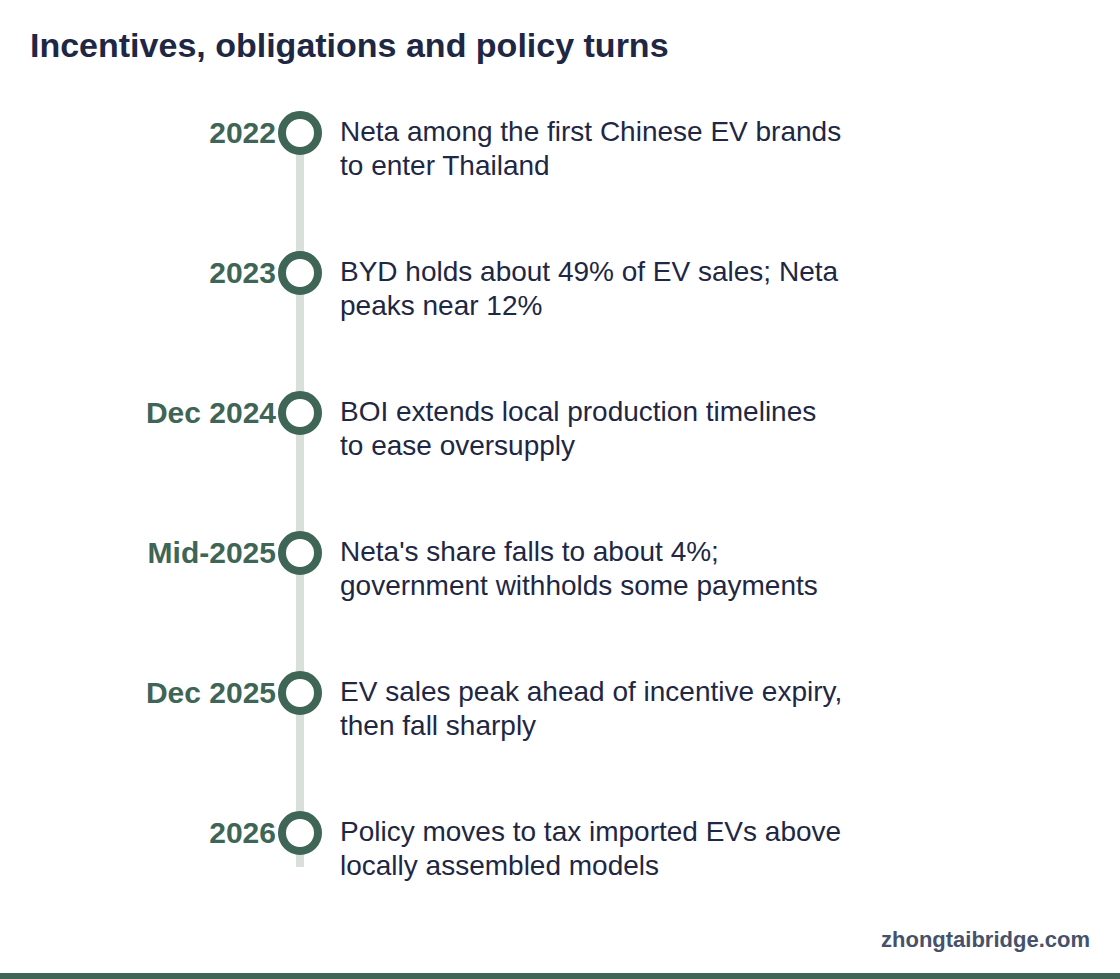
Obligations are real. Reuters reported that Neta, one of the earliest Chinese EV entrants in 2022, struggled to meet its local production requirements after its share of Thai EV sales fell from about 12% in 2023 to about 4% in the first five months of 2025, and the government withheld some payments. After a sharp contraction in sales, Thailand's Board of Investment extended local production timelines in December 2024 to reduce the risk of oversupply and a worsening price war.
The lesson is that incentives are better understood as a loan against future performance. They accelerate entry, but they commit the company to a production and sales trajectory that must hold even if the market turns.
Incentives, obligations and policy turns
Timeline. 2022: Neta among the first Chinese EV brands to enter Thailand. 2023: BYD holds about 49% of EV sales; Neta peaks near 12%. Dec 2024: BOI extends local production timelines to ease oversupply. Mid-2025: Neta's share falls to about 4%; government withholds some payments. Dec 2025: EV sales peak ahead of incentive expiry, then fall sharply. 2026: Policy moves to tax imported EVs above locally assembled models.
Source: Reuters; Automotive World.
What did the price war look like?
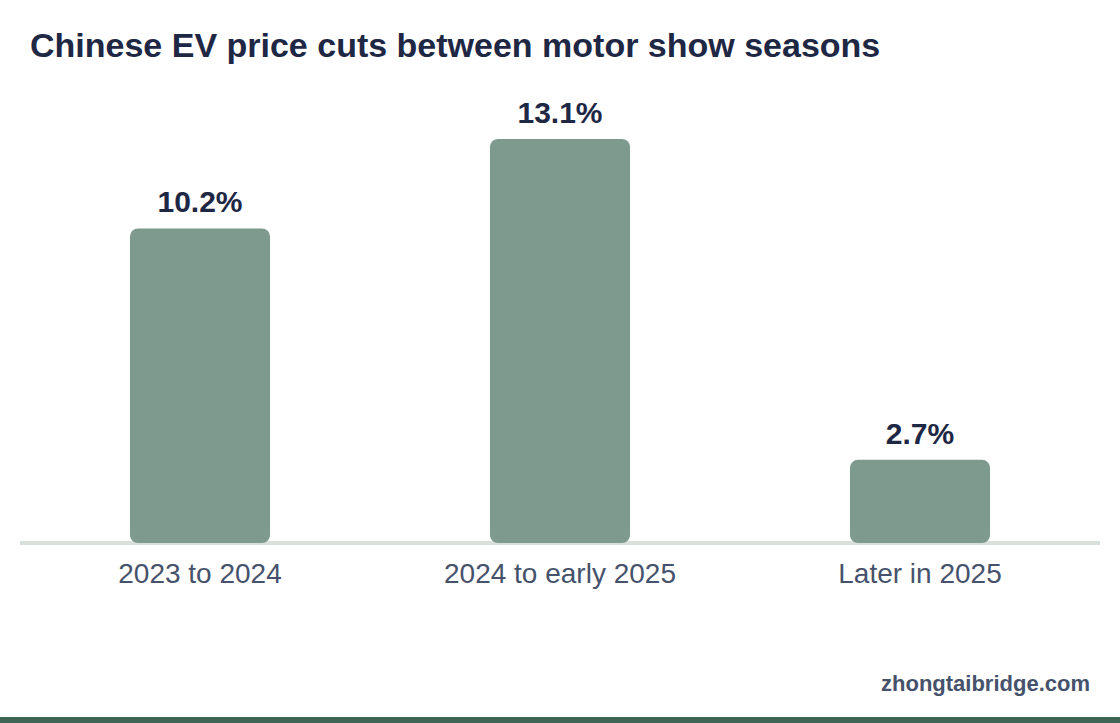
Thai research institute Krungsri found that Chinese EV brands cut prices by 10.2% between the 2023 and 2024 motor show seasons, then by a further 13.1% by early 2025, before the pace moderated to 2.7% later in the year. BYD drew government scrutiny in early 2025 for discounts of up to 340,000 baht per vehicle. Rhodium Group found price gaps of up to 50% between Chinese and non-Chinese EV models as of May 2026.
Sales also moved around policy deadlines. Chinese EV sales peaked in December 2025 as incentives approached expiry in January, fell sharply afterward and recovered to near-2025 levels within months, while overall market share barely changed. Demand signals around incentive deadlines are distorted, and executives should look at underlying demand and not the peak.
Chinese EV price cuts between motor show seasons
Column chart. 2023 to 2024: 10.2%; 2024 to early 2025: 13.1%; Later in 2025: 2.7%
Source: Krungsri, via Automotive World.
How is policy responding?
Having encouraged investment, Thailand is now moving to tax imported EVs above locally assembled models, a measure aimed at the loophole that let imports dominate while local production lagged. Rates and the grace period had not been set at the time of the Automotive World report, and the extent to which the policy changes the market will depend on those decisions.
The broader point is that policy is dynamic. A rule that helps early entrants can tighten once a sector is dominated by one nationality of players. Boards should assume that success invites scrutiny, and plan for a future in which the favorable conditions of today are renegotiated.
Six lessons that apply beyond autos
Treat incentives as obligations. Model the cost of meeting commitments in a downturn, not only in the base case.
In price wars, scale decides. Subscale brands exit first. Decide early whether you can be a top-three player in your segment or whether you must differentiate on something other than price.
Policy risk is path-dependent. The rules that welcomed you can tighten after you succeed. Build local value, such as manufacturing, partners and jobs, before you are asked to.
Visible dominance attracts attention from regulators, competitors and public opinion. Plan your public posture before you need it.
Read demand through the noise. Deadlines, subsidies and promotions create spikes. Track baseline demand and repeat purchase.
Chinese-market scale is not a Thai advantage by itself. Success in Thailand depends on local distribution, service and brand trust, which take time to build.
A resilience scorecard for your own entry plan
Score each statement from 0 to 2 and review the total with your leadership team.
We have a plan to remain profitable if prices in our category fall 15% to 25% over two years.
We know which commitments we have made to government, partners or platforms, and what they cost if sales fall.
We have a local partner, supplier or production plan that builds local value.
We have a clear differentiator that is not price.
We can explain our contribution to Thailand to a journalist or regulator in two sentences.
We track baseline demand separately from promotion-driven spikes.
We have a contingency plan if rules on tax, content or imports change.
We have service and after-sales capacity that matches our sales promises.
A total below 8 indicates that foundations should be strengthened before scaling spend.
How does this connect to the rest of your plan?
For consumer brands, the same logic shows up in marketplace price competition, creator costs and platform rules. For B2B and industrial firms, it shows up in incentive structures, local content expectations and partner selection. In every case, the question is not whether Thailand is attractive, but whether your plan stays robust when competitors copy your moves and policy adapts.
A feasibility study with scenario analysis, and an entry strategy with explicit sequencing and exit criteria, are the practical tools that turn these lessons into decisions.
What does the EV case imply for suppliers and B2B firms?
Anchor manufacturers pull entire supply chains into Thailand, but they also concentrate risk. When a second-tier brand struggles to meet its production commitments, as Neta did, its suppliers feel the shock before the headline reaches the market. A B2B firm that follows an anchor customer should diversify across several customers, avoid long unsecured credit to a single brand and track the anchor's incentive obligations and sales trend as leading indicators. It should also assume that local content expectations will rise, so a partnership with a Thai supplier or a local production step may become a requirement, not an option.
For marketing and service firms the signal is different: when price cuts run into double digits within a single year, the competitive advantage shifts to service quality, brand trust and communication, the areas where the 2025 academic research on Chinese car brands in Thailand found that after-sales service and quality supported loyalty alongside price.
Key terms and the sequence that matters
Coverage of the Thai market often frames the story in four terms: new energy vehicles, price war, localized production and policy risk. The Thai case is a live example of all four. The sequence matters more than any single event: incentives opened the door, imports and discounts filled it, local production obligations arrived, and policy tightened as Chinese brands approached 89% of the electric vehicle market.
Key terms explained
Term
Meaning
Why it matters
New energy vehicle (NEV)
An electric or plug-in hybrid vehicle
Category covering EVs and related vehicles
Price war
Repeated price cuts among competitors that squeeze margins
Repeated price cuts that squeeze margins
Localized production
Manufacturing or assembling in the market itself
Building locally to meet incentive or content rules
Policy risk
The chance that rules change in ways that affect your plan
Rules that change after you succeed
BYD
A Chinese carmaker that led Thai EV sales in 2023
Market leader in Thai EV sales in 2023
Neta
A Chinese EV brand that entered Thailand early and later struggled
Early Chinese entrant that struggled with local production commitments
Plain-language definitions for teams and partners.
Scenario planning for the next 24 months
Boards should hold three scenarios for any Chinese brand concentrated in a Thai niche. In the continuity scenario, incentives and import rules hold and price competition eases slowly. In the tightening scenario, import taxes rise and local production requirements expand, which favors firms that already manufacture or assemble in Thailand. In the shock scenario, a safety or quality incident or a sudden price move erodes trust and margin at once. For each, define the trigger, the response and the owner. A brand that has decided in advance what it will do if import duty doubles, a competitor cuts prices by 15%, or a regulator asks for local content evidence acts in days, not months.
Scenario planning frame for a concentrated Chinese brand
Scenario
Trigger
Prepared response
Continuity
Stable incentives, gradual price easing
Invest in service and brand; grow share steadily
Tightening
Higher import tax or local content rules
Accelerate local assembly, partners or supply
Shock
Safety event or sudden discounting
Crisis plan, price floor policy, customer care surge
Pricing governance when competitors discount
The Thai EV market shows that discounting is contagious: price cuts of about 10.2% and then 13.1% in successive motor show seasons forced rivals to respond, and regulators scrutinized discounts of up to THB 340,000 in one case. A company that reacts without rules ends up discounting by habit. A governance rule set protects margin and reputation. Define a price floor by product, the maximum discount depth and duration, who can approve exceptions and how you will communicate promotions. Decide in advance whether you will match a competitor's cut, differentiate with service or bundles, or hold price and accept lower volume for a period.
Customers also remember pricing history. If you cut a price sharply a few months after launch, early buyers feel punished and future buyers wait. Use limited, time-bound offers and value-added incentives, and avoid across-the-board cuts that cannot be reversed.
Signals to watch and how to respond
Early-warning signals for a crowded Thai niche
Signal
Meaning
Response
Competitor price cuts of 10% or more
Price war risk
Review cost structure; protect core margin; plan service-led differentiation
Policy consultation or statement on imports or incentives
Rule change ahead
Brief leadership; model scenarios; speak with advisers
Spikes in sales around deadlines
Distorted demand
Track baseline demand and repeat purchase
Rising complaints about service
Trust risk
Add service capacity; communicate openly
Supplier or partner distress
Concentration risk
Diversify; secure alternative suppliers
Service continuity: the promise behind durable goods
The EV case also shows that for durable goods the sale is the start of an obligation. Customers expect parts, repair and warranty support for years, so a brand that struggles financially or retreats from the market leaves buyers exposed, and the damage spreads to every brand from the same country. Any Chinese company selling durable products in Thailand, whether vehicles, appliances or equipment, should plan service continuity from the first sale: a spare-parts commitment with local stock, a certified repair network, warranty backing that survives a change in distributor, a clear escalation path for complaints and a published plan for what happens to customers if the business changes. Such commitments cost money, but they are cheaper than the loss of trust that follows a visible failure.
What to tell headquarters in three lines
First, Thailand rewards early movers who commit locally, but the rules change once a sector is dominated by one group of foreign players, so build scenarios for tightening. Second, price cuts of 10.2% and then 13.1% in successive seasons show that competition can erase margin within a year, so price governance and service quality matter as much as product. Third, obligations tied to incentives, such as local production, are binding commitments, and companies that cannot meet them face financial and reputational consequences. These three lines turn a long case into a decision frame that executives can apply to any category.
Frequently asked questions
Do these lessons apply if I am not in the auto industry?
Yes. The mechanisms of crowded entry, price competition, incentive obligations and policy response appear across consumer goods, electronics, e-commerce and industrial categories.
Is Thailand still attractive for Chinese brands?
Yes, but the easy phase is ending in many categories. Success increasingly depends on local capability, brand trust and unit economics.
How can I test my plan against a price war?
Model landed cost and margin at lower shelf prices using the calculator in our Tools section, and identify the price at which your plan breaks.
Thailand's digital economy is projected at US$56 billion in 2025. Why sources disagree on growth, what drives it and how to model it for your entry plan.
Thailand taxed low-value imports with VAT from February 2025 and duty from 1 baht on 1 January 2026. What changes for Chinese sellers and how to respond.