Cross-Border E-commerce into Thailand After the 2026 Duty Change: What It Means for Chinese Sellers
By ZhongTai Bridge Editorial · Last reviewed October 2026 · 9 min read
Photo: Unsplash
Short answer
Thailand has closed the low-value import loophole in two steps: VAT on parcels of 1,500 baht or less from 18 February 2025, and import duty from the first baht on 1 January 2026, collected with the cooperation of Shopee, Lazada, TikTok Shop, Temu and SHEIN. Cross-border price advantages shrink, and local stock, branding and compliance become the new competitive levers.
What exactly changed, and when?
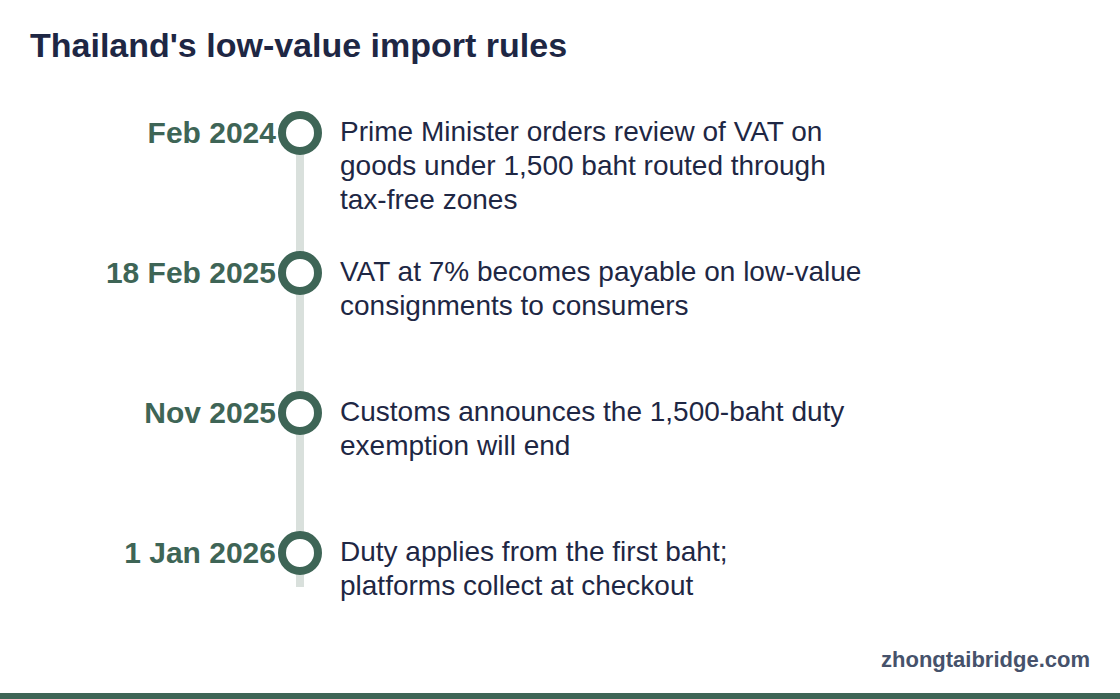
February 2024: Thailand's then prime minister ordered officials to consider VAT on goods under 1,500 baht routed through tax-free zones, citing a flood of cheap Chinese goods through e-commerce platforms and smuggling.
From 18 February 2025: VAT at 7% became payable on low-value consignments imported directly to consumers, after a soft launch in December 2024. Previously, shipments at or below 1,500 baht were exempt.
November 2025: Thailand's Customs Department announced that the 1,500-baht duty exemption would end.
From 1 January 2026: import duty applies to online imports from the first baht, in addition to VAT. Customs signed cooperation agreements with Lazada, Shopee Thailand, SHEIN, TikTok Shop Thailand and Temu so that taxes can be collected upstream.
Initial reports from the Finance Minister's announcement referred to a duty of about 10% on low-value goods. Actual rates depend on the product classification, so treat any single percentage as indicative and confirm with a licensed customs broker.
Thailand's low-value import rules
Timeline. Feb 2024: Prime Minister orders review of VAT on goods under 1,500 baht routed through tax-free zones. 18 Feb 2025: VAT at 7% becomes payable on low-value consignments to consumers. Nov 2025: Customs announces the 1,500-baht duty exemption will end. 1 Jan 2026: Duty applies from the first baht; platforms collect at checkout.
Initial reports cited about 10% duty; actual rates depend on product classification. Source: Bloomberg; VATcalc; Forvis Mazars; Khaosod English.
How large is the flow being taxed?
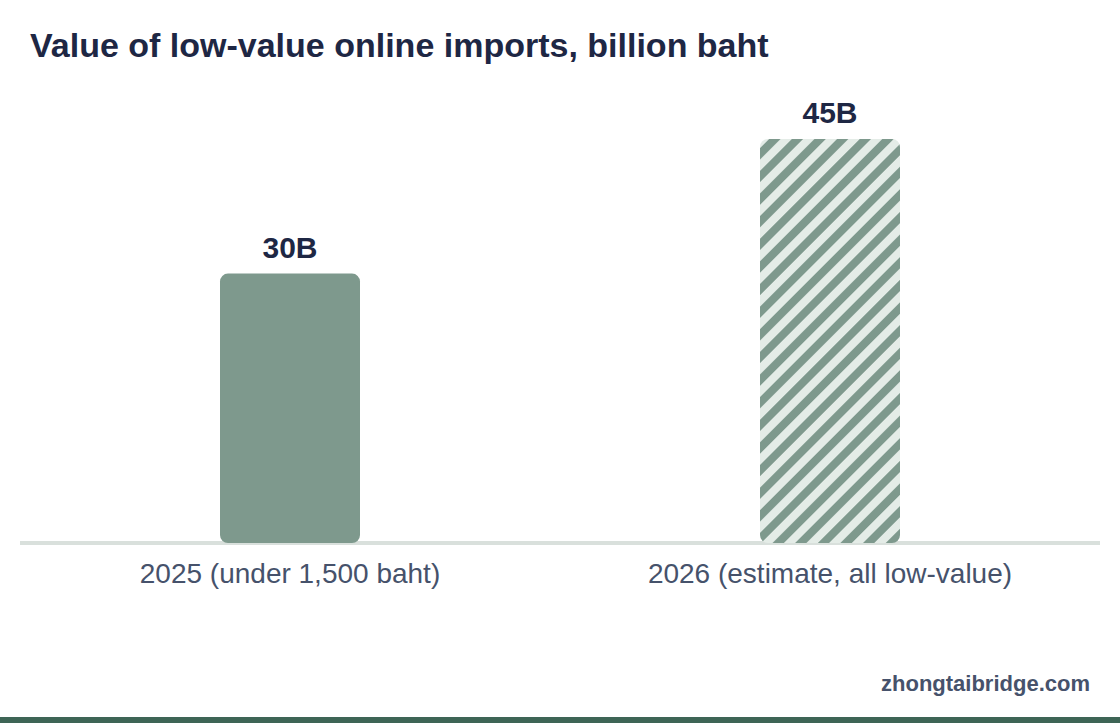
Customs officials said imports valued below 1,500 baht totaled about 30 billion baht in 2025, roughly 150 to 160 million items. For 2026, authorities estimated about 250 million parcels worth more than 45 billion baht. The expected additional revenue is modest, around 3 billion baht a year, and officials said the main objective was to protect domestic operators from the price disadvantage of untaxed imports. Most low-value imports fall into fashion.
These figures matter for two reasons. They show that the measure targets a specific, high-volume segment of low-ticket goods, and they show that the Thai government is willing to act at scale with platform cooperation rather than relying on border inspection alone.
About 150–160 million items in 2025; about 250 million parcels estimated for 2026. Source: Thai Customs Department, as reported by Khaosod English.
Why did Thailand act?
The policy sits inside a larger trade picture. China was Thailand's largest trading partner in 2023, with total trade of about US$105 billion and a Thai deficit of US$36.6 billion according to the Thai Commerce Ministry, as reported by Bloomberg. Thai business groups, including the Chamber of Commerce, argued that low-priced Chinese goods hurt local manufacturers and small businesses, and some factory closures were attributed to the pressure.
One detail is instructive for brand builders. In 2024, Thai authorities ordered customs to block imports of copies of a registered local design, the so-called elephant pants pattern. Intellectual property that was once treated as informal now has enforcement behind it. Entrants should assume that copying local designs or names creates real legal and reputational exposure.
How does collection work in practice?
Most platforms will include taxes and duties in the displayed price, so consumers pay once before delivery. Shipments sent through Thailand Post may still have duties collected on delivery. Because platforms and customs link sales data, undervaluation or misdeclaration becomes easier to detect. Plan on accurate declared values and consistent product descriptions, and expect fewer inspections at the border and more checks upstream.
For the shopper, shelf prices of affected products rise. For the seller, the effect depends on cost structure: where duty and VAT are a small share of the product's value the impact is modest, and where margins were built entirely on the exemption it is severe.
Who is most exposed, and who benefits?
Most exposed: low-ticket, high-volume fashion and accessory sellers who ship parcels directly from China and compete on price alone.
Moderately exposed: mid-priced branded goods, where duty and VAT add a visible but manageable amount, and where brand, reviews and service can defend price.
Relatively advantaged: sellers with local stock, Thai importers of record and brands that can show product quality and after-sales service, because the price gap with cross-border parcels narrows.
Platforms: they gain a clearer compliance structure but face pressure on conversion for ultra-low-price products.
Exposure by seller type
Seller type
Exposure
Likely response
Low-ticket fashion shipped as parcels
Highest
Reprice, raise basket value or localize stock
Mid-priced branded goods
Moderate
Defend with brand, reviews and service
Local-stock sellers
Relative advantage
Hold price, grow share, tighten inventory
B2B importers
Different rules
Confirm classification and duty with a broker
What strategic options do Chinese sellers have?
Reprice and absorb: pass part of the cost to shoppers and accept lower volume. Works only where demand is not purely price-driven.
Raise the average order value: bundle products so that fixed costs and duty are spread across a larger basket.
Localize inventory: hold stock in Thailand through a local importer or warehouse partner. This shortens delivery, supports quality perception and simplifies returns, but it adds working capital, inventory risk and compliance obligations, including VAT registration where thresholds are met.
Shift to brand-led selling: differentiate with design, service and content so that price is one factor among several.
Rebalance the portfolio: keep cross-border for products where margin survives the new costs, and move others to local fulfillment or drop them.
Use the landed cost calculator in our Tools section to compare scenarios. Enter the duty rate for your product, set VAT status, and read the minimum shelf price that still reaches your target margin.
How should you manage reputation and policy risk?
The measure responds to a political concern: Thai small businesses feel exposed to cheap imports. New entrants from China should expect scrutiny and should make their local contribution visible: Thai-language service, transparent pricing, fair returns, local partners and, where relevant, local jobs or production.
Avoid competing through practices that invite enforcement, such as undervaluing shipments or copying local designs. A brand that is easy to defend publicly is also easier to partner with, to list on platforms and to scale.
What should you monitor over the next twelve months?
Duty schedules by product category, and any revision of rates or exemptions.
How each platform displays and collects taxes, and whether this changes conversion.
The date on which the reduced 7% VAT rate is scheduled to revert, currently 30 September 2027 unless extended again.
Customs enforcement patterns on valuation and classification.
Thai policy on local content and protection for domestic producers in your category.
This article is market intelligence, not legal or tax advice. Rules change frequently, so confirm details with qualified advisers before you restructure your supply chain.
Three seller archetypes and a 30-day response plan
The examples are illustrative. A parcel seller of low-priced accessories discovers that duty and VAT now add visibly to the checkout price, and conversion falls. The response is to bundle products to lift basket value, drop the lowest-margin lines and run a small local-stock test on the two best sellers. A branded home-appliance exporter sees only a small change in total price, because duty and VAT are a modest share of a high ticket. The response is to keep cross-border for the long tail and move the hero model to local stock for faster delivery and easier warranty service. A Thai importer already holding stock sees competitors lose their price edge. The response is to hold prices, take share and avoid overstocking.
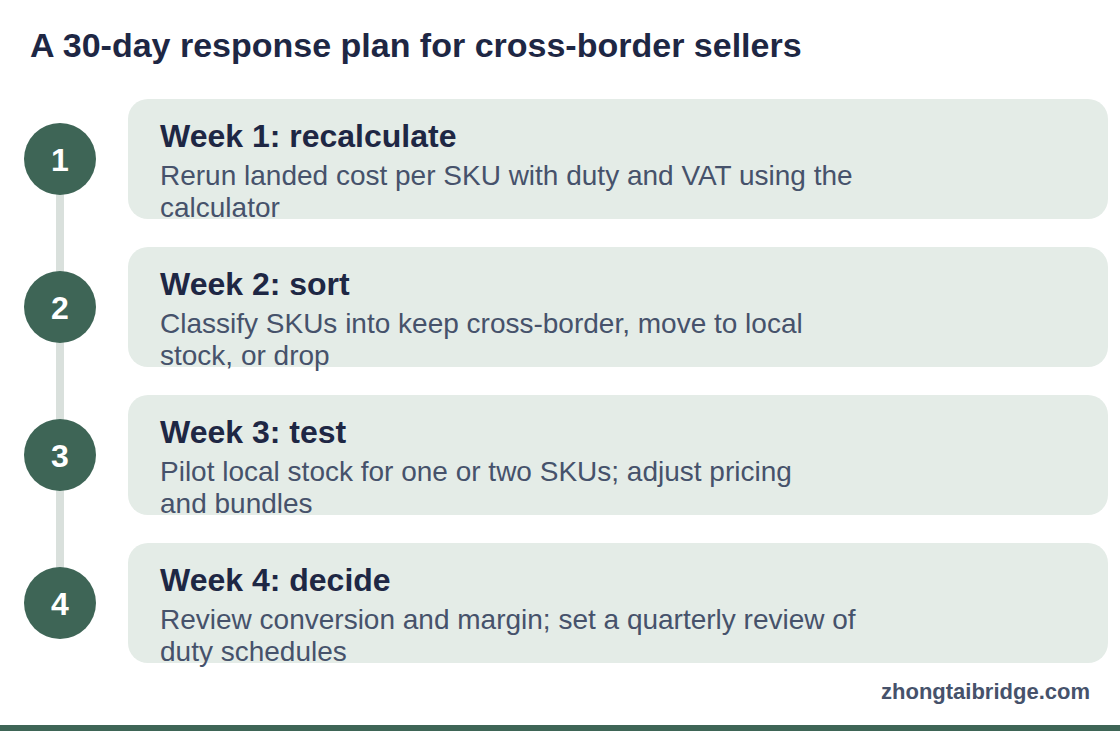
A 30-day response plan for cross-border sellers
Process diagram. 1. Week 1: recalculate: Rerun landed cost per SKU with duty and VAT using the calculator. 2. Week 2: sort: Classify SKUs into keep cross-border, move to local stock, or drop. 3. Week 3: test: Pilot local stock for one or two SKUs; adjust pricing and bundles. 4. Week 4: decide: Review conversion and margin; set a quarterly review of duty schedules.
Declared values and product classifications must be accurate. With platforms sharing sales data upstream, misdeclaration is easier to detect, and the cost of a dispute is larger than the saving.
Terms, numbers and questions for Chinese headquarters
Teams researching these changes usually look for the same handful of facts, and they are stable: VAT at 7% on low-value consignments since 18 February 2025, import duty from the first baht since 1 January 2026, collection through platform agreements, and a scale of roughly 30 billion baht of low-value imports in 2025 and over 45 billion baht estimated for 2026. Expect headquarters to ask three questions: what changes in price at checkout, which products stay viable cross-border, and when does local stock pay back.
Key terms explained
Term
Meaning
Why it matters
Low-value consignment
An imported parcel valued at 1,500 baht or less
Online import parcels up to 1,500 baht
Import duty
A tax charged on imported goods
Tax on imported goods, now from the first baht
VAT
Value added tax, charged on sales and imports
Currently a reduced 7% until 30 Sep 2027
Landed cost
The total cost of one unit delivered to Thailand, including freight and taxes
Total delivered cost per unit
Overseas warehouse
Stock held in Thailand rather than shipped from China
Local stock held in Thailand
Customs broker
A licensed specialist who classifies goods and handles declarations
Licensed adviser for classification and duty
Plain-language definitions for teams and partners.
Questions to ask a customs broker
Question
Why it matters
What is the duty rate for each of my product codes?
Duty varies by classification
How are declared values checked?
Misdeclaration risk
What documents are needed for local stock?
Importer of record and compliance
How does VAT interact with my registration status?
Cost versus recoverable tax
How will rules change after September 2027?
VAT reversion scenario
A worked pricing example under the new rules
The example is illustrative and uses a 10% duty rate and 7% VAT for simplicity, although actual rates depend on classification. A cross-border seller ships an accessory with a product cost of THB 150 and parcel shipping of THB 60, so the cost and freight value is THB 210. Duty at 10% adds THB 21 and VAT at 7% on THB 231 adds about THB 16, so taxes add THB 37 to the checkout price compared with the former exemption. If the seller previously listed at THB 349 with a margin of THB 90, it must now either raise the price by about THB 37, accept a thinner margin of about THB 53, or reduce cost elsewhere. At a shelf price of THB 349 and a competitor with local stock listed at THB 359, the cross-border price advantage disappears, and delivery time favors the local seller.
The conclusion is not that cross-border cannot work, but that it must be priced and tested product by product. Use the landed cost calculator to run the numbers, and compare with a local-stock scenario that includes warehousing and domestic shipping.
A local-stock pilot checklist
Choose one or two best sellers with steady demand and a long shelf life.
Confirm the importer of record, customs broker and VAT status with advisers.
Calculate landed cost for local stock and compare with cross-border at the same volume.
Order a small first batch, equal to six to eight weeks of demand.
Set up a warehouse or fulfillment partner with clear service levels and a returns process.
Update listings to show faster delivery and local stock, and monitor conversion and ratings.
Review after 60 days: margin, stock turns, returns and cash tied up.
Decide whether to extend local stock to more products.
Positioning against Thai small sellers
The policy was shaped by concern for Thai small businesses, so tone matters. Chinese sellers that compete on price alone invite the criticism that motivated the rules. Positioning that emphasizes quality, service, design and local contribution is more durable and easier to defend: invest in Thai-language support, honest product information, fair returns, local partnerships and, where relevant, local assembly or packaging. Avoid copying designs from Thai makers, and be ready to explain how your pricing is sustainable. A brand that is seen as a fair competitor can win customers, platform support and media goodwill.
The rules in one table
Thailand's low-value import rules at a glance
Item
Rule or fact
Status
VAT on low-value consignments
7% on parcels up to 1,500 baht
From 18 Feb 2025
Import duty
From the first baht; actual rates vary by product
From 1 Jan 2026
Collection
Platform agreements with Shopee, Lazada, TikTok Shop, SHEIN and Temu
Announced late 2025
Reduced VAT rate
7% instead of the statutory 10%
Until 30 Sep 2027 unless extended
Scale of flow
About 30B baht in 2025; over 45B baht estimated for 2026
Customs estimates
Confirm current rates with a licensed customs broker before you change prices or fulfillment.
Frequently asked questions
Is there still a duty-free threshold for online purchases in Thailand?
Not for goods subject to the new rules. From 1 January 2026 Thailand applies import duty to online imports from the first baht, ending the 1,500-baht exemption.
Does the change apply only to Chinese sellers?
The rules apply to low-value imports in general, but Chinese sellers account for a large share of the cross-border parcels that motivated the policy.
Should I move to local stock?
It depends on your volume, margin and capital. Model the total landed cost for both routes, then pilot with a limited range before committing inventory.
Thailand's digital economy is projected at US$56 billion in 2025. Why sources disagree on growth, what drives it and how to model it for your entry plan.