Thailand's Household Debt and What It Means for Discretionary Brands
By ZhongTai Bridge Editorial · Last reviewed October 2026 · 7 min read
Photo: Unsplash
Short answer
Thailand's household debt-to-GDP ratio fell to a six-year low of 85.9% in the first quarter of 2026, yet the average household owes nearly THB 795,000, the highest in 17 years. The ratio fell because credit was restricted and nominal GDP grew, not because households got stronger. Plan pricing, ticket size and trade credit for constrained liquidity, not for a recovery in borrowing.
What is the paradox in the household debt data?
Thailand's household debt-to-GDP ratio fell to 85.9% in the first quarter of 2026, the lowest in six years. On the surface, this looks like healthier household finances. SCB Economic Intelligence Center (SCB EIC) argues the opposite: the ratio fell because banks restricted retail credit, because households became cautious about spending, and because nominal GDP, the denominator, grew faster than debt. The value of household debt itself continued to rise, and households' capacity to service it showed no clear improvement.
SCB EIC calls this constraint-driven deleveraging: a lower ratio produced by limited access to credit, not by stronger balance sheets. It expects the ratio to drift down to 83.5% to 84.5% by the end of 2026, and a University of the Thai Chamber of Commerce (UTCC) projection points to about 84%. Both warn against reading the decline as a recovery.
For an executive building a Thailand plan, the lesson is methodological. A ratio that improves for the wrong reason can mislead a demand forecast. The right question is not how indebted Thai households are in aggregate, but how much free cash and credit they can use for the product you sell.
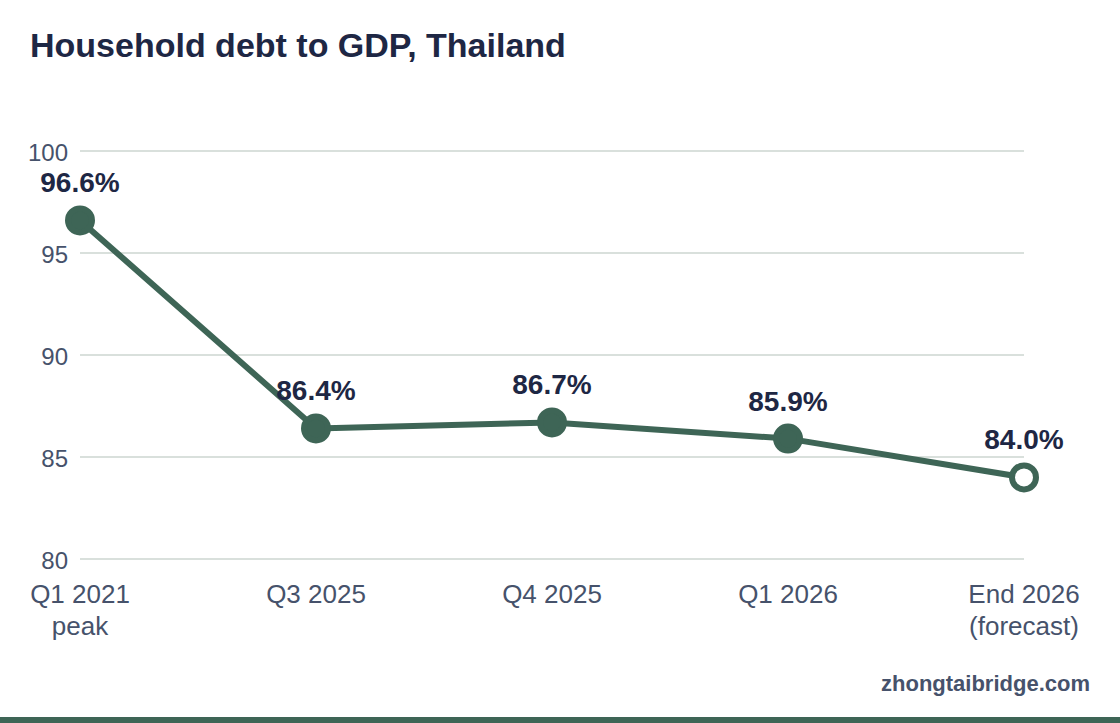
Household debt to GDP, Thailand
Line chart. Q1 2021 peak: 96.6%; Q3 2025: 86.4%; Q4 2025: 86.7%; Q1 2026: 85.9%; End 2026 (forecast): 84.0%
Forecasts of 83.5% to 84.5% by SCB EIC and about 84% by UTCC. Source: Bank of Thailand; SCB EIC; UTCC; The Nation.
How large is the debt, and who holds it?
At the end of 2025's fourth quarter, household debt stood at THB 16.44 trillion, or 86.7% of GDP, up from 86.4% in the third quarter, according to Bank of Thailand data reported by The Nation.
The all-time high was 96.6% of GDP in the first quarter of 2021, so current levels are lower than the pandemic peak but still among the highest in Asia.
A 2026 UTCC survey found average household debt of THB 794,945, up 7.3% from the previous year and the highest in 17 years.
Credit cards top household borrowing in the UTCC survey, and regulated credit card and personal loan debt reached about THB 1.39 trillion at the end of 2025.
UTCC estimates that total household debt could reach THB 16.5 trillion to 16.6 trillion by the end of 2026.
The composition matters as much as the total. Rising reliance on short-term, unsecured and non-bank borrowing signals households managing cash flow rather than investing, which is consistent with slow income growth and cost-of-living pressure noted in the coverage.
Household debt snapshot
THB 16.44T
household debt, end 2025
THB 795K
average household debt, 2026 survey
+7.3%
rise in average debt, highest in 17 years
THB 1.39T
regulated credit card and personal loans
Source: Bank of Thailand via The Nation; UTCC survey.
What does this mean for demand?
Constrained liquidity changes behavior in three ways that matter to brands.
Ticket-size sensitivity. When households use credit to bridge month-end gaps, big-ticket discretionary purchases are postponed first, and low-ticket, high-frequency items hold up better.
Promotion dependence. Shoppers concentrate purchases on campaign days and on offers that spread the payment. A brand that is not visible on sale days loses disproportionate share.
Rising value scrutiny. Reviews, product specifications and price comparison take more time in the buying journey, which rewards clear information and visible proof.
None of this means demand disappears. Thailand's platform e-commerce still grew 51.8% in 2025. It means growth is flowing toward formats and price points that fit tight household budgets.
How should pricing and assortment respond?
Build a price ladder. Offer an entry pack at a low absolute price, a core product and a premium bundle, so that stretched households can enter and loyal ones can trade up.
Protect margin through pack design, not only discounts. Smaller sizes, multipacks and bundles can raise perceived value without cutting the shelf price of the hero product.
Plan promotions as an annual calendar. Use the commercial calendar in our Tools section to align stock and budgets with double-date sales, and decide in advance which campaign days you will join and at what depth.
Test willingness to pay before launch. A short price test across three levels on a marketplace listing reveals elasticity faster than desk research.
Be careful with long-term commitments such as subscriptions or large minimum orders in segments that are cash constrained.
What about trade credit and B2B sales?
For companies selling to Thai retailers, distributors and small and medium enterprises, household strain can transmit into working-capital stress downstream. This is an inference, not a finding in the data, but it follows from tight consumer liquidity and cautious credit supply.
Run credit checks on new distributors and keep early limits conservative.
Prefer shorter payment terms or partial prepayment in the first orders.
Track days of sales outstanding by customer and set escalation rules.
Diversify across several mid-sized partners instead of a single large account.
How do you build the downside into your forecast?
Use scenarios rather than a single projection. A practical set for consumer brands is a base case that reflects current campaign-day conversion, a downside case with conversion 20% to 30% lower and a higher return rate, and an upside case in which credit conditions ease.
In the landed cost calculator, test whether the plan still reaches your target margin at a shelf price 10% below your base assumption. In the market size estimator, reduce your year-one share by half and check whether the project still clears your investment hurdle. If it does not, the plan relies on conditions that Thai households may not provide.
A scenario frame for constrained demand
Scenario
Conversion
Returns
Action
Base
Current campaign-day conversion
Current
Plan to current thresholds
Downside
20% to 30% lower
2 points higher
Cut spend, protect margin, delay big stock
Upside
Credit conditions ease
Current
Add range and budget in steps
Which indicators should you watch?
Bank of Thailand quarterly household debt releases and the breakdown by loan purpose.
Credit card and personal loan growth, and the share of non-bank lenders.
Consumer confidence and retail sales data, alongside platform campaign-day results.
Delinquency and non-performing loan trends reported by banks.
Your own data: conversion by price band, share of orders on campaign days, return rate and chat enquiries about installments.
Household debt is a slow-moving variable. The point of watching it is not to time the market, but to avoid planning for a consumer that does not exist.
Three illustrative categories: how the constraint shows up
The examples below are hypothetical and show how the same macro constraint produces different decisions in different businesses. They are not client cases.
A premium small-appliance brand. Average order value is high, and purchases are often planned. In a liquidity-constrained market, conversion stalls on price rather than interest. Response: introduce an entry model at a lower price point, offer bundles that raise perceived value and align launches with campaign days when shoppers expect discounts.
A beauty and personal-care brand. Purchases are frequent and low-ticket, but shoppers trade down quickly when budgets tighten. Response: win trial with small sizes, build repeat through LINE reminders and avoid deep discounts on the hero product that train customers to wait.
A B2B component supplier selling to Thai manufacturers and distributors. Demand depends on customers' working capital. Response: tighten credit terms, qualify buyers carefully, and offer smaller, more frequent shipments so that customers can match cash flow.
In each case, the macro data does not change the strategy by itself. It changes the sensitivity analysis: which assumption you test first and which downside you protect.
Five questions to ask your CFO before committing inventory
At what price band does our product become a postponed purchase for a household with limited liquidity?
How much of our forecast sales depend on campaign days, and what is our margin on those days?
What happens to margin if conversion is 20% lower and returns are two points higher?
How much inventory can we carry for two quarters if demand grows slower than planned?
Which customers or distributors represent concentration risk if payment terms stretch?
If the answers are unknown, the first investment should be a small, instrumented test, not additional stock.
Frequently asked questions
Is a falling household debt ratio good news for Thai consumer demand?
Not necessarily. SCB EIC attributes the decline to restricted credit access and faster nominal GDP growth, and describes it as constraint-driven deleveraging, not stronger household finances.
Which categories are most exposed?
Big-ticket discretionary categories and anything that depends on easy consumer credit. Low-ticket, high-frequency and essential-adjacent products tend to be more resilient. Test within your own category.
How current are these figures?
They come from Bank of Thailand data as reported in 2026 and from a UTCC survey published in September 2026. Check the latest quarterly release before using them in a board paper.
Thailand's digital economy is projected at US$56 billion in 2025. Why sources disagree on growth, what drives it and how to model it for your entry plan.
Thailand taxed low-value imports with VAT from February 2025 and duty from 1 baht on 1 January 2026. What changes for Chinese sellers and how to respond.