
Thai Localization vs Translation: What Chinese Brands Must Adapt
Translation versus localization for Thailand: a comparison table, payment data, a localization audit, tone guidance and a testing method.
Read article →Localization

Photo: Unsplash
Short answer
Before launch, test your brand name for Thai pronunciation, unintended meanings and spelling variants, check trademark availability and fix one canonical Thai spelling. A weak name costs you in word of mouth and in search, where spelling variants split demand.
A name that works in Chinese or English can be hard to pronounce, awkward to spell or accidentally funny in Thai. It is also the most valuable search term you will own. Because Google handles about 99.5% of Thai searches, how people type your name decides whether they find you. If five different Thai spellings circulate, demand for your brand fragments, and competitors can capture the variants.
Thai has its own sounds and tones, and some sounds common in Chinese or English have no direct equivalent. Ask five to ten native speakers of different ages and regions to read the name aloud, then write how they would spell it in Thai. If the spellings differ, searches will be fragmented, and you need to choose a canonical spelling and teach it consistently.
A naming test in seven steps
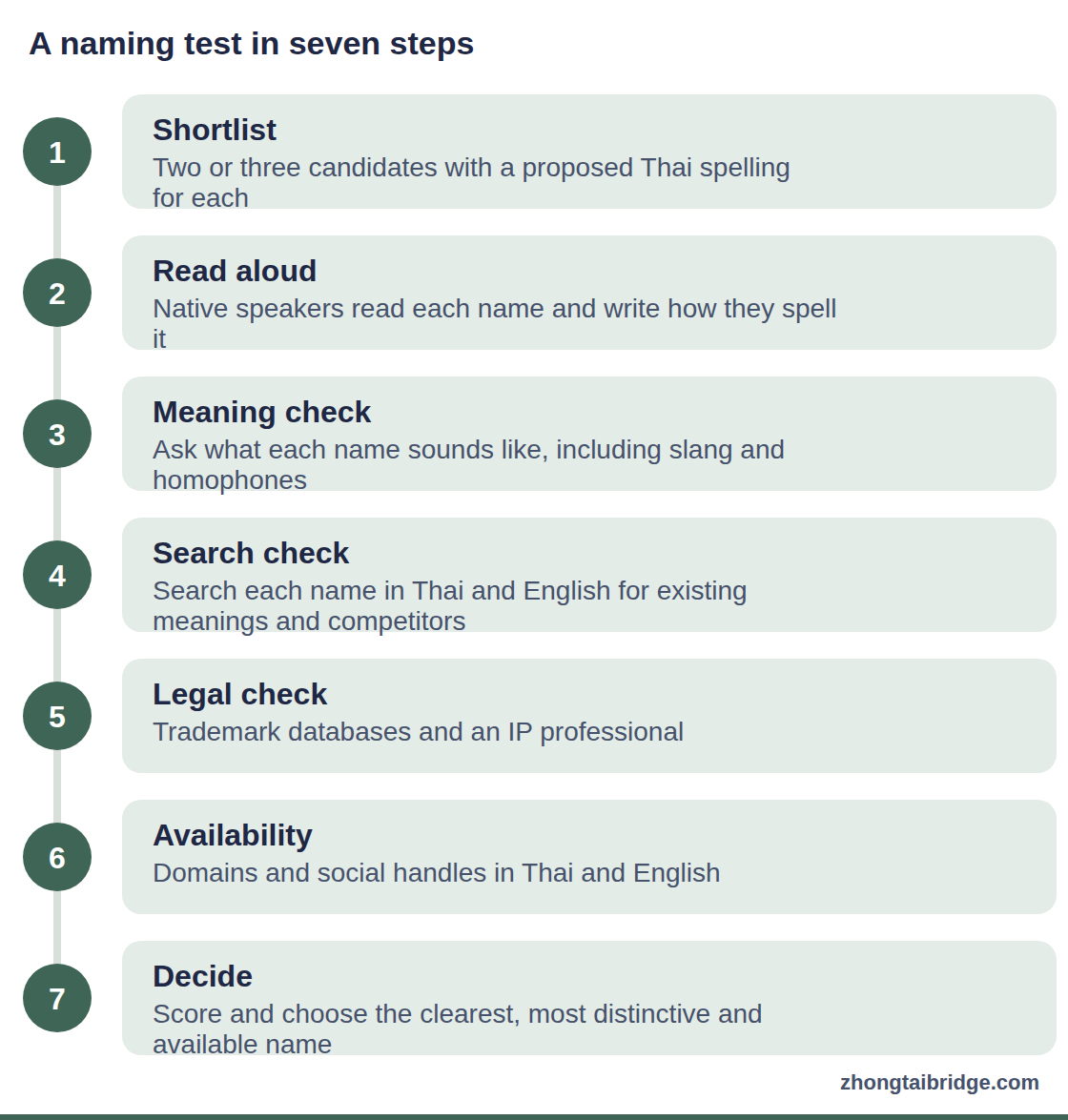
Process diagram. 1. Shortlist: Two or three candidates with a proposed Thai spelling for each. 2. Read aloud: Native speakers read each name and write how they spell it. 3. Meaning check: Ask what each name sounds like, including slang and homophones. 4. Search check: Search each name in Thai and English for existing meanings and competitors. 5. Legal check: Trademark databases and an IP professional. 6. Availability: Domains and social handles in Thai and English. 7. Decide: Score and choose the clearest, most distinctive and available name.
Ask several native speakers across ages and regions what the Thai pronunciation sounds like. Check homophones, slang and words that carry negative or comic associations. Search the name in Thai to see what already ranks and which brands already use similar sounds. A name that creates a pun for Thai ears can be an advantage when it is positive, but a risk when it is not, so do not rely on one reviewer.
Naming options for Thailand
| Option | When it fits | Risk |
|---|---|---|
| Keep the original name with a Thai transliteration | Name is distinctive and pronounceable | Spelling variants if not standardized |
| Adapt spelling to Thai phonetics | Small changes improve pronunciation | Inconsistency with other markets |
| Create a Thai-market name | Original name is hard or risky in Thai | Splits brand equity across markets |
| Use an English name with a Thai descriptor | Category clarity matters most | Weaker distinctiveness |
Search the records of the Department of Intellectual Property and consult an IP professional before you invest in packaging and advertising. Early registration reduces the risk that someone else claims your name, and clear registrations help with marketplace brand protection programs. Check domain names and social handles in Thai and English, and secure consistent handles across LINE, Facebook, Instagram, TikTok and Xiaohongshu.
Naming decision matrix
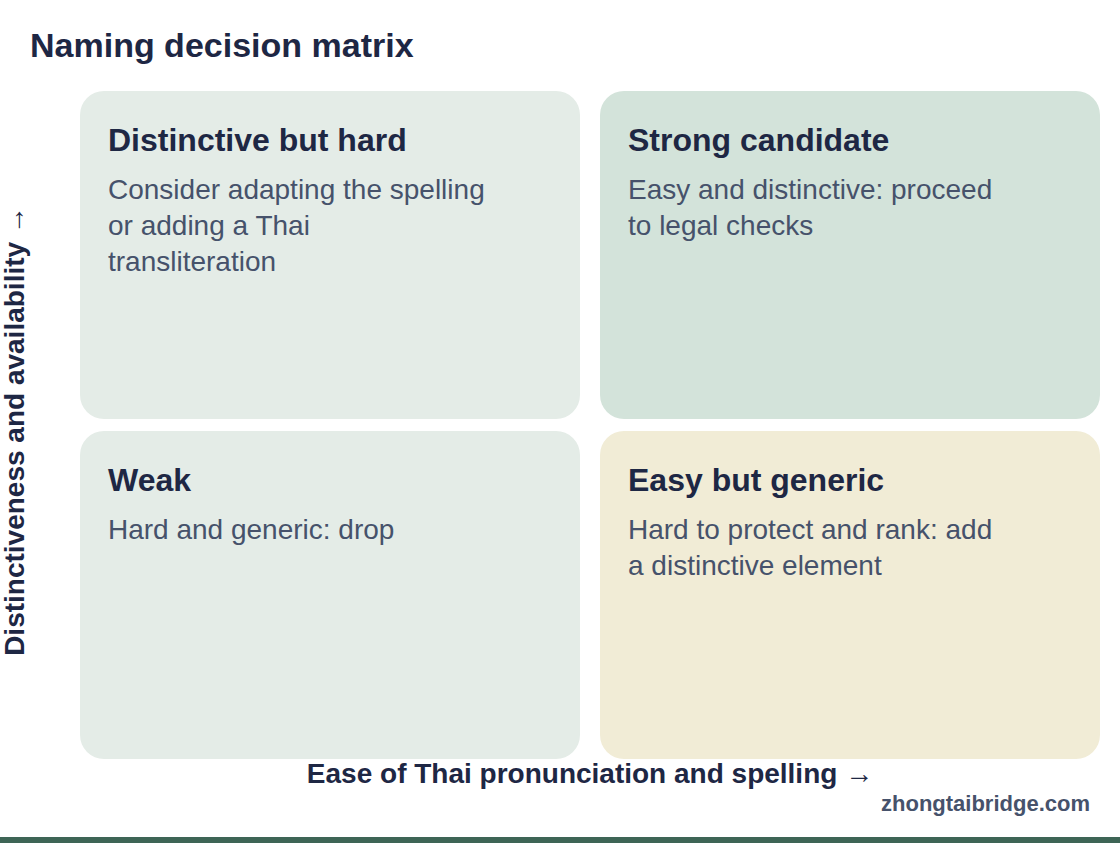
Two-by-two matrix. Horizontal axis: Ease of Thai pronunciation and spelling. Vertical axis: Distinctiveness and availability. Distinctive but hard: Consider adapting the spelling or adding a Thai transliteration. Strong candidate: Easy and distinctive: proceed to legal checks. Weak: Hard and generic: drop. Easy but generic: Hard to protect and rank: add a distinctive element.
Score each candidate from 1 to 5 on pronunciation, spelling, absence of negative meanings, distinctiveness, availability, searchability and fit with price positioning, then discuss the lowest scores before you decide.
Pick one Thai spelling, use it on every channel and tell partners and creators to use it. Mention common variants naturally in content so you capture both searches. Put the canonical spelling in your structured data, page titles, social profiles and press materials, and keep a short brand name guide in Chinese, Thai and English. If you must change a name later, plan redirects, updates to listings and a communication plan, because renaming after launch is expensive.
The example is illustrative. A Chinese beverage brand has two candidate names. Name A is short and distinctive in Chinese, but native Thai speakers produce three different Thai spellings and one reviewer says it resembles a slang word. Name B is slightly longer, but every reviewer spells it the same way and no negative associations appear. Trademark searches show that Name A has a close existing registration in a related class, while Name B is clear. The brand picks Name B for the Thai market, keeps the Chinese name in its home market and uses the same logo and color system across both so that the visual identity stays consistent.
The decision costs some Chinese brand equity but avoids fragmented search, legal risk and awkward associations. It also simplifies marketplace listings, packaging and creator briefs.
Is it risky to keep a Chinese name in Thailand? It can be fine if it is easy to say and spell in Thai and has no negative associations, but test it with native speakers and add a Thai transliteration.
Who decides the final name? The brand owner with input from native speakers, an IP professional and the search team. Do not delegate it to one reviewer.
How long does a naming check take? A focused check takes two to three weeks, including trademark searches.
What if a competitor already uses a similar name? Take legal advice and consider an alternative, because conflicts become costly after launch.
Not always. Test it first. Some names work well, and a small adaptation may be enough.
Native speakers from different ages and regions who match your target customers.
Before packaging, domains and advertising are produced.
They split search demand across forms. A canonical spelling plus natural mention of common variants captures both.
Make your brand feel native, not imported.
 Localization
Translation versus localization for Thailand: a comparison table, payment data, a localization audit, tone guidance and a testing method.
Read article → Localization
How to hire a Thai–Chinese business interpreter: consecutive vs simultaneous modes, team and equipment, a briefing checklist, quality checks and common mistakes.
Read article → Market Entry
A six-stage guide for Chinese companies entering Thailand, with 2026 market data, a China-to-Thailand translation table, a 90-day plan and a launch checklist.
Read article →Tell us about your business and goals.
We'll reply within 1–2 business days with next steps.