
Thai Localization vs Translation: What Chinese Brands Must Adapt
Translation versus localization for Thailand: a comparison table, payment data, a localization audit, tone guidance and a testing method.
Read article →Localization

Photo: Unsplash
Short answer
A business interpreter converts speech in real time, which is different from translating documents. Choose the mode by setting: consecutive for negotiations, simultaneous for seminars and conferences, whispered for small groups and remote for online meetings. Brief the interpreter in advance, agree confidentiality and plan a team for long sessions.
Translators convert written text and can revise, research and polish. Interpreters convert speech as it happens, so accuracy, speed, memory and composure matter as much as vocabulary. For Chinese companies in Thailand, interpreting is the layer that lets executives negotiate, inspect a site, address staff or speak at a conference without a language gap. Documents such as contracts, manuals and technical specifications need a translator, and many projects need both.
Demand is visible in the labor market. In a sample of 47 public job posts for Thai speakers on Chinese job boards in October 2026, 26 were translation or interpreting roles, and several asked specifically for consecutive or accompanying interpreting, meeting interpreting and factory-floor support. The sample is small and not random, but it shows that companies with Thai operations treat interpreting as an everyday need.
Roles in a sample of 47 Thai-related job posts on Chinese job boards
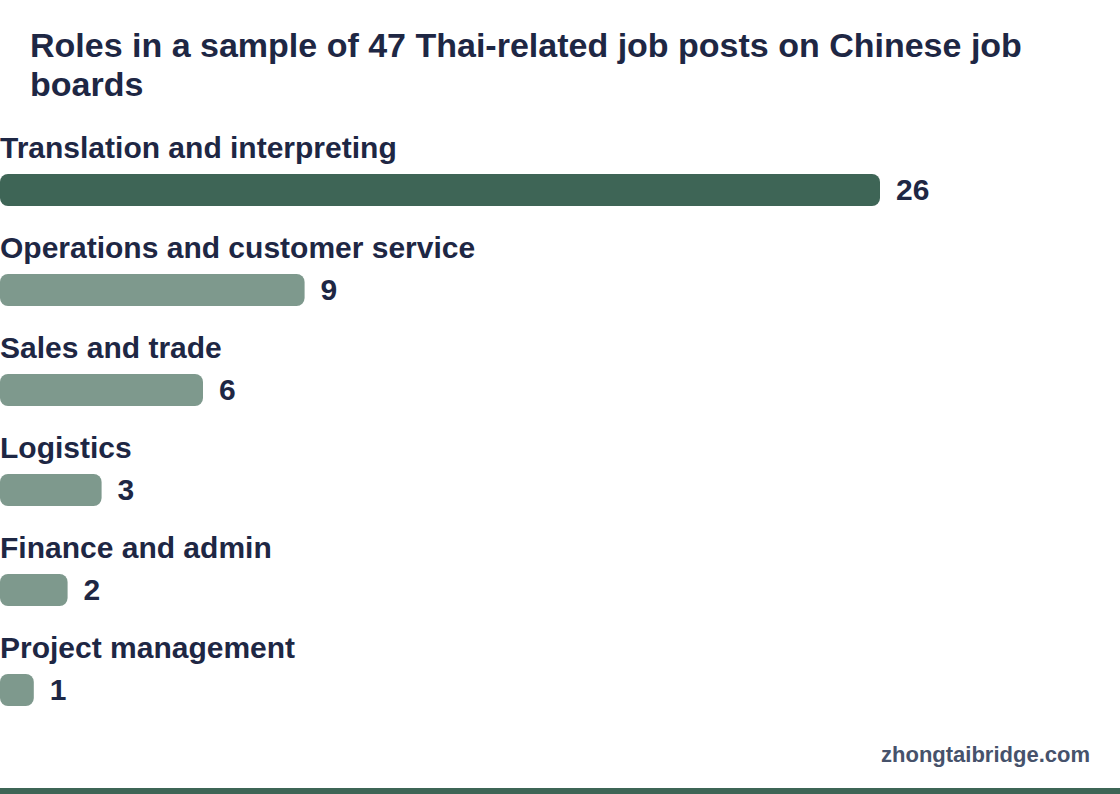
Horizontal bar chart. Translation and interpreting: 26; Operations and customer service: 9; Sales and trade: 6; Logistics: 3; Finance and admin: 2; Project management: 1
Interpreting modes compared
| Mode | How it works | Best for | Team |
|---|---|---|---|
| Consecutive | Speaker pauses; interpreter renders each segment | Negotiations, interviews, site visits, small meetings | One interpreter for short sessions; two for long or intense ones |
| Simultaneous | Interpreter speaks while the speaker continues, usually in a booth with headsets | Seminars, conferences, large presentations | At least two interpreters per language pair, rotating about every 20–30 minutes |
| Whispered | Interpreter whispers to one or two listeners | Tours, factory walks, a delegate in a longer meeting | One or two, depending on length |
| Remote | Interpreter joins by video or audio platform | Online meetings, webinars, urgent calls | One or two; needs a stable connection and a backup |
Consecutive interpreting doubles the time of a conversation but supports detailed negotiation, because each side can pause, clarify and think. Simultaneous interpreting saves time and suits one-to-many events, but it requires equipment, preparation and a team. Choose by the number of listeners, the sensitivity of the discussion and the venue.
For short consecutive meetings, one skilled interpreter is usually enough. For full-day negotiations or factory audits, plan two so that quality does not fall as fatigue builds. For simultaneous events, plan a team and equipment: soundproof booths or portable booths, transmitters, receivers and headsets, microphones with clear audio and a technician. Ask the venue about audio systems early, and confirm that the speaker's microphone feeds the interpreters directly.
For remote meetings, use a platform that supports an interpreter channel or run a separate audio setup, test with the interpreter before the event and prepare a backup connection.
A five-step interpreter briefing
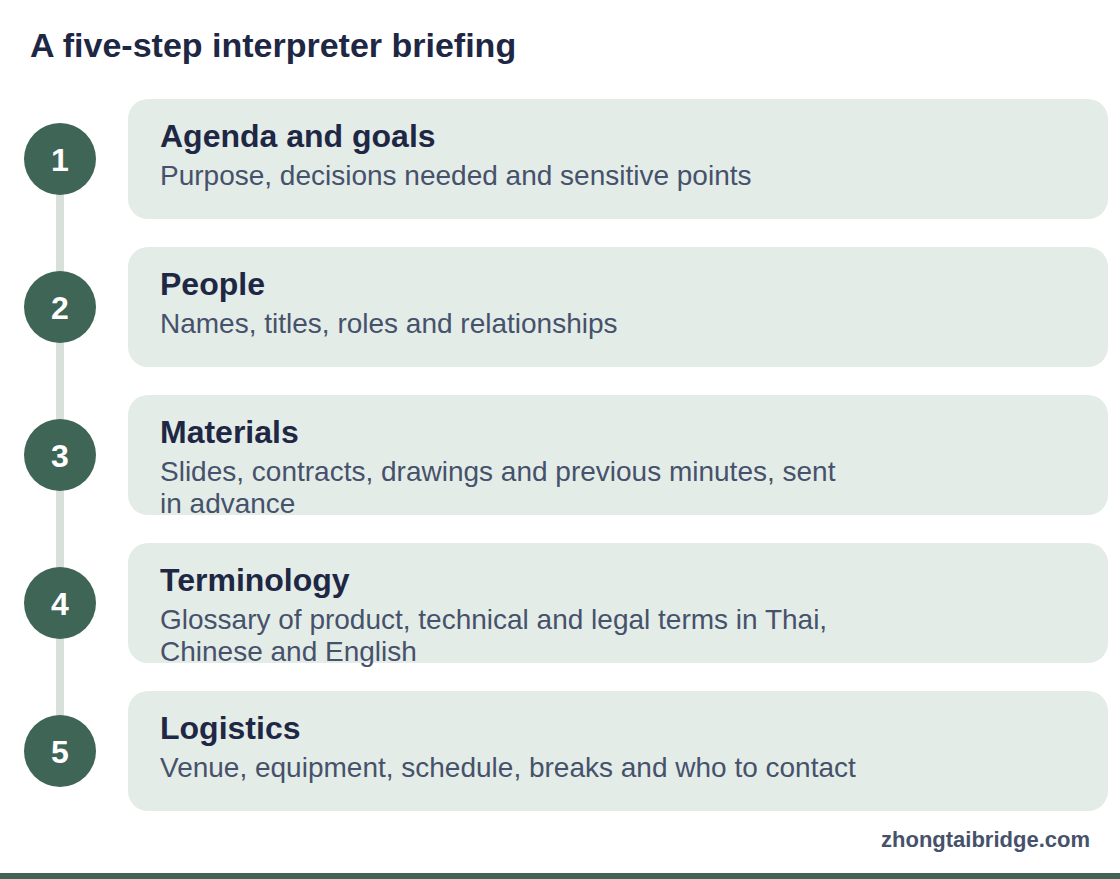
Process diagram. 1. Agenda and goals: Purpose, decisions needed and sensitive points. 2. People: Names, titles, roles and relationships. 3. Materials: Slides, contracts, drawings and previous minutes, sent in advance. 4. Terminology: Glossary of product, technical and legal terms in Thai, Chinese and English. 5. Logistics: Venue, equipment, schedule, breaks and who to contact.
Send materials at least a few days ahead for technical topics, and hold a short call to align on terms and style. Ask speakers to avoid reading at high speed, to pause between ideas and to share numbers and names in writing. A briefed interpreter can prepare terminology, anticipate arguments and avoid mistakes that cost time and trust.
Test candidates with a short glossary and a mock exchange. Judge accuracy, clarity, composure and how they handle a term they do not know.
In negotiations, the interpreter should convey meaning, tone and register faithfully and should not add opinions or soften statements without instruction. Agree beforehand how to handle ambiguity, for example by flagging it to both sides. Thai business communication uses polite particles and formal registers that signal respect, and an interpreter who understands both cultures can preserve the level of courtesy without distorting content. For seminars and conferences, share the program, speaker biographies and slides early, and give interpreters access to a quiet rest area and water.
Business interpreting covers meetings, negotiations, site visits and smaller events, usually in consecutive or whispered mode. Conference interpreting covers larger events, usually simultaneous, with booths, headsets and a team of interpreters.
Use consecutive for negotiations and small meetings and simultaneous for conferences and seminars with many listeners and a tight schedule.
For intense sessions, plan at least two interpreters so that they can rotate and quality stays high.
Interpreters can travel or work remotely, and the setting affects logistics and cost. Confirm availability, travel and visa requirements with your provider.
Sources
Thai, Chinese and English interpreters for meetings, negotiations, seminars and conferences in Thailand and China.
 Localization
Translation versus localization for Thailand: a comparison table, payment data, a localization audit, tone guidance and a testing method.
Read article → Localization
How to test a brand name for Thailand: pronunciation, unintended meanings, spelling variants, trademark and domain checks, search impact and a scoring matrix.
Read article → Market Entry
A six-stage guide for Chinese companies entering Thailand, with 2026 market data, a China-to-Thailand translation table, a 90-day plan and a launch checklist.
Read article →Tell us about your business and goals.
We'll reply within 1–2 business days with next steps.