How Chinese Companies Can Enter the Thai Market: A Step-by-Step Guide
By ZhongTai Bridge Editorial · Last reviewed October 2026 · 9 min read
Photo: Unsplash
Short answer
Enter Thailand in six stages: research demand, test economics, choose an entry model, localize, launch in sequence and optimize with data. Platform e-commerce reached US$35.5 billion in 2025, but platforms, search, payments and language differ from China, so a rebuilt plan outperforms a copied one.
Why do Chinese companies choose Thailand, and why now?
Thailand pairs a connected consumer base with fast-growing digital commerce. DataReportal counted 67.8 million internet users and 56.6 million social media user identities in October 2025, and Momentum Works reports that platform e-commerce grew 51.8% to US$35.5 billion in 2025, the fastest growth in Southeast Asia. Google, Temasek and Bain project the wider digital economy at US$56 billion for 2025, second in the region.
Thailand at a glance
67.8M
internet users, Oct 2025
56.6M
social media user identities
US$35.5B
platform e-commerce, 2025
US$56B
digital economy GMV, 2025 (projection)
Different reports measure different scopes, so do not add these figures. Source: DataReportal; Momentum Works; e-Conomy SEA 2025.
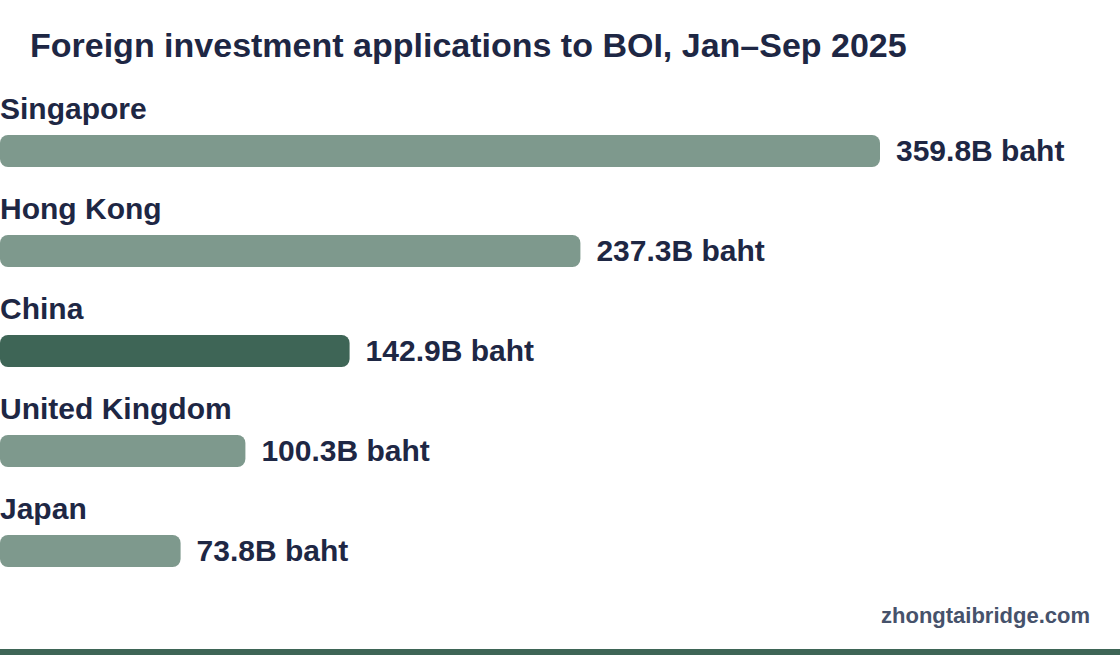
Chinese capital is already moving in. In the first nine months of 2025, China ranked third among sources of foreign investment applications to Thailand's Board of Investment, behind Singapore and Hong Kong. A Thai government summary notes that Singapore often acts as a gateway for Chinese and American parent firms, so Chinese capital is larger than the official ranking suggests.
Foreign investment applications to BOI, Jan–Sep 2025
Horizontal bar chart. Singapore: 359.8B baht; Hong Kong: 237.3B baht; China: 142.9B baht; United Kingdom: 100.3B baht; Japan: 73.8B baht
Applications show intent, not completed investment. Source: Thailand Board of Investment.
How is Thailand different from China for a brand builder?
Most early mistakes come from assuming that a Chinese tool, habit or benchmark has a Thai twin. It usually has a cousin: the same purpose with different mechanics. The table works as a translation guide when you plan.
Payments illustrate the point. Account-to-account transfers, mostly PromptPay, captured about 44% of Thai e-commerce value in 2025 according to Worldpay data, and wallets another 25%. PromptPay had more than 81 million registrations by March 2025 and processed over two billion transactions a month. A checkout that offers only cards will lose orders.
What are the six stages of a sound entry?
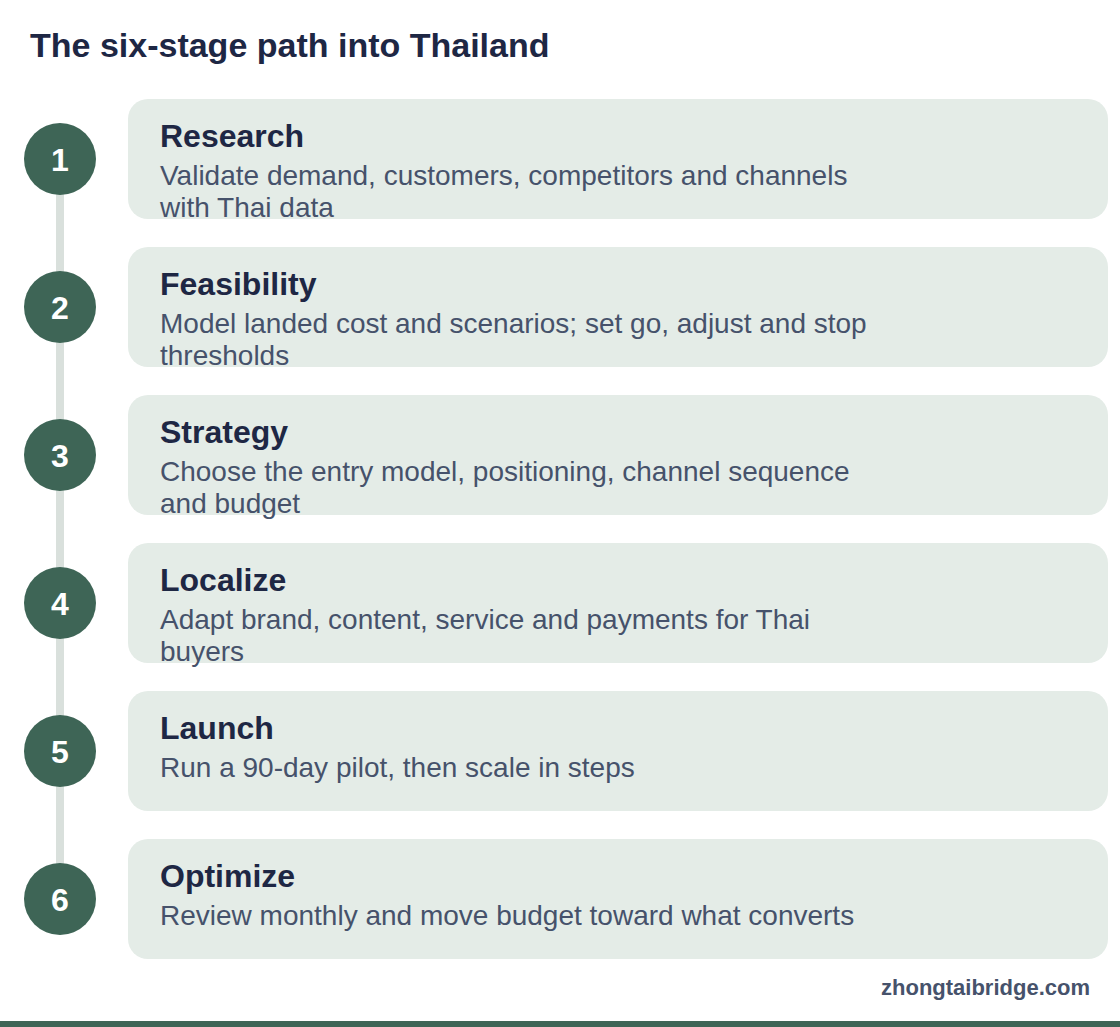
The six-stage path into Thailand
Process diagram. 1. Research: Validate demand, customers, competitors and channels with Thai data. 2. Feasibility: Model landed cost and scenarios; set go, adjust and stop thresholds. 3. Strategy: Choose the entry model, positioning, channel sequence and budget. 4. Localize: Adapt brand, content, service and payments for Thai buyers. 5. Launch: Run a 90-day pilot, then scale in steps. 6. Optimize: Review monthly and move budget toward what converts.
Stages overlap, but the go or no-go decision must precede large spending.
Each stage ends in a decision, not a report. Research ends in a recommendation about where to compete. Feasibility ends in a go, adjust or stop decision with explicit thresholds. Strategy ends in an approved plan with owners and budgets. Treat the sequence as a series of gates that release money in proportion to evidence.
Stages 1 and 2: how do you validate demand and test the economics?
Start with Thai-language evidence, not China sales data. Combine search demand from Google tools, marketplace best-seller and review data, competitor price audits and a small number of interviews with target buyers. The output should answer four questions: how large is reachable demand, who buys and why, who competes at which price, and which channels fit.
Then build a landed-cost model. Convert ex-factory cost to baht, add freight, import duty, VAT treatment, platform commission, payment fees, fulfillment, advertising and returns. Thailand currently charges VAT at a reduced 7% until 30 September 2027, with a statutory rate of 10%, and online imports now attract duty from the first baht. Our landed cost calculator shows your net margin, break-even return on ad spend and minimum viable price. If the plan only works at China-level prices or at unrealistic conversion, stop or redesign before spending.
Stage 3: which entry model fits?
The main options are marketplace-first, an owned website with chat commerce, a distributor or retail partner, and a local partnership. Most consumer brands start on one marketplace to learn quickly, build search and LINE assets in parallel, and add owned or offline channels once conversion and margin are proven. B2B and industrial firms usually start with a handful of target accounts and a carefully chosen distributor. See our guide to entry models for a decision matrix and an 18-month sequence.
Platform choice is part of this decision. Shopee leads with more than half of the market, TikTok Shop is the fastest-growing platform through video and live selling, and Lazada has moved toward brands and higher-value goods. Choose by category fit, margin after fees and your capacity to produce content, not by habit.
Stage 4: what does localization really include?
Brand name and tagline checked for pronunciation, meaning and spelling variants in Thai.
Product pages written by native editors around real Thai search terms, with specifications, proof and answers to common questions.
Customer service in Thai on LINE, Messenger and marketplace chat, with response targets.
Payment and delivery options that match local habits, including PromptPay QR.
Visuals, claims and promotions adapted to Thai expectations and rules.
Machine-translated pages signal low quality to both shoppers and search systems. Budget for native editing as a core cost, not an extra.
Stage 5: how should you launch?
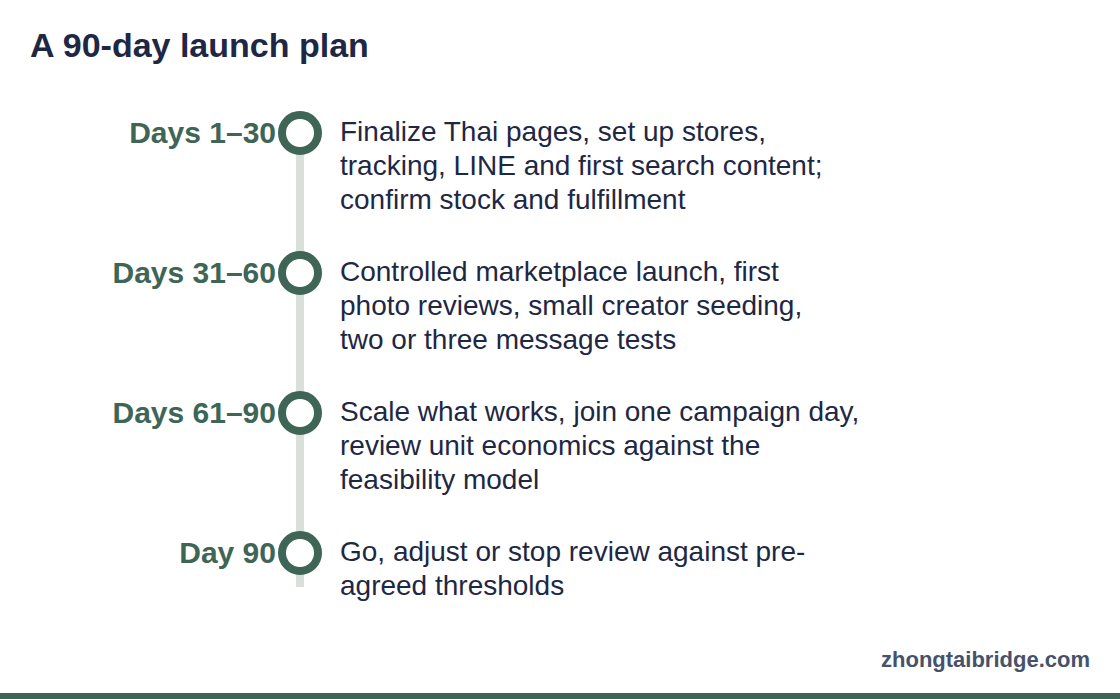
A 90-day launch plan
Timeline. Days 1–30: Finalize Thai pages, set up stores, tracking, LINE and first search content; confirm stock and fulfillment. Days 31–60: Controlled marketplace launch, first photo reviews, small creator seeding, two or three message tests. Days 61–90: Scale what works, join one campaign day, review unit economics against the feasibility model. Day 90: Go, adjust or stop review against pre-agreed thresholds.
Add a second channel only when the first is stable.
Sequence channels instead of opening everything at once. Spreading budget across marketplaces, social, creators and PR before the product page converts teaches you little and burns cash. Advertise only listings that already convert, and judge success on contribution margin, not on revenue.
Stage 6: how do you optimize and manage policy risk?
Review monthly: conversion, cost per order, margin, ratings, repeat purchase and branded search. Move budget toward products and messages that pay back. Watch the rules that change your economics. Thailand ended its 1,500-baht import exemption from the start of 2026, extended the reduced 7% VAT rate to 30 September 2027, and has shown willingness to adjust incentive programs once a sector is dominated by Chinese players. Build scenarios for rule changes into your plan.
Local value is also protection. Thai-language service, transparent pricing, local partners and visible contribution to the Thai economy make a brand easier to defend, partner with and scale.
Who does the work: in-house team, agency or partner?
Most firms use a hybrid. Keep strategy, pricing and brand stewardship in-house. Give an experienced local partner research, localization and execution until your own team has the capability. Whatever the split, keep ownership of accounts, listings, content and data, require written scope and reporting, and assign one accountable executive for Thailand.
A pre-commitment checklist
We have local demand evidence in Thai, not only China data.
We know landed cost, the minimum viable price and the break-even return on ad spend.
We have chosen an entry model and a first channel.
Our brand name has passed a Thai pronunciation and meaning check.
Product pages and customer replies are in natural Thai.
We know the Thai search terms for our category.
Our checkout supports PromptPay and the payment methods Thai buyers expect.
We have a plan for returns, damaged goods and chat support.
We have agreed 90-day KPIs and a go, adjust or stop review.
We know who owns each account, listing and data set.
If more than three items are missing, pause and close the gaps before you spend on advertising.
Three entry archetypes: which plan looks like yours?
Most Chinese companies entering Thailand fall into one of three archetypes, and each needs a different first 12 months. A consumer brand with proven demand in China should start on one marketplace, build Thai pages, LINE and search assets, and add creators and retail once conversion and margin are proven. A B2B manufacturer should pick 30 to 50 target accounts, including Chinese-owned plants already in Thailand, appoint a distributor with technical and service staff, and invest in Thai-language materials and local spare parts. A technology or software provider should choose one vertical, secure a Thai integrator and run a pilot with measurable outcomes before building a team.
Three entry archetypes
Archetype
First channel
First proof
Common trap
Consumer brand
One marketplace plus LINE and search
Conversion, rating and margin in 90 days
Scaling ads before the page converts
B2B manufacturer
Distributor plus key accounts
Pilot orders and service response times
Over-reliance on one distributor
Technology provider
Thai integrator and one vertical
Pilot with agreed success criteria
Selling features instead of local outcomes
Questions Chinese executives ask first, with direct answers
Do we need a Thai company before we sell? Not always: some marketplace and distributor routes work without one, but tax, import and liability depend on your model, so take advice early. How much Thai do we need on our site? Product pages, checkout, support and legal pages should be in natural Thai, with English and Chinese for regional and home teams. Can we reuse our Chinese content? Reuse ideas and research, but write Thai pages from Thai keyword research. Which platform first? Choose by category fit and best-seller evidence, not by habit. How long until profit? It depends on margin structure, but a pilot should show positive contribution margin per order within 90 days or the plan needs adjusting.
Key terms explained
Term
Meaning
Why it matters
Market entry
The plan and steps for starting to sell or operate in a new country
The overall plan from research to launch
Localization
Adapting language, brand, payments and service so they feel native
Adapting language, brand, payments and service
Landed cost
The total cost of one unit delivered to Thailand, including freight and taxes
Total cost per unit delivered to Thailand
Conversion rate
The share of visitors or viewers who place an order
Share of visitors who buy
ROAS
Revenue generated for each unit of advertising spend
Revenue per unit of ad spend
Campaign day
A marketplace sale day such as 9.9, 11.11 or 12.12
Marketplace sale days that concentrate demand
Distributor
A partner that buys your goods and resells them in a territory
Partner who imports and sells to retailers
Joint venture
A company owned jointly with a local partner
Shared-ownership local partnership
Plain-language definitions for teams and partners.
A risk register for the first year
A plan without a risk register hides the assumptions that will hurt you. List the ten risks that could change the decision, give each an owner and a trigger, and review the register monthly. For Thailand entry, the usual entries are conversion below threshold, rising advertising cost, a rule change on duty or VAT, a supplier or shipping delay, a negative review pattern, a creator or partner dispute, currency movement between yuan and baht, a price war that erodes margin, key-person dependency and a data or privacy incident.
Starter risk register for a Thailand launch
Risk
Early signal
Response
Owner
Conversion below threshold
Two weeks under target
Fix page, test price, pause ads
Country lead
Duty or VAT change
Customs or platform notice
Re-run landed cost; adjust price or fulfillment
Finance
Price war
Competitors cut 10% or more
Hold price floor; bundle; differentiate
Commercial lead
Supply delay
Lead time rising
Safety stock; second source
Operations
Negative review pattern
Rating falls below 4.6
Contain, fix, contact customers
Customer service
Currency swing
Yuan–baht move beyond band
Review price and hedging
Finance
What leadership should see every month
A one-page monthly report keeps the program honest. Show revenue and contribution margin against plan, conversion and cost per order by channel, rating and return rate, stock cover in days, cash invested, the top three risks and the decisions needed. Add a short note on what the team learned and what it will test next. If the same page shows a rising margin and a falling rating, leadership can see that quality is being sacrificed for growth. Review the report with the same people each month, and keep the format stable so that trends are visible.
Over time, add a quarterly strategy page that revisits the entry model, the channel order and the investment case. The aim is not more reporting, but faster, better decisions.
Frequently asked questions
How long does it take to enter the Thai market?
A marketplace-first launch can go live within weeks once decisions are made, but research, feasibility and localization usually take two to three months, and search visibility and brand awareness build over several months.
How much budget do I need?
Build the number bottom-up from landed cost, fees, advertising, fulfillment and a test period long enough to produce a decision. Avoid budgeting from a revenue target alone.
Do I need a Thai company or partner?
Some marketplace routes allow you to start without one, but requirements and tax treatment vary. You need Thai-language capability for content and service, whether from hires, an agency or a partner. Take legal and tax advice on structure.
What is the biggest risk?
Scaling spend before the product page, price and customer service are proven in Thai. Fix conversion first, then increase traffic.
What a Thailand feasibility study includes, with a worked landed-cost example, scenario design, a go, adjust or stop rule and the warning signs that kill a plan.
Compare Thailand's four entry models on speed, margin, control and capital, with a decision matrix, an 18-month sequence and the mistakes to avoid when choosing.
Seven costly mistakes Chinese brands make entering Thailand, from copying China playbooks to price-war exposure, with a diagnostic table and a recovery plan.