
How Chinese Companies Can Enter the Thai Market: A Step-by-Step Guide
A six-stage guide for Chinese companies entering Thailand, with 2026 market data, a China-to-Thailand translation table, a 90-day plan and a launch checklist.
Read article →Market Entry

Photo: Unsplash
Short answer
A feasibility study tests whether your specific plan can make money in Thailand before you commit. It combines demand validation, landed-cost economics, risk assessment and scenario analysis, and it ends in a go, adjust or stop recommendation with explicit thresholds.
Market research describes the market. A feasibility study tests whether your product, price and channels can win in it, and it ends in a decision. The study treats your plan as a hypothesis, identifies the assumptions that matter most and shows what must be true for the plan to work.
Anatomy of a feasibility study
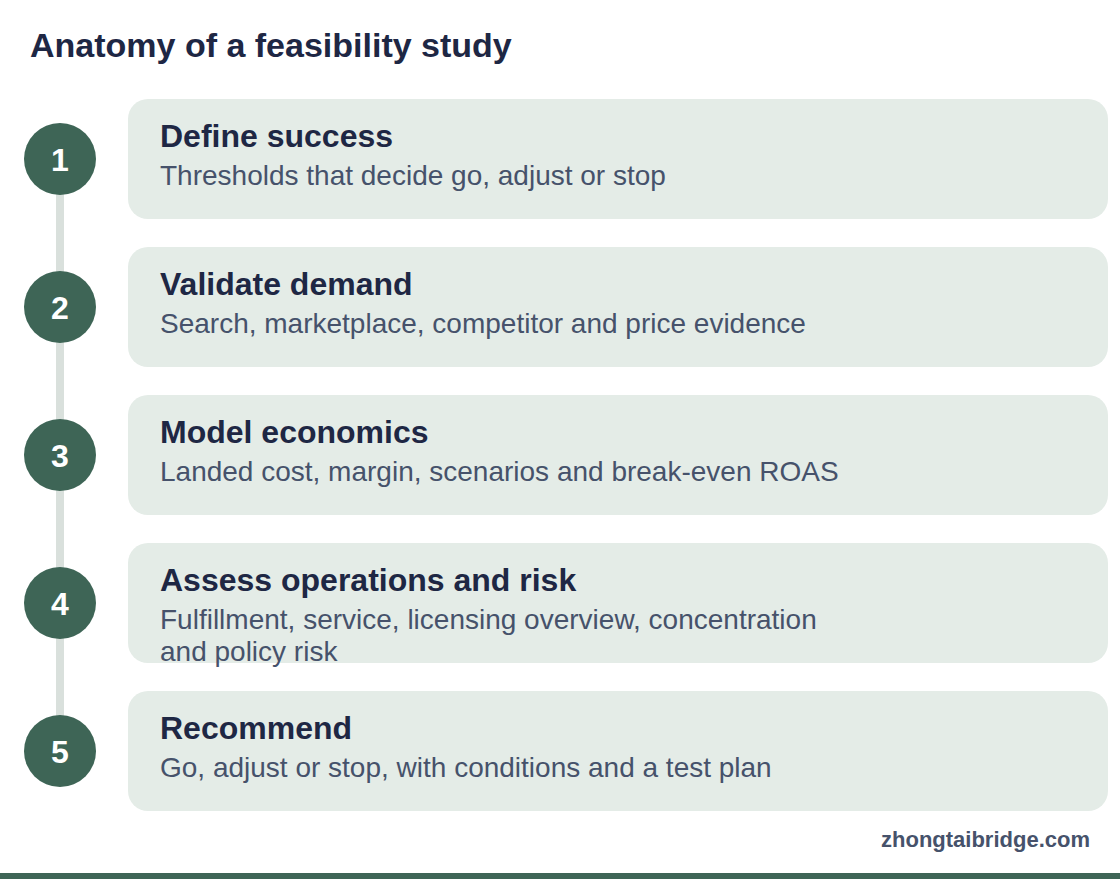
Process diagram. 1. Define success: Thresholds that decide go, adjust or stop. 2. Validate demand: Search, marketplace, competitor and price evidence. 3. Model economics: Landed cost, margin, scenarios and break-even ROAS. 4. Assess operations and risk: Fulfillment, service, licensing overview, concentration and policy risk. 5. Recommend: Go, adjust or stop, with conditions and a test plan.
A licensing and regulatory overview belongs in the study, but legal structure, product registration and tax treatment should be confirmed with qualified advisers.
Start with ex-factory cost, convert to baht at your current exchange rate and add freight and handling, import duty, platform commission, payment fees, fulfillment, advertising and a returns allowance. Thailand's VAT is a reduced 7% until 30 September 2027, against a statutory 10%, and import duty now applies to online imports from the first baht, collected through platforms. Whether import VAT is a cost depends on your VAT status, so model both.
Where a THB 899 shelf price goes (illustrative example)
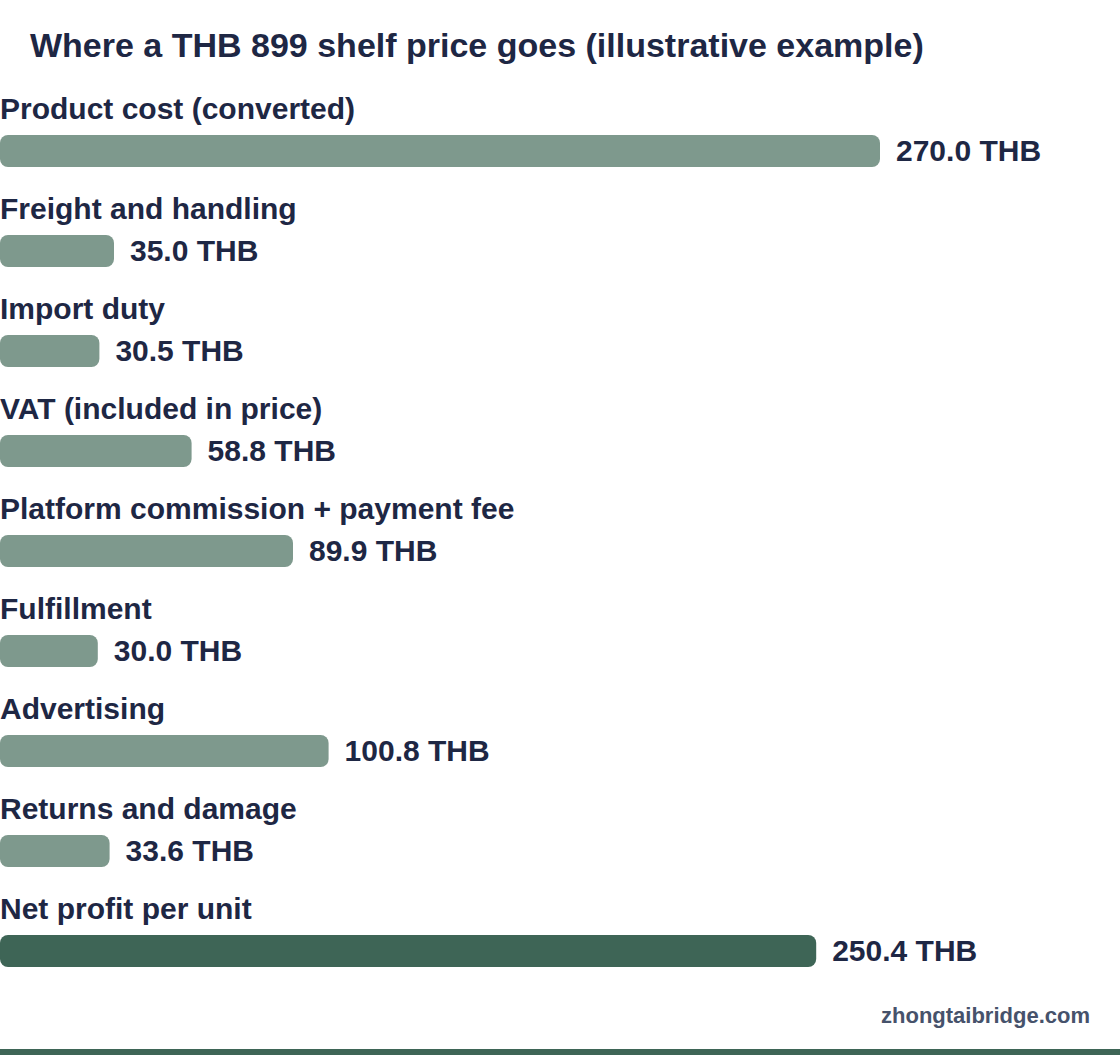
Horizontal bar chart. Product cost (converted): 270.0 THB; Freight and handling: 35.0 THB; Import duty: 30.5 THB; VAT (included in price): 58.8 THB; Platform commission + payment fee: 89.9 THB; Fulfillment: 30.0 THB; Advertising: 100.8 THB; Returns and damage: 33.6 THB; Net profit per unit: 250.4 THB
In the example, a 29.8% net margin looks healthy, and break-even return on ad spend is about 2.4x. Raise the advertising share or the return rate and the picture changes quickly, which is why the study tests scenarios instead of trusting a single case.
Identify which assumptions drive the result. Usually they are conversion rate, advertising cost per order, return rate and shelf price. Test those first with a small pilot. Add the household context to the downside case: debt-to-GDP fell to 85.9% in early 2026 because credit tightened, not because households grew stronger, so assume value-seeking behavior.
Reading feasibility results
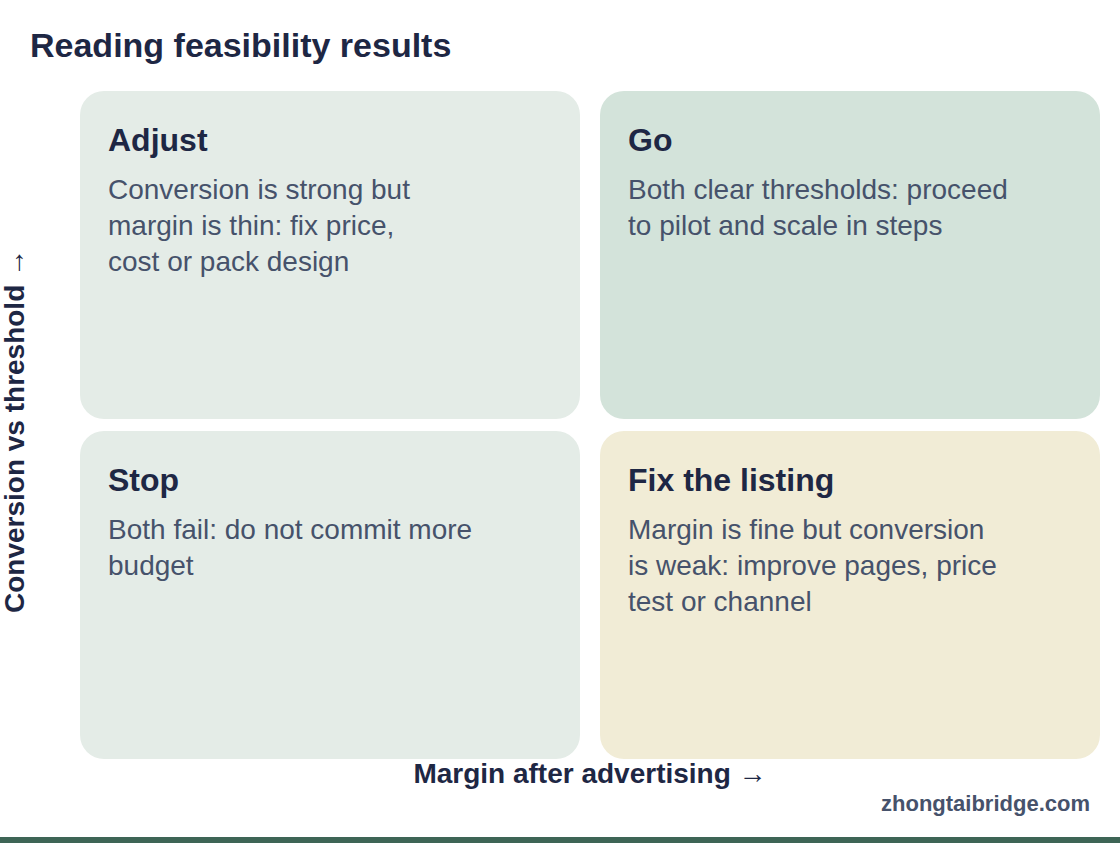
Two-by-two matrix. Horizontal axis: Margin after advertising. Vertical axis: Conversion vs threshold. Adjust: Conversion is strong but margin is thin: fix price, cost or pack design. Go: Both clear thresholds: proceed to pilot and scale in steps. Stop: Both fail: do not commit more budget. Fix the listing: Margin is fine but conversion is weak: improve pages, price test or channel.
Write thresholds into the report. For example: proceed if contribution margin after ads is at least your target at the base case and the pilot reaches the agreed conversion rate by day 60. A study that says no is still valuable, because it saves the cost of a failed launch.
The faster you provide accurate inputs, the sooner the study can reach a useful answer.
The example is illustrative. The study tests a silicone food-storage set. Demand evidence shows steady search interest and many competing listings, with crowded low price tiers and fewer options around THB 600 to 900 with design and material claims. The landed-cost model finds that at THB 899 and a 12% advertising share the unit earns a healthy margin, but at THB 599 margin disappears after fees, ads and returns. Scenarios show that margin is most sensitive to conversion and return rate. The study recommends a go for the THB 899 core model with a pilot on one marketplace, a stop on the lowest tier and a condition: proceed to scale only if conversion reaches the threshold and returns stay below the ceiling by day 60.
A good readout is short, explicit and conditional. It tells the board what to do, what to avoid and what would change the recommendation.
Who should commission the study? The executive responsible for the decision, with finance and the commercial lead involved so that assumptions are shared.
How do we avoid a study that confirms what we hoped? Set thresholds first, include a downside scenario and ask the author to list what would change the recommendation.
Can we run the study ourselves? You can build the model, but independent input on demand evidence and local costs reduces bias.
What happens after a go decision? A pilot with the same thresholds, then staged scaling.
It can include an overview of licensing and regulatory topics, but legal structure, product registration and tax decisions should be confirmed with qualified counsel.
It is only as accurate as its assumptions, which is why each assumption is documented and tested with scenarios.
Typically three to five weeks, depending on product complexity and how quickly inputs are provided.
Yes. A credible study states the conditions under which you should proceed, delay or stop.
Sources
Validate the business case before committing budget.
 Market Entry
A six-stage guide for Chinese companies entering Thailand, with 2026 market data, a China-to-Thailand translation table, a 90-day plan and a launch checklist.
Read article → Market Entry
Compare Thailand's four entry models on speed, margin, control and capital, with a decision matrix, an 18-month sequence and the mistakes to avoid when choosing.
Read article → Market Entry
Seven costly mistakes Chinese brands make entering Thailand, from copying China playbooks to price-war exposure, with a diagnostic table and a recovery plan.
Read article →Tell us about your business and goals.
We'll reply within 1–2 business days with next steps.