
How Chinese Companies Can Enter the Thai Market: A Step-by-Step Guide
A six-stage guide for Chinese companies entering Thailand, with 2026 market data, a China-to-Thailand translation table, a 90-day plan and a launch checklist.
Read article →Market Entry

Photo: Unsplash
Short answer
Chinese brands rarely struggle in Thailand because the product is wrong. They struggle because the playbook is: wrong channel stack, literal translation, no Thai search plan, scattered launches, weak chat service, last-click measurement and no plan for price and policy shocks. Each has a specific fix.
Chinese companies bring scale, speed and strong products. What often fails is the translation of a China playbook into a market with different platforms, search habits, payments and policy. The seven mistakes below recur across categories, and each can be diagnosed with a simple test.
Seven mistakes: diagnosis and fix
| Mistake | Symptom | Fix |
|---|---|---|
| 1. Copying the China channel stack | Presence on platforms Thai shoppers do not use | Rebuild channels from Thai usage data |
| 2. Translating, not localizing | Stiff copy, low conversion, odd search terms | Native Thai writing and keyword research |
| 3. No Thai search plan | No traffic from Google, though it handles about 99.5% of searches | Thai keyword map and content cluster |
| 4. Launching everywhere at once | Thin budgets, no learning | Sequence channels with learning goals |
| 5. Buying followers, not results | Reach without orders | Vet creators and track sales per creator |
| 6. Weak customer chat | Slow replies, poor ratings | Thai chat team, scripts and targets |
| 7. Last-click measurement | Starting channels look useless | Blend platform, search and chat data |
A team that built its business on Taobao, Douyin and WeChat may look for the same stack in Thailand. The Thai equivalents are Shopee, TikTok Shop and Lazada for marketplaces, LINE and Messenger for conversation, and Facebook, Instagram, YouTube and TikTok for discovery. Payments run on PromptPay QR and wallets, which together carry about 69% of e-commerce value. The fix is to start from Thai usage data and rebuild the plan, not to port the China structure.
Thai is written without spaces between words, and buyers mix Thai, English and transliterated brand names when they search. Literal translations of Chinese keywords miss much of real demand, and stiff language lowers trust. With Google handling about 99.5% of web searches in Thailand, a missing Thai search presence means missing the main discovery engine outside marketplaces and social feeds.
Fix: commission Thai keyword research, write pages from the research with native editors, and map each page to one search intent.
Splitting a budget across marketplaces, social, creators and PR before the product page converts teaches you almost nothing, because no channel gets enough spend to produce a signal. Sequence instead: validate on one marketplace, build search and LINE assets in parallel, then add creators and PR once the page converts. Set a learning goal and a decision threshold for each stage.
Creator follower counts do not equal orders. Vet audience location, engagement quality and fit, give each creator a unique code or link and compare cost per order. In chat, many Thai purchase decisions close in a private message, so reply speed and tone are conversion levers. Marketplaces score chat responsiveness, so slow service also lowers visibility.
Last-click reports credit the final touch, which is often a branded search or a marketplace listing, and they undercredit the video or creator content that created demand. Combine platform data, search data, chat-sourced enquiries and branded search growth to see the chain. Review contribution margin, not only revenue.
Thailand's EV market shows what can happen when many Chinese entrants chase the same demand. Chinese brands cut prices by 10.2% between the 2023 and 2024 motor show seasons and a further 13.1% by early 2025, according to Krungsri, and held about 89% of the EV market by the end of 2025. Policy then moved to tax imported EVs above locally assembled models. The same logic applies to online imports: duty from the first baht began in January 2026. Build scenarios for price pressure and rule changes, and invest in local value before you are asked to.
Chinese EV price cuts in Thailand
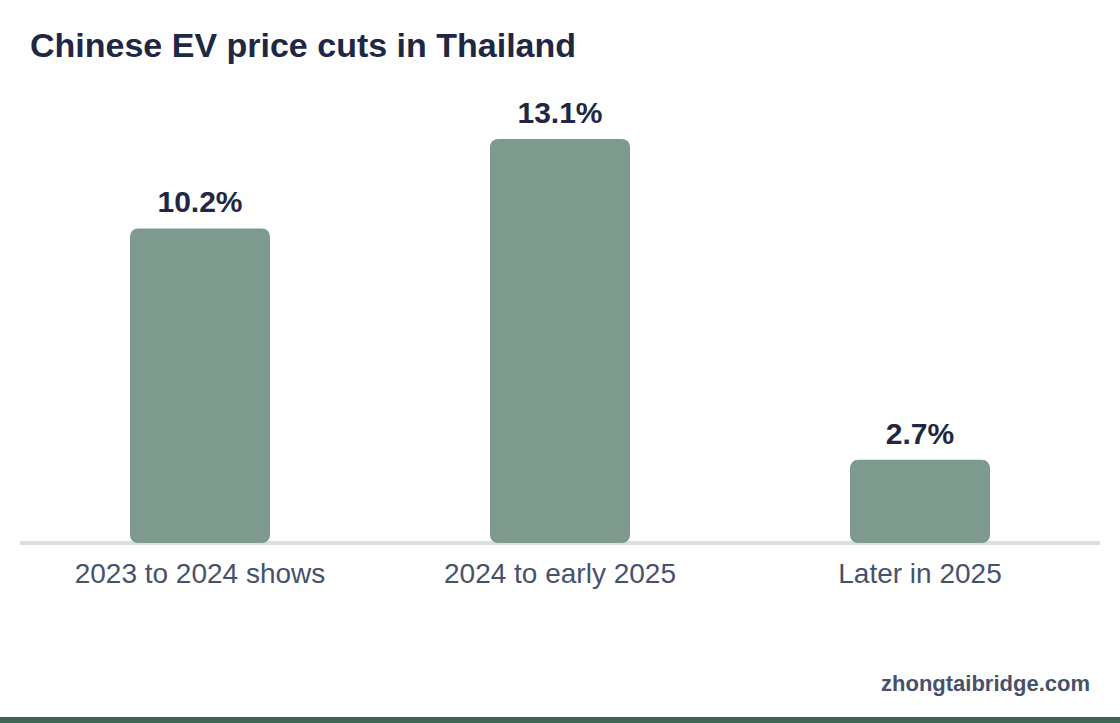
Column chart. 2023 to 2024 shows: 10.2%; 2024 to early 2025: 13.1%; Later in 2025: 2.7%
A four-week recovery plan
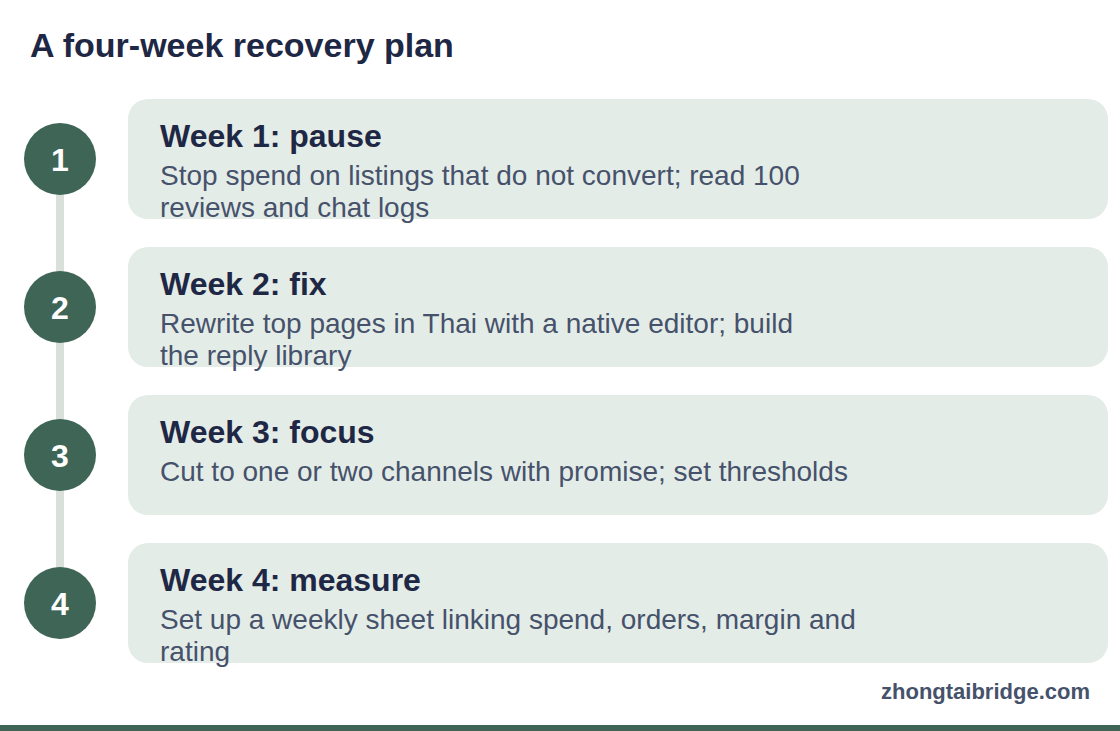
Process diagram. 1. Week 1: pause: Stop spend on listings that do not convert; read 100 reviews and chat logs. 2. Week 2: fix: Rewrite top pages in Thai with a native editor; build the reply library. 3. Week 3: focus: Cut to one or two channels with promise; set thresholds. 4. Week 4: measure: Set up a weekly sheet linking spend, orders, margin and rating.
Recovery usually takes weeks, not months, if you address the largest bottleneck first. Resist the urge to spend your way out before the page converts.
The example is illustrative. A Chinese brand launched on two marketplaces and a social channel with translated pages and agency creators. Conversion was weak and returns high. In the first month it paused ads on weak listings, read 100 reviews and found that sizing and delivery times were the main complaints. In the second month it rewrote the pages with native editors, added size guides and a delivery promise and set chat response targets. In the third month it consolidated to one marketplace and a LINE account, set a weekly dashboard and resumed ads only on listings that met thresholds.
Conversion rose, returns fell and cost per order dropped. The brand did not need a new product. It needed to fix the playbook.
How do we check whether we are making these mistakes? Run the diagnostic table with your team and compare your data with thresholds, then ask a native reviewer to audit your pages and chat.
Which mistake is the cheapest to fix? Rewriting Thai product pages and chat scripts with native editors usually pays back quickly.
Which is the hardest? Policy and price shocks, because they require scenario planning and local value-building.
Should we stop advertising until the page is fixed? Pause spend on weak listings, fix, and restart with small budgets.
Scaling advertising before the product page converts. It multiplies every other weakness.
Many can be fixed with a clear process and native-speaking support. An outside diagnostic often saves time.
Compare actual conversion, cost per order, margin, rating and return rate with the thresholds from your feasibility model.
Yes, in different forms: copying China's sales model, no Thai-language materials, relying on one distributor and ignoring policy risk.
Sources
A practical plan for how, where and when to launch.
 Market Entry
A six-stage guide for Chinese companies entering Thailand, with 2026 market data, a China-to-Thailand translation table, a 90-day plan and a launch checklist.
Read article → Market Entry
What a Thailand feasibility study includes, with a worked landed-cost example, scenario design, a go, adjust or stop rule and the warning signs that kill a plan.
Read article → Market Entry
Compare Thailand's four entry models on speed, margin, control and capital, with a decision matrix, an 18-month sequence and the mistakes to avoid when choosing.
Read article →Tell us about your business and goals.
We'll reply within 1–2 business days with next steps.