
How Chinese Companies Can Enter the Thai Market: A Step-by-Step Guide
A six-stage guide for Chinese companies entering Thailand, with 2026 market data, a China-to-Thailand translation table, a 90-day plan and a launch checklist.
Read article →Market Entry

Photo: Unsplash
Short answer
Marketplace-first gives the fastest learning, an owned site with chat commerce gives the most control, distributors add reach at the cost of margin, and partnerships add capability at the cost of control. Most consumer brands sequence the models instead of choosing one.
Four entry models compared
| Model | Speed | Margin kept | Control | Capital |
|---|---|---|---|---|
| Marketplace-first | Fast | Medium, after fees | Medium | Low to medium |
| Owned site plus chat commerce | Slow | High | High | Medium |
| Distributor or retail partner | Medium | Low | Low | Low to medium |
| Local partnership or JV | Slow | Shared | Shared | Medium to high |
The right choice depends on how much you value speed, margin, control and learning, and on the resources you can commit. The comparison gives a starting point.
Your first sales infrastructure is a store on Shopee, Lazada or TikTok Shop. You use the platform's traffic, payment, logistics and buyer-protection tools while you learn what Thai shoppers buy and at what price. Momentum Works estimates that platforms account for about 85% of Southeast Asian e-commerce value, with brand websites, multi-brand retailers and social commerce making up the rest. In Thailand, platform e-commerce reached US$35.5 billion in 2025.
Where Southeast Asian e-commerce happens
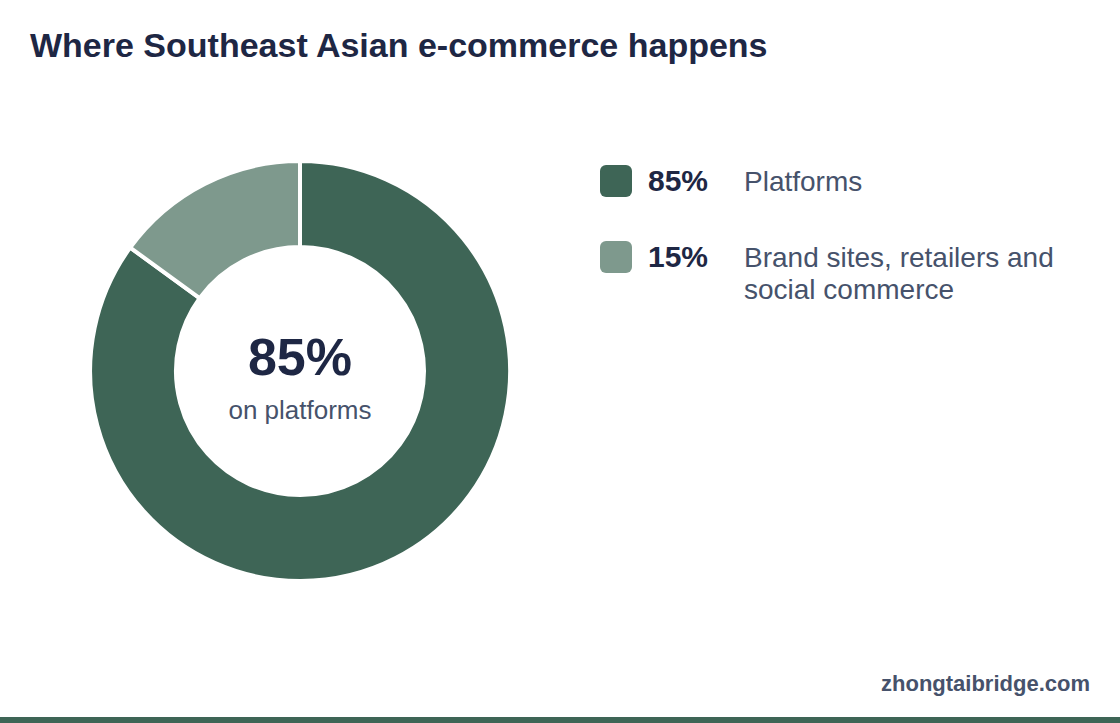
Donut chart. Platforms: 85%; Brand sites, retailers and social commerce: 15%
The advantages are speed and low fixed cost. The costs are commission and fees, price comparison that pushes margins down, and limited access to customer relationships. Marketplace-first suits products that are easy to describe, easy to ship and supported by demand evidence.
An owned store gives you control of brand, pricing, data and the customer journey. The cost is acquiring every visitor yourself. In Thailand a website works best when paired with chat, because many shoppers ask questions on LINE or Messenger before paying. LINE reaches about 56 million monthly users and Messenger about 55.8 million accounts, so chat is the natural closing channel.
A practical set-up includes Thai pages built for search, a LINE Official Account with a clear rich menu, PromptPay and other local payment methods, and a plain-Thai returns policy. Choose this model when your brand story matters, your price sits above the marketplace norm or your category depends on advice and trust.
A distributor imports, stores and sells to retailers. A retail partner places your product in stores. Thai modern retail is concentrated: CP All operated 15,945 7-Eleven stores at the end of 2025, and Central Group leads larger formats, while provision stores remain the leading FMCG channel. Reaching that structure alone would take years.
Before signing, define territory, exclusivity tied to performance, minimum volumes, pricing floors, brand-use rules, marketing duties, data sharing and exit terms. A weak distributor can freeze a brand for years, so make exclusivity conditional.
A partner brings relationships, operations and credibility, and can accelerate access to retailers or large buyers. It also raises governance questions about pricing, product changes, brand voice, spending and profit sharing. Start with a smaller commercial agreement, such as a pilot distribution contract, before entering a structure that is hard to unwind. Take advice from qualified legal and tax professionals on structure and licensing.
Where each model sits
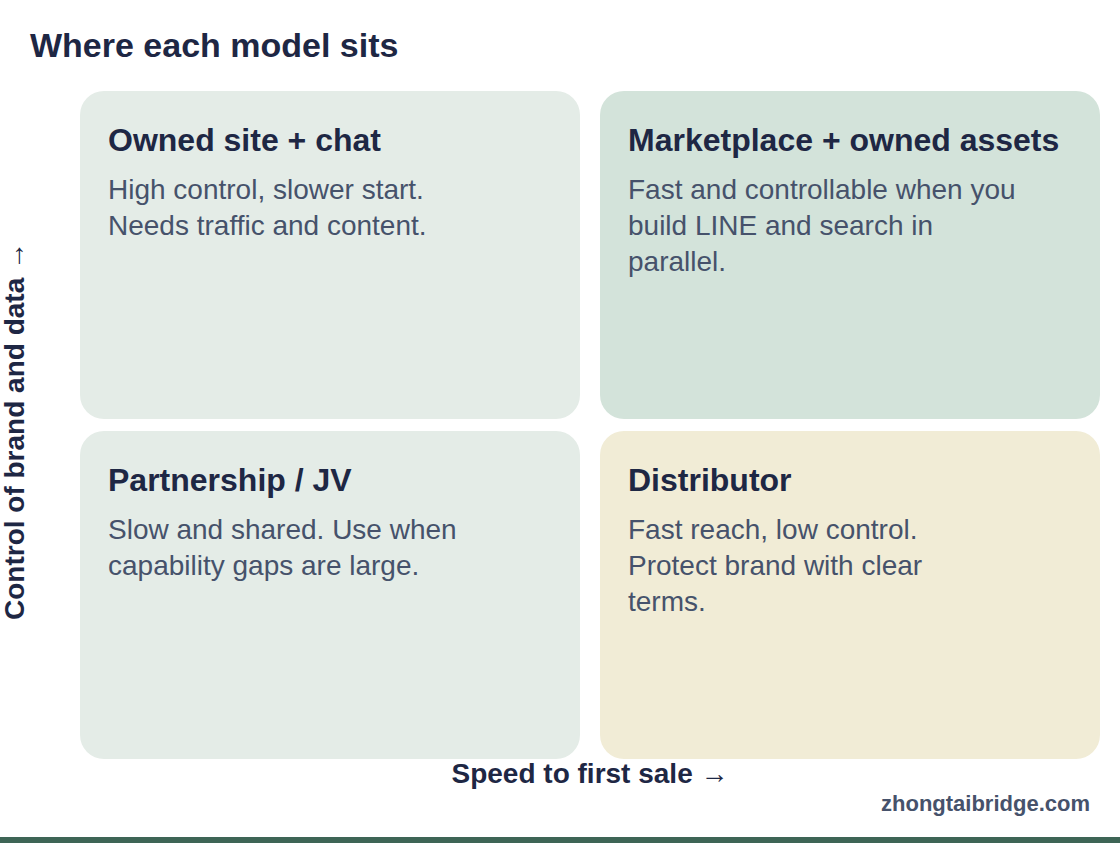
Two-by-two matrix. Horizontal axis: Speed to first sale. Vertical axis: Control of brand and data. Owned site + chat: High control, slower start. Needs traffic and content.. Marketplace + owned assets: Fast and controllable when you build LINE and search in parallel.. Partnership / JV: Slow and shared. Use when capability gaps are large.. Distributor: Fast reach, low control. Protect brand with clear terms..
Score each model from 1 to 5 against speed, margin, control, capital, workload, learning and fit with your product's need for education or service. The aim is to make trade-offs visible to everyone involved.
An 18-month sequence for a consumer brand
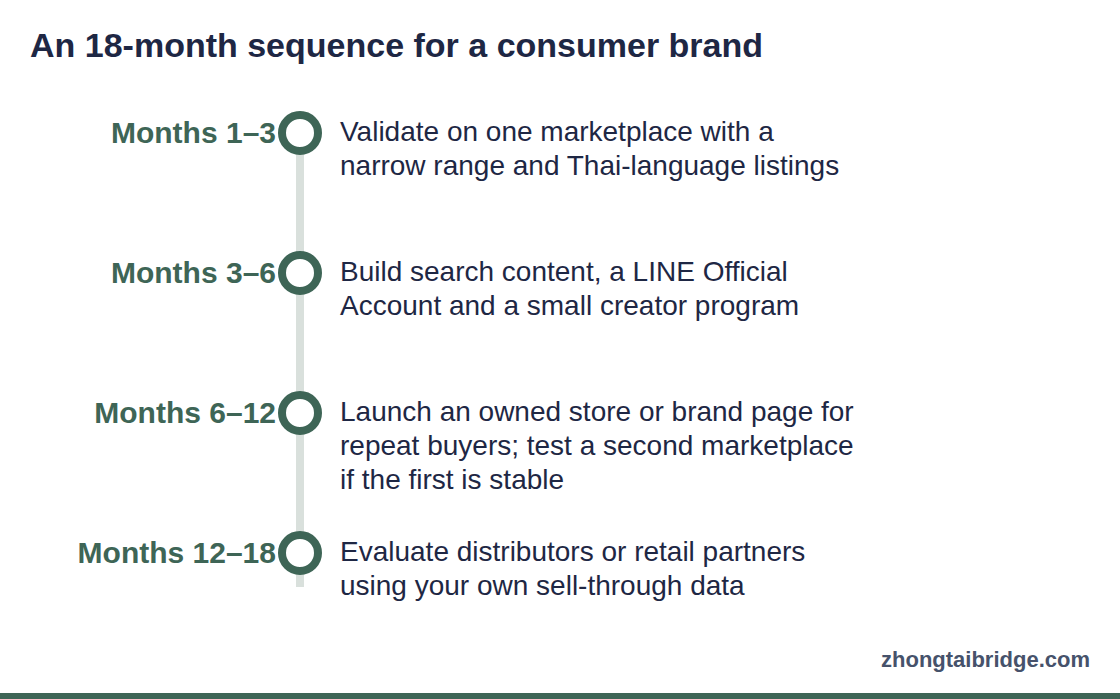
Timeline. Months 1–3: Validate on one marketplace with a narrow range and Thai-language listings. Months 3–6: Build search content, a LINE Official Account and a small creator program. Months 6–12: Launch an owned store or brand page for repeat buyers; test a second marketplace if the first is stable. Months 12–18: Evaluate distributors or retail partners using your own sell-through data.
Add a model only when the previous one is stable and you know exactly what the new one must prove. Resist copying competitors' channel lists.
From 1 January 2026, Thailand taxes online imports from the first baht, with Shopee, Lazada, TikTok Shop, SHEIN and Temu collecting at checkout, after VAT on low-value parcels began in February 2025. Direct parcels from China therefore lose a large part of their former price advantage. Model both direct shipping and local stock before choosing, using the landed cost and chargeable weight calculators.
The example is illustrative. The brand starts on one marketplace with three products and Thai-language listings. It builds a LINE account from marketplace buyers and publishes search content on compatibility questions. After six months, it sees repeat purchase on a refill product and a strong review base, so it launches an owned store for bundles and subscriptions. After twelve months, a distributor approaches with access to electronics retailers, and the brand negotiates a pilot in one region with performance-based exclusivity. It maintains marketplace and owned channels, so that the distributor does not control pricing.
At each step, the brand adds a model only when the previous one has proven stable. The sequence reduces risk, builds assets that the brand owns and keeps options open.
Which model is best for a B2B firm? Often a distributor or partner model with a few direct key accounts, but it depends on service requirements and customer concentration.
Can we combine models from day one? Yes, but only if you have the resources. Otherwise sequence them.
How do we protect our brand with distributors? Use written brand rules, approval rights, performance conditions and termination rights.
When should we consider local production? When volume, lead times, incentives and customer expectations justify it. Test demand first.
Executives often frame entry as a choice between wholly owned, joint venture and agent or distributor models. The Thai context adds questions about ownership rules in some sectors, licensing, local content and brand control, which should be answered by qualified advisers for your activity. For consumer brands, the more relevant decision is often channel-led: marketplace-first, owned site plus chat, distributor or partnership, and the order in which you add them.
Key terms explained
| Term | Meaning | Why it matters |
|---|---|---|
| Wholly owned subsidiary | A local company fully owned by the foreign parent | Company fully owned by the foreign investor |
| Joint venture | A company owned jointly with a local partner | Shared ownership with a local partner |
| Distributor | A partner that buys your goods and resells them in a territory | Buys and resells in a territory |
| Agent | A party that sells on the brand's behalf for commission | Sells on behalf of the brand for commission |
| Marketplace-first | Starting on Shopee, Lazada or TikTok Shop before other channels | Start on Shopee, Lazada or TikTok Shop |
| Owned channel | A channel the brand controls, such as its website or LINE account | Own website, app, LINE account |
Questions to settle before choosing a structure
| Question | Who to ask |
|---|---|
| Does my activity have ownership or licensing limits? | Qualified Thai counsel |
| How will tax and VAT apply to my model? | Tax adviser |
| What control do I need over brand, price and data? | Your leadership team |
| What local capability am I missing? | Your operating plan and partners |
| What is the exit path if it fails? | Legal and finance |
Pitfalls and containment by model
| Model | Common pitfall | Containment |
|---|---|---|
| Marketplace-first | Price war and thin margin | Differentiate with bundles, content and service; track contribution margin |
| Owned site plus chat | No traffic | Build search content, LINE and creators before heavy site investment |
| Distributor | Loss of brand control | Written brand rules, approval rights, performance-based exclusivity |
| Partnership or JV | Governance conflict | Define decision rights, funding and exit terms up front |
Containment is cheaper before launch than after. Write the controls into the plan and contracts, and review them at each stage gate.
A short memo helps leadership choose. Include the objective, the options considered, the evaluation criteria and weights, the scores and the recommended sequence with dates. Add the key assumptions and the evidence for each, the risks and mitigations, and the decision needed. State what would change the recommendation, for example a change in duty, a platform fee increase or a failed pilot threshold. Attach the scorecard and the financial model so that the board can test the logic. Keep the memo to two pages, with appendices for detail.
After approval, track the plan against the memo each quarter. If conditions change, update the memo rather than silently drifting from it, so that the organization learns how its assumptions held up.
The example is illustrative. A consumer brand weights five criteria: speed to first sale 30%, margin kept 20%, control of brand and data 20%, capital required 15% and workload 15%. It scores each model from 1 to 5. Marketplace-first scores 5, 3, 3, 4 and 3, for a weighted total of 3.85. An owned site with chat commerce scores 2, 5, 5, 3 and 2, for 3.45. A distributor scores 4, 2, 2, 4 and 5, for 3.55. A partnership or joint venture scores 2, 3, 3, 2 and 3, for 2.60. The result supports marketplace-first as the starting model, with the owned site as a second step to build control and margin, and distributors considered after proof. The numbers are less important than the discussion they trigger about what the company values most.
Illustrative budget phasing by model
| Period | Main model | Typical share of 18-month budget |
|---|---|---|
| Months 1–3 | Marketplace pilot | 20% |
| Months 4–6 | Search, LINE and creator foundations | 20% |
| Months 7–12 | Owned store and second marketplace | 30% |
| Months 13–18 | Distributor or partner pilots | 30% |
Release the next tranche only when thresholds from the previous phase are met. Phasing protects the company from committing the entire budget before it has evidence.
Triggers for moving to the next model
| From | To | Trigger |
|---|---|---|
| Marketplace pilot | Search and LINE assets | Conversion and margin meet thresholds for two consecutive months |
| Marketplace plus owned assets | Owned store | Repeat purchase and brand search are growing; chat volume justifies a site |
| Owned channels | Distributor or retail pilot | Sell-through data supports a negotiation; supply and service can handle scale |
| Any model | Partnership or JV | A clear capability gap that partners can fill with defined governance |
Resist adding a model because competitors have it. Add it when your data show that the previous model is stable and that the new model solves a specific constraint.
Before you sign with a platform, distributor or partner, ask what happens if sales are below plan, who owns customer data, how pricing is controlled, what the exit terms are, how disputes are resolved and which local laws govern the agreement. Ask for references, and speak to at least one existing customer or brand. Ask what support you will receive in the first 90 days and how success will be measured. Take advice from qualified Thai legal and tax professionals on structure, licensing and liability, because the model that looks simple commercially may carry obligations that you do not see at first glance.
Not always. Some marketplace routes and distributor models allow you to start without one, but requirements and tax treatment vary. Take professional advice before you choose a structure.
Not necessarily. A distributor lowers your workload but takes margin. Compare total cost to serve, not only unit price.
When the current channel has stable conversion, positive contribution margin and a team that can handle the extra workload.
Usually a marketplace, because traffic and logistics already exist.
Sources
A practical plan for how, where and when to launch.
 Market Entry
A six-stage guide for Chinese companies entering Thailand, with 2026 market data, a China-to-Thailand translation table, a 90-day plan and a launch checklist.
Read article → Market Entry
What a Thailand feasibility study includes, with a worked landed-cost example, scenario design, a go, adjust or stop rule and the warning signs that kill a plan.
Read article → Market Entry
Seven costly mistakes Chinese brands make entering Thailand, from copying China playbooks to price-war exposure, with a diagnostic table and a recovery plan.
Read article →Tell us about your business and goals.
We'll reply within 1–2 business days with next steps.