Thai Localization vs Translation: What Chinese Brands Must Adapt
By ZhongTai Bridge Editorial · Last reviewed October 2026 · 5 min read
Photo: Unsplash
Short answer
Translation converts words. Localization adapts the whole experience: language and tone, names, formats, payments, visuals and service. Thai shoppers notice the difference, and so do search systems, since Google handles about 99.5% of Thai searches and rewards native, useful pages.
What is the difference between translation and localization?
Translation versus localization
Translation
Localization
Goal
Convert words from one language to another
Make the experience feel native to Thai buyers
Scope
Text
Text, tone, names, formats, payments, visuals, service
Who does it
Translator
Native writer, editor, designer, support team
Typical result
Accurate but stiff copy
Natural copy, higher trust and conversion
Search effect
Misses real Thai queries
Built around Thai keywords and intent
A translated product page may be technically correct and still fail. It uses terms no Thai shopper types, tones that feel stiff or odd, and visuals that signal a foreign product. Localization starts from the Thai buyer's question and works backward to the page.
What language elements need adapting?
Thai has levels of formality and polite particles that signal respect. Customer-facing text normally uses a warm, polite and clear register. Overly formal language feels distant, and overly casual language can look careless for a new brand. A native editor chooses the register by audience and channel and records the decisions in a style guide.
Search terms matter as much as tone. Thai is written without spaces between words, and buyers mix Thai, English and Thai spellings of brand names. Product names, benefits and category words should come from real Thai queries, reviews and marketplace suggestions, not from a dictionary. Claims, humor and idioms that work in Chinese often do not carry over, and some need to be rebuilt from scratch.
Which formats, units and details change?
Currency in baht, with tax-inclusive prices stated clearly. VAT is currently charged at a reduced 7% until 30 September 2027.
Dates: Thailand's official calendar uses the Buddhist Era, so 2026 is 2569, which can appear on documents and labels.
Sizes and units, with size charts suited to Thai customers.
Address formats with district and province, and delivery options familiar to Thai buyers.
Warranty, return and privacy text in plain Thai.
How do payments and service change the experience?
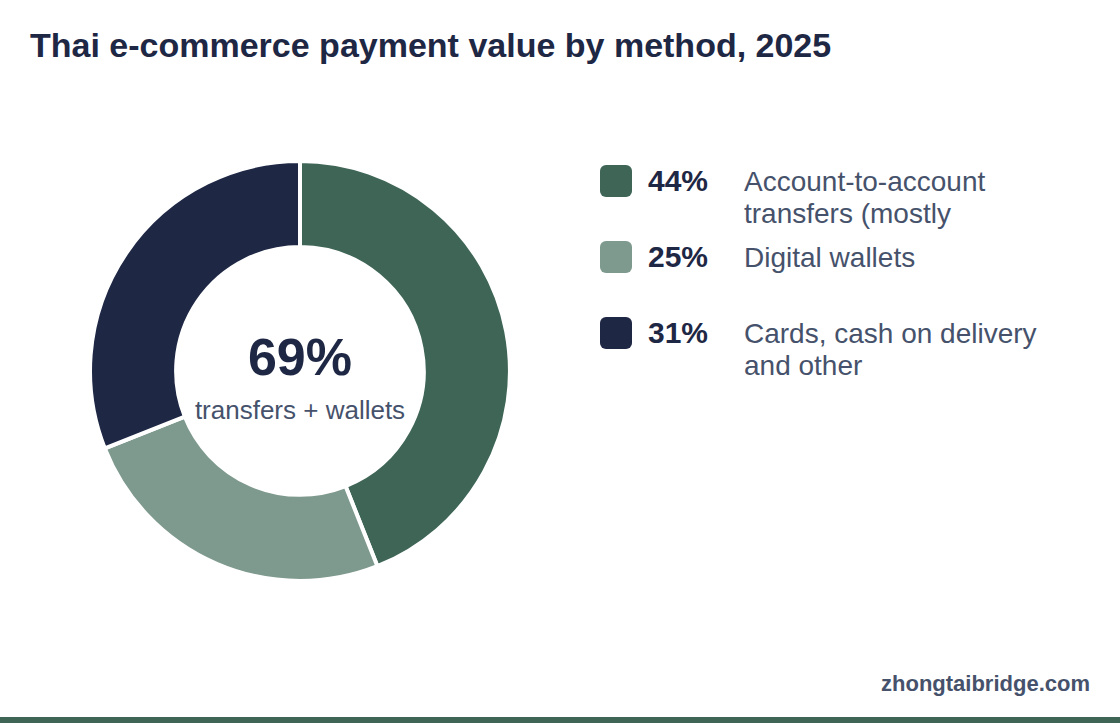
Thai e-commerce payment value by method, 2025
Donut chart. Account-to-account transfers (mostly PromptPay): 44%; Digital wallets: 25%; Cards, cash on delivery and other: 31%
Remainder derived from the two reported shares. Source: Worldpay data via Antom.
Payment localization is part of the product. PromptPay had more than 81 million registrations by March 2025 and handled over two billion transactions a month, and about 61.5% of the population used QR codes monthly in 2024. Cards remain relevant for travel, international purchases and premium goods, and cash on delivery is offered on many marketplaces. A checkout that ignores these habits loses orders even when the page is perfect.
Service must be local too. Provide support in Thai on LINE, Messenger and marketplace chat, with scripted replies and response targets. Thai buyers often ask questions before they pay, and the reply is part of the brand.
How should visuals be adapted?
Use imagery, models and settings that reflect Thai customers and homes. Check colors, symbols and gestures for local meaning, and check packaging text for legibility and required information. Avoid copying competitor images, and invest in clear photography that shows scale and use. For video, add Thai voiceover or subtitles written by a native speaker, and use local creators where possible.
A localization audit and workflow
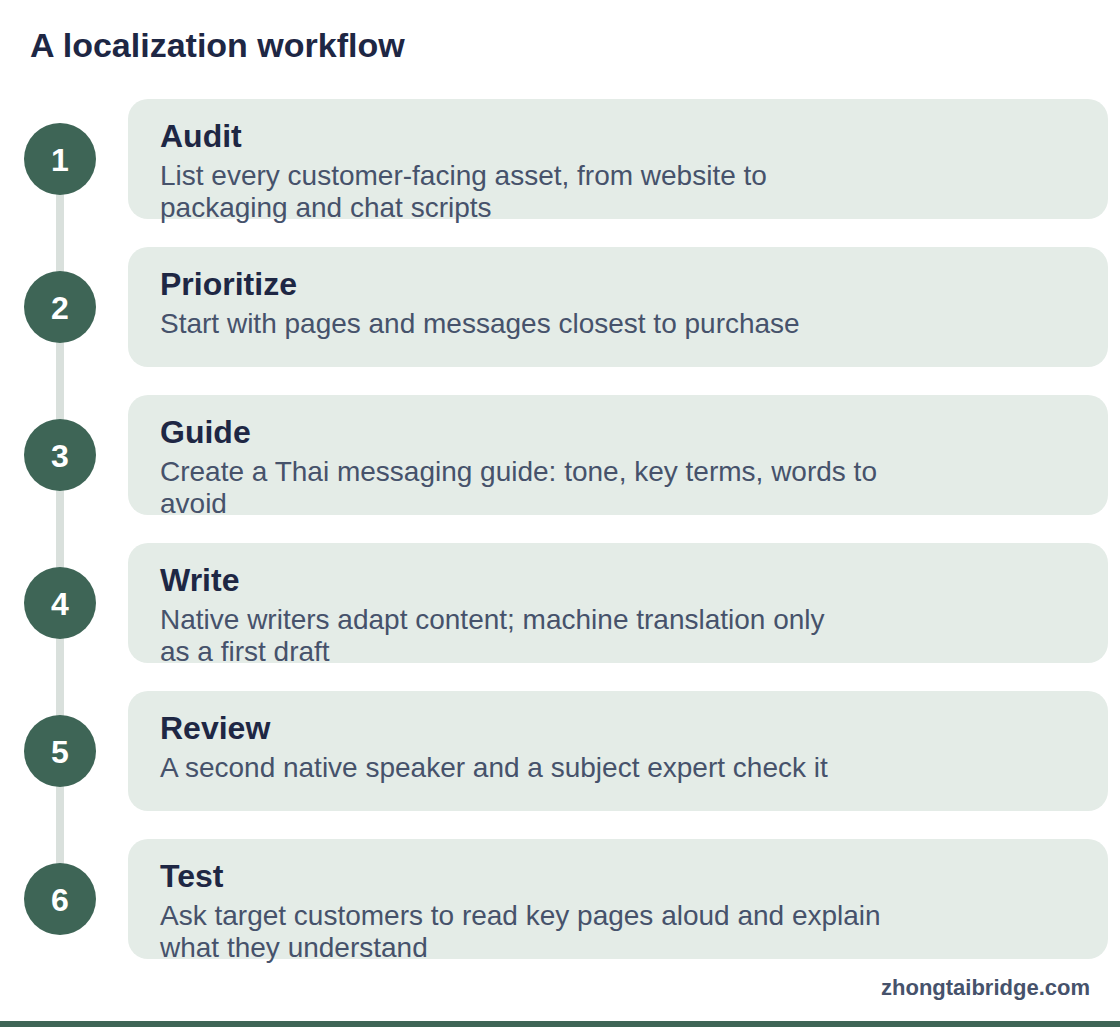
A localization workflow
Process diagram. 1. Audit: List every customer-facing asset, from website to packaging and chat scripts. 2. Prioritize: Start with pages and messages closest to purchase. 3. Guide: Create a Thai messaging guide: tone, key terms, words to avoid. 4. Write: Native writers adapt content; machine translation only as a first draft. 5. Review: A second native speaker and a subject expert check it. 6. Test: Ask target customers to read key pages aloud and explain what they understand.
Score each asset as ready, needs edit or needs rebuild. Build a glossary of approved product and brand terms and share it with every agency and creator.
How do you test localized content?
Ask five to ten target customers to read your key pages aloud and explain what they understand. Note hesitations, misreadings and words they would replace. Run a small A/B test on titles or headlines, and update the glossary with confirmed terms. Measure the effect on conversion, bounce rate and support questions, because a localized page should reduce the number of questions customers need to ask.
A worked example: before and after on a product page
The example is illustrative. A Chinese smart-home brand's translated page described its product with a literal translation of a Chinese slogan and listed specifications without context. Native editors rebuilt the page: the title used the term Thai shoppers search for, the first paragraph answered the main buyer question in plain Thai, the specifications were explained in terms of use, and the page included a short FAQ about installation, compatibility and warranty. The images showed the product in a Thai apartment, and the checkout offered PromptPay and cards. The chat team received scripts for the five most common questions.
The team measured conversion, bounce rate and chat questions before and after. A drop in basic questions and an increase in conversion showed that the page was doing its job. The example shows that localization is a measurable improvement, not a cosmetic one.
Governance for ongoing localization
Appoint one native editor as the owner of Thai quality.
Maintain a glossary and style guide, updated monthly.
Review high-traffic pages quarterly.
Track support questions to find confusing content.
Re-localize when product features or regulations change.
Executive questions on localization
Is localization worth the cost for a small range? Yes for the pages closest to purchase, because conversion and trust improve. Start small and expand.
Who should lead it? A native editor with authority to reject unnatural copy, supported by marketing and customer service.
Can we use AI for first drafts? Yes as a draft, but human editing is required for tone, accuracy and compliance.
How do we know localization worked? Compare conversion, bounce rate, support questions and review comments before and after.
Frequently asked questions
Can I use machine translation?
Only as a draft. Always have a native speaker edit and approve the final text.
What should I localize first?
Start with product pages, key marketing messages, checkout and customer service scripts.
How long does localization take?
A focused set of core pages can be done in a few weeks. Larger asset sets take longer.
Does localization affect SEO?
Yes. Native Thai pages built from Thai keyword research rank and convert better than translated pages.
How to test a brand name for Thailand: pronunciation, unintended meanings, spelling variants, trademark and domain checks, search impact and a scoring matrix.
How to hire a Thai–Chinese business interpreter: consecutive vs simultaneous modes, team and equipment, a briefing checklist, quality checks and common mistakes.
A six-stage guide for Chinese companies entering Thailand, with 2026 market data, a China-to-Thailand translation table, a 90-day plan and a launch checklist.