
How Chinese Companies Can Enter the Thai Market: A Step-by-Step Guide
A six-stage guide for Chinese companies entering Thailand, with 2026 market data, a China-to-Thailand translation table, a 90-day plan and a launch checklist.
Read article →Market Entry

Photo: Unsplash
Short answer
A Thai-speaking employee advertised at RMB 15,000 a month in a tier-one Chinese city costs about RMB 288,000 in the first year once 13-month pay, 30% employer social insurance and housing fund, and a 20% recruitment fee are included. A dedicated on-demand professional billed near the advertised monthly salary costs around 30% less in year one, starts in days rather than weeks, and needs no work permit in China.
Chinese companies post a steady stream of jobs for Thai speakers: interpreters, translators, operations staff, customer service agents and sales coordinators. In a sample of 47 public posts on Chinese job boards in October 2026, more than half were translation or interpreting roles, advertised mostly between RMB 5,000 and RMB 15,000 a month, with operations roles reaching RMB 18,000. Many posts also promised 13, 14 or even 16 months of pay a year. The advertised salary is only the starting point of what the employer pays.
Four costs sit on top of the monthly salary. First, extra months: many posts offer 13 to 16 months of pay. Second, the employer share of social insurance and the housing provident fund: payroll specialists put it at roughly 30% to 35% on top of gross salary in a tier-one city, with pension alone at about 16%. Third, recruitment: agencies in China generally charge 15% to 25% of the annual salary for a permanent hire. Fourth, time: an average time-to-hire of about 38 days has been reported for China, and a foreign hire also needs a work permit and visa before starting.
First-year cost of a Thai-speaking role in a tier-one city (model)
| Cost item | RMB 12,000 role | RMB 15,000 role | RMB 20,000 role |
|---|---|---|---|
| Salary, 13 months | 156,000 | 195,000 | 260,000 |
| Employer social insurance and housing fund (30% of 12 months) | 43,200 | 54,000 | 72,000 |
| Recruitment fee (20% of annual salary) | 31,200 | 39,000 | 52,000 |
| First-year total | 230,400 | 288,000 | 384,000 |
| Effective monthly cost | 19,200 | 24,000 | 32,000 |
The model is conservative. It leaves out the weeks of vacancy before the person starts, onboarding and training time, office space and equipment, management time, annual leave cover and the cost of replacing someone who leaves.
Year-one cost of a RMB 15,000 Thai-speaking role (RMB)
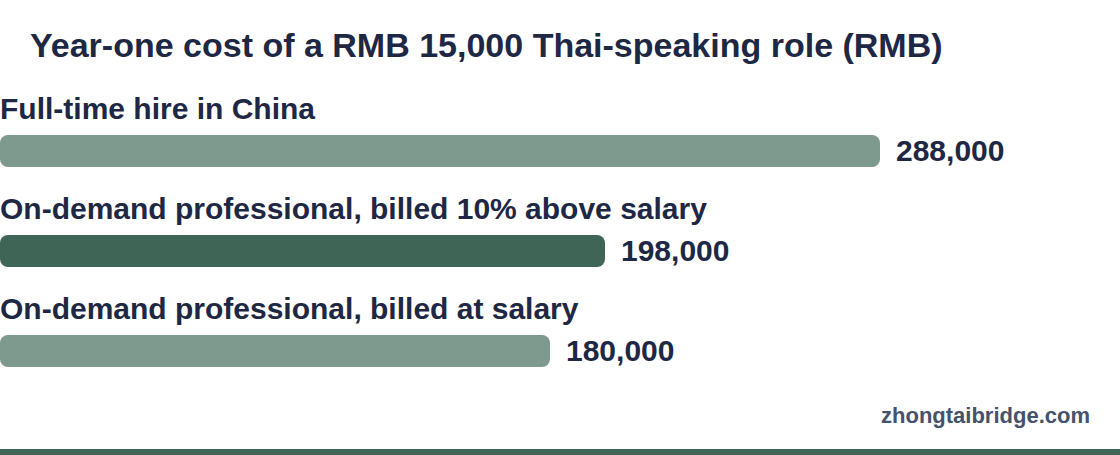
Horizontal bar chart. Full-time hire in China: 288,000; On-demand professional, billed 10% above salary: 198,000; On-demand professional, billed at salary: 180,000
With an on-demand model, the client pays one monthly fee for a dedicated professional, and the provider carries recruitment, employment costs, training and replacement. Even when that fee is 10% above the advertised salary, the client's first-year cost is about 31% lower than a full-time hire, and 37.5% lower if billed at the salary level. From the second year, when there is no recruitment fee, the saving narrows to roughly 20% to 28%. When the work is part-time, seasonal or project-based, the saving grows, because the client pays only for the capacity used.
Thai–Chinese professionals based in Thailand are typically advertised at THB 30,000 to 50,000 a month for interpreting and translation roles, with some industrial roles up to THB 65,000. A provider can therefore pay competitive local salaries, verify language and subject skills, add quality checks and still price below the full cost of a hire in a Chinese city. The work suits remote delivery for translation, localization, marketplace operations, content and customer service, and on-site delivery in Thailand for meetings, factory visits, inspections and events.
Many companies combine both: a permanent coordinator in China and on-demand professionals for peaks, projects and work in Thailand.
Payroll specialists estimate the employer share of social insurance and the housing fund at roughly 30% to 35% of gross salary in tier-one cities, before recruitment, extra months of pay and training.
In our model of a RMB 15,000 role, about 30% to 38% in the first year for a dedicated full-time equivalent, and more when the workload is part-time or seasonal.
Not for remote work from Thailand or on-site work in Thailand. Work on site in China requires the appropriate visa and permit, arranged case by case.
Many providers, including us, support a transition to a permanent hire when the workload justifies it.
Sources
Verified Thai–Chinese professionals for interpreting, translation, operations and customer service, without recruiting, training or visa waits.
 Market Entry
A six-stage guide for Chinese companies entering Thailand, with 2026 market data, a China-to-Thailand translation table, a 90-day plan and a launch checklist.
Read article → Market Entry
What a Thailand feasibility study includes, with a worked landed-cost example, scenario design, a go, adjust or stop rule and the warning signs that kill a plan.
Read article → Market Entry
Compare Thailand's four entry models on speed, margin, control and capital, with a decision matrix, an 18-month sequence and the mistakes to avoid when choosing.
Read article →Tell us about your business and goals.
We'll reply within 1–2 business days with next steps.