
How Chinese Companies Can Enter the Thai Market: A Step-by-Step Guide
A six-stage guide for Chinese companies entering Thailand, with 2026 market data, a China-to-Thailand translation table, a 90-day plan and a launch checklist.
Read article →Market Entry

Photo: Unsplash
Short answer
Chinese employers post Thai-language roles across interpreting, operations, sales, logistics and finance, and many will post staff to Thailand or accept Thai nationals who speak Chinese. Define the role and language level, source from boards and networks, screen with language and subject tests and benchmark pay against public posts. Take legal advice on work permits and hiring rules.
A review of public posts on BOSS Zhipin, Liepin, Zhaopin, 51job, the national student jobs platform and two Chinese-language boards based in Thailand found 47 posts seeking Thai speakers or Thailand-related roles in October 2026. The sample is limited to what these boards show publicly and is not a count of the market, but it reveals clear patterns.
What employers seek in 47 Thai-related posts
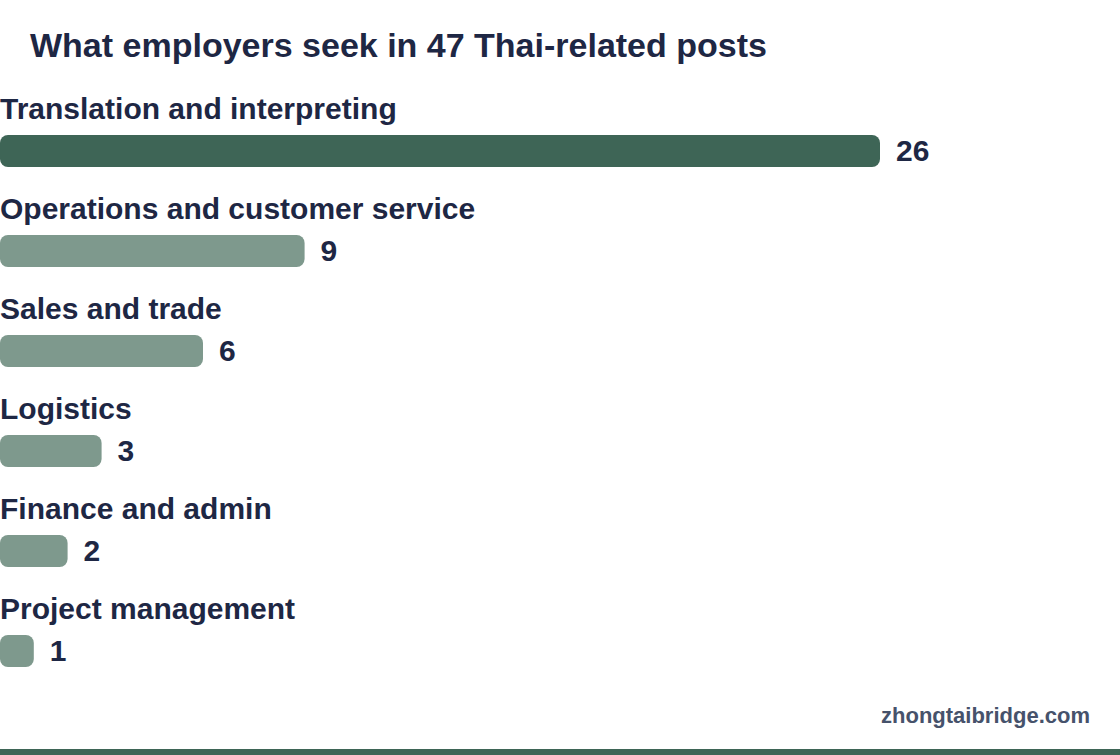
Horizontal bar chart. Translation and interpreting: 26; Operations and customer service: 9; Sales and trade: 6; Logistics: 3; Finance and admin: 2; Project management: 1
Employers are mostly industrial and trading firms in machinery, steel, auto parts, construction and electronics, plus game and content companies, cross-border logistics firms and e-commerce platforms. Several describe the role as posting to Thailand, and two employers, a machinery company in Suzhou and a logistics firm in Shenzhen, say they also accept Thai nationals who speak Chinese.
Typical Thai-speaking roles and what posts ask for
| Role | Typical tasks in posts | Seen pay (China-based posts, per month) |
|---|---|---|
| Translator or interpreter | Documents, drawings, meetings, accompanying, training sessions | RMB 5K to 12K |
| Operations and customer service | User support, product operations, app promotion | RMB 6K to 18K |
| Trade and sales | Developing Thai customers, trade orders | RMB 4K to 15K |
| Logistics and freight | Customer service, forwarding, branch roles | RMB 10K to 15K for some posted roles |
| Finance and admin | Accounting, tax, local paperwork | RMB 6K to 8K |
Pay figures are what employers advertise, not what hires accept, and they vary by city, experience and employer size. Use them as a starting benchmark, not as a rule.
Start with the tasks. A factory interpreter needs technical vocabulary, patience and the ability to work between managers and operators. A customer service role needs polite, natural Thai and quick writing. A sales role needs commercial judgment and the ability to hold a negotiation. For each role, define the language levels required in listening, speaking, reading and writing for both Thai and Chinese, and whether English is needed. Also decide where the person will work, because posting to Thailand has different requirements from working in China.
Write job posts in both languages, state the tasks, location, language level and pay range, and avoid vague requirements.
A four-stage screening process
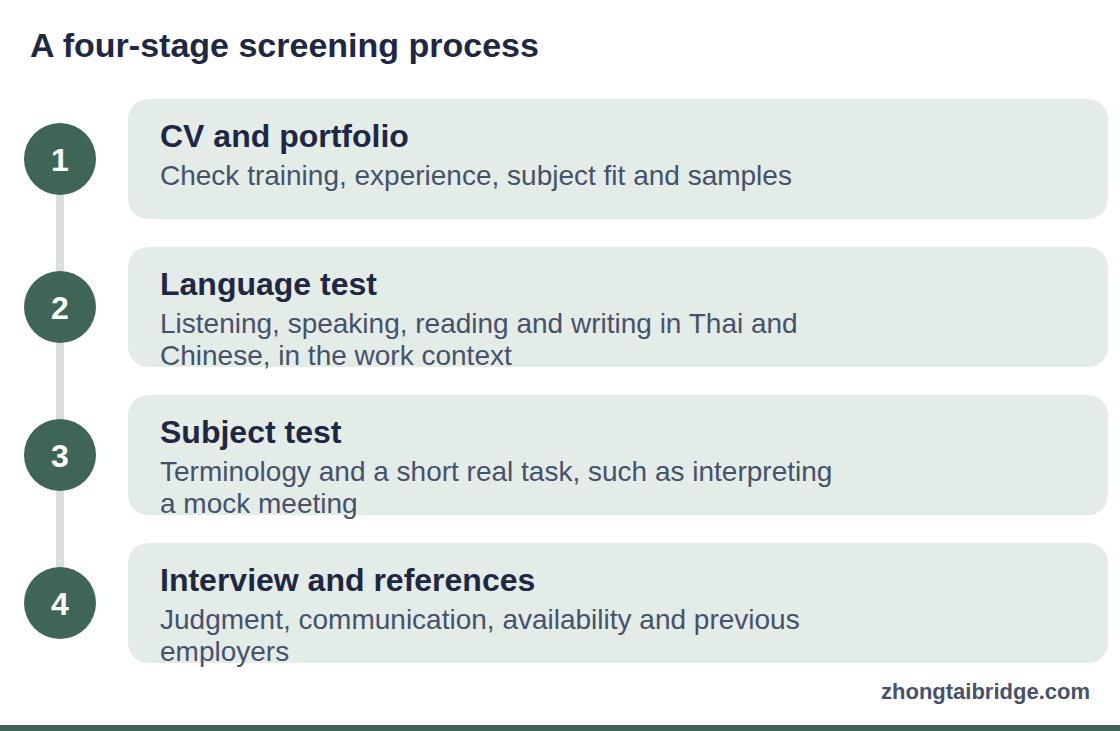
Process diagram. 1. CV and portfolio: Check training, experience, subject fit and samples. 2. Language test: Listening, speaking, reading and writing in Thai and Chinese, in the work context. 3. Subject test: Terminology and a short real task, such as interpreting a mock meeting. 4. Interview and references: Judgment, communication, availability and previous employers.
Use a native Thai speaker or an experienced bilingual professional to assess language quality, because a hiring manager who does not speak Thai cannot judge nuance. For interpreters, test with a glossary and a role-play. For operations roles, test writing speed and tone with a sample customer message.
Hiring a foreign national in Thailand or China, or posting your staff abroad, involves work permit, visa, social insurance and tax rules, and some employers state that a role does not need a work visa while others offer visa support. These rules change and depend on nationality, role and company structure, so obtain advice from qualified local counsel before you make an offer. Recruitment services themselves may be regulated in each country, so check licensing requirements before you charge fees for placement.
If you need interpreting only for negotiations, audits or events, an experienced contract interpreter is usually more cost-effective and of higher quality than a full-time hire. If you need daily communication across a factory or office, hire. Many companies combine both: a permanent bilingual coordinator and contract interpreters for high-stakes sessions.
In the sample reviewed, translation and interpreting roles made up more than half of the posts, followed by operations, sales, logistics and finance.
Some do. Two employers in the sample said they accept Thai nationals who speak Chinese, and others post Chinese staff to Thailand. Check each employer's requirements and the legal rules for the role.
Posts reviewed advertised about RMB 5,000 to 12,000 a month for China-based translator and interpreter roles. Pay varies by city, experience and employer.
Work permits and employment contracts should be handled by qualified local counsel. We can coordinate with your advisers.
Sources
Verified Thai–Chinese professionals for interpreting, translation, operations and customer service, without recruiting, training or visa waits.
 Market Entry
A six-stage guide for Chinese companies entering Thailand, with 2026 market data, a China-to-Thailand translation table, a 90-day plan and a launch checklist.
Read article → Market Entry
What a Thailand feasibility study includes, with a worked landed-cost example, scenario design, a go, adjust or stop rule and the warning signs that kill a plan.
Read article → Market Entry
Compare Thailand's four entry models on speed, margin, control and capital, with a decision matrix, an 18-month sequence and the mistakes to avoid when choosing.
Read article →Tell us about your business and goals.
We'll reply within 1–2 business days with next steps.