
How Chinese Companies Can Enter the Thai Market: A Step-by-Step Guide
A six-stage guide for Chinese companies entering Thailand, with 2026 market data, a China-to-Thailand translation table, a 90-day plan and a launch checklist.
Read article →Market Entry

Photo: Unsplash
Short answer
Choose a Thailand partner that works in your language and in Thai, scopes deliverables in writing, shows how it measures results, lets you own accounts and data and explains how it is paid. Use a weighted scorecard, ask ten questions and start with a defined pilot project before any retainer.
Partner types for Thailand entry
| Type | Strength | Typical gap |
|---|---|---|
| Consultants and advisory firms | Strategy, structure, risk | Execution capacity in marketing |
| Digital and performance agencies | Search, social, advertising | Market-entry strategy for Chinese firms |
| Specialist cross-border agencies | Strategy plus execution, bilingual | Scale; check depth in each service |
| Freelancers | Specific tasks, flexible | Continuity, breadth, governance |
Most Chinese businesses need strategy, localization and execution to work together, so check whether a partner covers the chain or only one link.
Build a weighted scorecard and score each partner from 1 to 5. Weigh the criteria by what matters to your business, for example 20% for Thai-language quality, 20% for method and evidence, 15% for deliverable clarity, 15% for reporting transparency, 10% for ownership of accounts and data, 10% for pricing clarity and 10% for cultural fit across Chinese and Thai business. Ask each partner to approach a hypothetical case from your category. The quality of the thinking, not the polish of the presentation, is the better indicator.
Proposal comparison grid
| Criterion | What to look for |
|---|---|
| Problem definition | Restates your goal accurately |
| Method | Steps, data sources, tools |
| Deliverables | Format, length, examples |
| Team | Who does the work; Thai-language capacity |
| Timeline | Milestones and dependencies on you |
| Pricing | Fixed, retainer or performance; exclusions |
| Risks | What could go wrong and how handled |
No one can honestly guarantee a Google ranking or an AI citation, because search systems and markets change. A partner who says otherwise is overstating what is possible.
From pilot to partnership
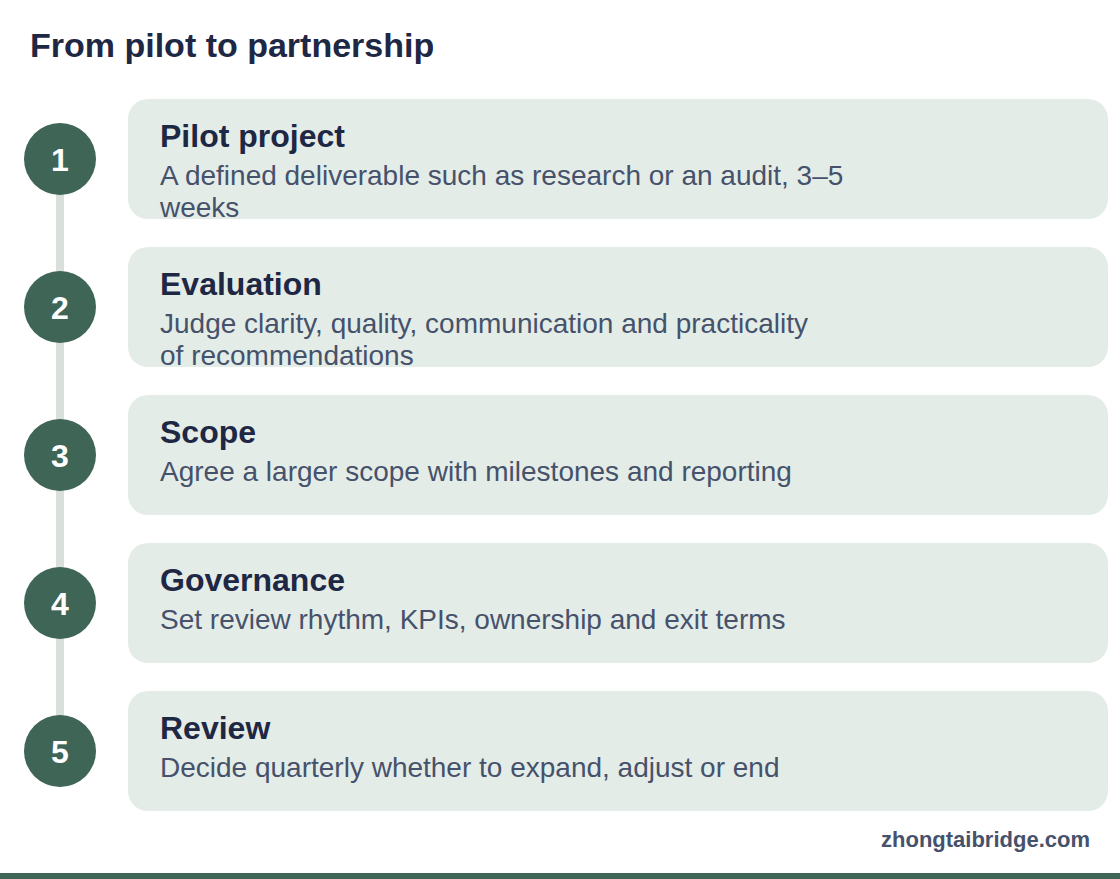
Process diagram. 1. Pilot project: A defined deliverable such as research or an audit, 3–5 weeks. 2. Evaluation: Judge clarity, quality, communication and practicality of recommendations. 3. Scope: Agree a larger scope with milestones and reporting. 4. Governance: Set review rhythm, KPIs, ownership and exit terms. 5. Review: Decide quarterly whether to expand, adjust or end.
Starting with a bounded project lets you test quality and communication with limited risk.
Keep admin access to your own accounts, domains and data, and ask legal counsel to review the contract.
The example is illustrative. A manufacturer scores three partners from 1 to 5. Partner A scores 5 on Thai-language quality, 4 on method, 3 on reporting and 2 on pricing clarity. Partner B scores 3 on language, 5 on method, 5 on reporting and 4 on pricing clarity. Partner C scores 4 on language, 3 on method, 3 on reporting and 5 on pricing. With weights of 25% for language, 25% for method, 20% for reporting, 15% for pricing and 15% for cultural fit across Chinese and Thai business, the totals favor Partner B, but only after a pilot confirms the claims. The scorecard does not make the decision; it forces the team to discuss why one partner is stronger on method and another on language, and what risk each introduces.
Run the scorecard with at least three internal evaluators, compare the differences between their scores and discuss them. Large disagreements often reveal unclear criteria or missing information.
Is a larger firm always safer? Not necessarily. Larger firms bring scale and process, while specialists can bring deeper focus and senior attention. Judge by who will do the work on your account and by evidence of similar work.
Should we ask for performance-based fees? They can align incentives, but they work best when results are measurable and attributable. Combine a base fee with a bonus linked to agreed outcomes.
How do we prevent lock-in? Keep ownership of accounts, listings, content and data, require documentation and agree handover terms.
What is a reasonable first project? A research report, feasibility study or technical audit with a fixed scope and a three to five week timeline.
Compare value, not only price. Low prices can hide limited scope or weak quality.
The best option has both: Thai-language execution and fluent communication with your team.
Three to five is usually enough to compare approaches.
Agree payment against clear deliverables and milestones.
Sources
A practical plan for how, where and when to launch.
 Market Entry
A six-stage guide for Chinese companies entering Thailand, with 2026 market data, a China-to-Thailand translation table, a 90-day plan and a launch checklist.
Read article → Market Entry
What a Thailand feasibility study includes, with a worked landed-cost example, scenario design, a go, adjust or stop rule and the warning signs that kill a plan.
Read article → Market Entry
Compare Thailand's four entry models on speed, margin, control and capital, with a decision matrix, an 18-month sequence and the mistakes to avoid when choosing.
Read article →Tell us about your business and goals.
We'll reply within 1–2 business days with next steps.