
How Chinese Companies Can Enter the Thai Market: A Step-by-Step Guide
A six-stage guide for Chinese companies entering Thailand, with 2026 market data, a China-to-Thailand translation table, a 90-day plan and a launch checklist.
Read article →Market Entry

Photo: Unsplash
Short answer
A good pilot answers a few expensive questions cheaply. Limit the range and channels, instrument the funnel, set thresholds before launch and hold a go, adjust or stop review at day 90. A pilot without decision rules becomes a slow, costly launch.
A 90-day pilot at a glance
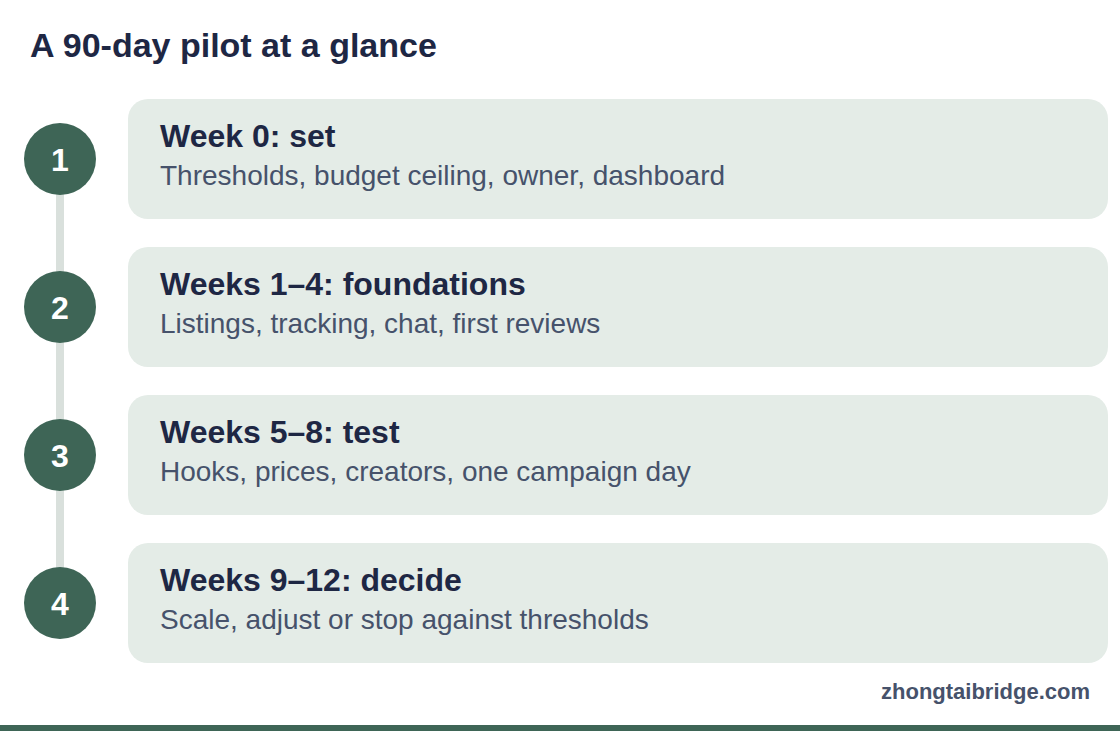
Process diagram. 1. Week 0: set: Thresholds, budget ceiling, owner, dashboard. 2. Weeks 1–4: foundations: Listings, tracking, chat, first reviews. 3. Weeks 5–8: test: Hooks, prices, creators, one campaign day. 4. Weeks 9–12: decide: Scale, adjust or stop against thresholds.
Define at least five numbers: minimum conversion rate, maximum cost per order, minimum rating, target contribution margin and a return-rate ceiling. Write the decision rule: for example, scale if at least four of five thresholds are met, adjust if two or three are met, and stop if fewer than two are met. Thresholds should come from your feasibility model, not from hope.
Reading the pilot at day 90
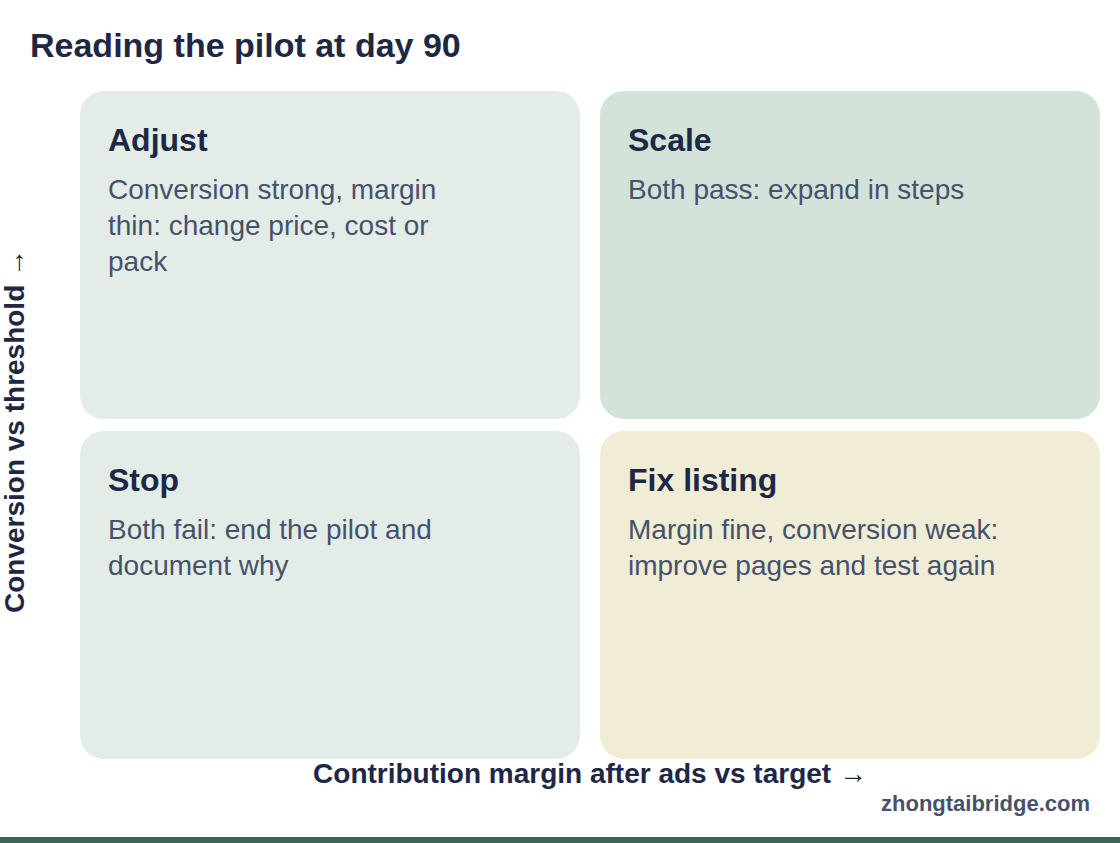
Two-by-two matrix. Horizontal axis: Contribution margin after ads vs target. Vertical axis: Conversion vs threshold. Adjust: Conversion strong, margin thin: change price, cost or pack. Scale: Both pass: expand in steps. Stop: Both fail: end the pilot and document why. Fix listing: Margin fine, conversion weak: improve pages and test again.
Keep a single test log with hypothesis, change, result and decision. It becomes your playbook for scale.
Hold a formal review with leadership. Present actual versus threshold, the learnings, the cost to date and the proposal for the next phase. If you decide to scale, scale in steps tied to evidence. If you adjust, define the specific changes and a shorter test. If you stop, document why and what you would need to see to restart.
For illustration only: conversion rate at least 2% on hero listings, cost per order below 60% of contribution before ads, rating of at least 4.7, return rate below 6%, and contribution margin after ads of at least 12%. Set your own numbers from the feasibility model.
This record is the main asset the pilot creates. It lets a new team member understand why decisions were made and shortens the next launch.
A pilot becomes persuasive when hypotheses are written before the data arrives. Write them as statements that can be wrong: for example, that the core product converts at least at the threshold with a rating of 4.7 or better, that cost per order stays below the contribution margin before ads, and that at least a third of orders come from non-campaign days. At the end, produce a one-page readout with five blocks: what we expected, what happened, why, what we will change and the decision requested. The discipline protects leadership from the story that fits the numbers after the fact, and gives the team a template to reuse in the next market.
The example is illustrative. The brand sets thresholds before launch: conversion of at least 2% on the hero listing, cost per order below 60% of contribution before ads, a rating of at least 4.7, a return rate under 6% and contribution margin after ads of at least 12%. In weeks one to four it publishes Thai listings, sets up chat scripts and collects first reviews. Weeks five to eight test two hooks, two price points and one creator batch. A campaign day in week nine lifts volume, but the team notes that margin fell on discounted units and sets a tighter discount limit.
At day 90, the hero listing meets four of five thresholds, with conversion just below target. The decision is to adjust: improve the main image and video, run a two-week test and scale only if conversion reaches the threshold. The pilot saved the brand from scaling on a campaign-day spike.
How big should a pilot be? Big enough to give a clear signal and small enough to lose without damage. For many brands that means three to five products and one main channel.
Should we pause during campaign days? No, but analyze them separately. Campaign days show peak potential, and ordinary days show baseline economics.
When can we change the thresholds? Only with a documented reason, and before the data arrive.
What do we deliver at the end? A readout with results versus thresholds, learnings and a recommendation to scale, adjust or stop.
It is enough to test demand, conversion and operations on a marketplace. Search and brand effects take longer to appear.
Treat that as a signal. Check whether baseline demand supports the plan, or whether the business depends on discounts.
A practical plan for how, where and when to launch.
 Market Entry
A six-stage guide for Chinese companies entering Thailand, with 2026 market data, a China-to-Thailand translation table, a 90-day plan and a launch checklist.
Read article → Market Entry
What a Thailand feasibility study includes, with a worked landed-cost example, scenario design, a go, adjust or stop rule and the warning signs that kill a plan.
Read article → Market Entry
Compare Thailand's four entry models on speed, margin, control and capital, with a decision matrix, an 18-month sequence and the mistakes to avoid when choosing.
Read article →Tell us about your business and goals.
We'll reply within 1–2 business days with next steps.