Local SEO in Thailand: A Google Business Profile Playbook
By ZhongTai Bridge Editorial · Last reviewed October 2026 · 5 min read
Photo: Unsplash
Short answer
Local visibility in Thailand depends on a complete, consistent Google Business Profile, accurate Thai and English naming, relevant categories, active reviews and consistent mentions across directories. Set up the profile properly, earn reviews, and measure calls, directions and bookings.
When does local SEO matter?
Local SEO matters for any business with a physical presence or a service area: showrooms, clinics, restaurants, retail stores, offices and service centers. It also matters for B2B firms that want to be found when buyers search for a local supplier. Visibility in map results and local packs can drive calls and visits.
How do you set up a strong profile?
Claim and verify the profile with the correct business name, address and phone number.
Choose a precise primary category and relevant secondary categories.
Write a clear Thai description, with an English version where relevant, focusing on what you do and for whom.
Add accurate opening hours, including holiday hours.
Upload high-quality photos of the exterior, interior, products and team.
Add products or services with descriptions and prices where appropriate.
Add booking, messaging or LINE links.
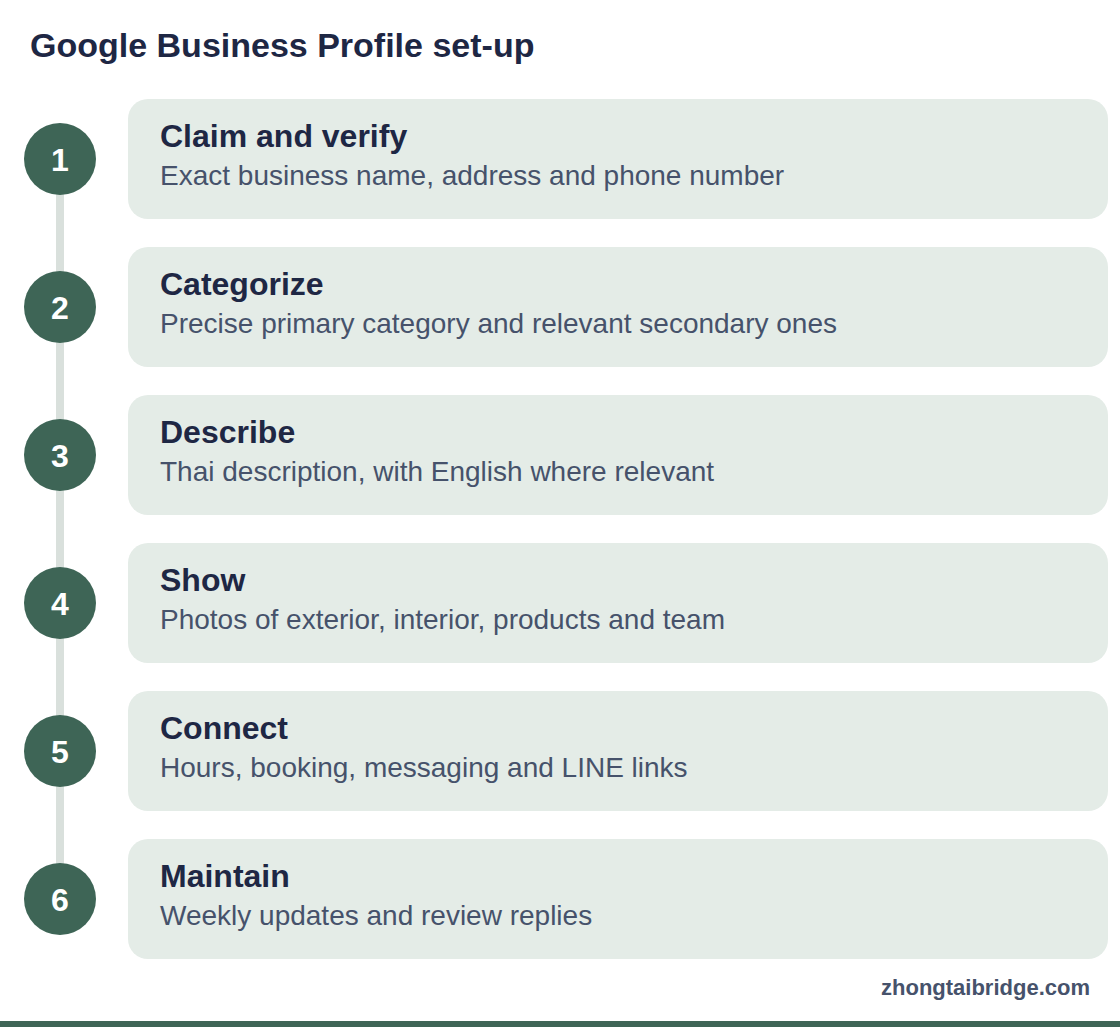
Google Business Profile set-up
Process diagram. 1. Claim and verify: Exact business name, address and phone number. 2. Categorize: Precise primary category and relevant secondary ones. 3. Describe: Thai description, with English where relevant. 4. Show: Photos of exterior, interior, products and team. 5. Connect: Hours, booking, messaging and LINE links. 6. Maintain: Weekly updates and review replies.
How should you handle Thai and English names?
Use the real business name as it appears on signage. Avoid keyword stuffing, which can lead to suspension. If your sign shows both Thai and English, decide which version leads and keep all channels consistent. Add the Thai address format carefully, including district and province, and test how the location appears on maps.
How do reviews influence local results?
Ask satisfied customers to leave reviews, using a QR code or a short link, and follow platform rules.
Reply to every review in Thai, politely and specifically.
Address complaints promptly and move conversations to chat or phone where appropriate.
Do not buy or fabricate reviews.
What other signals matter?
Consistent name, address and phone across your website, social profiles and directories.
A local landing page for each location with unique content.
Local mentions and links from Thai sites and associations.
Mobile-friendly pages and fast loading.
How do you measure local SEO?
Profile views and searches that triggered your listing.
Calls, direction requests and website clicks.
Bookings or sales attributed to local channels.
Review volume, rating and response time.
Review monthly and compare locations.
Local SEO scorecard
Metric
Where to find it
Review
Profile views and searches
Profile insights
Monthly
Calls and direction requests
Profile insights
Weekly
Website clicks
Profile and analytics
Monthly
Reviews, rating, response time
Profile
Weekly
Sales or bookings from local
Your CRM or POS
Monthly
Weekly routine for local visibility
Post an update or offer.
Add new photos.
Reply to new reviews.
Check questions and answers.
Review insights for calls and directions.
Update hours before holidays and Songkran.
A worked example for a showroom
The example is illustrative. A Chinese appliance brand opens a showroom in Bangkok. It claims the profile with the exact signage name, selects a precise category, adds Thai and English descriptions, uploads photos of each product zone, lists service hours and a LINE link, and posts weekly updates about demonstrations. It invites visitors to review after a demo and replies to each review. Within a few weeks, the profile receives more direction requests and calls, and the team tracks which products drive showroom visits.
Multi-location patterns for Thailand
Businesses with several branches need a consistent pattern: a unique profile per location, a unique landing page per location with address, map, opening hours, local photos and staff, and consistent naming such as brand plus area where it matches signage. Avoid duplicating the same text across pages and avoid creating profiles for locations you do not staff. In Thailand, address formats combine building, street, subdistrict, district and province, and names can appear in Thai and English, so test how each location appears on maps and in search on a phone before launch. Review each location's reviews weekly and compare performance across locations to spot service problems early.
A worked example: a showroom and service center
The example is illustrative. A Chinese appliance brand opens a showroom with a service counter in Bangkok. It creates one profile with the showroom's exact signage name, selects a primary category that matches the business, and adds secondary categories for service. It uploads photos of the showroom zones, staff and the service counter, writes a Thai description that mentions products and services and lists opening hours, including holidays. It posts weekly updates on demonstrations and repair services, invites customers to review after a visit and replies to each review in Thai. It tracks calls, directions and bookings, and compares them with online enquiries.
Over time, the profile receives more direction requests, and the team learns which products drive visits. The example demonstrates that local SEO is operational: accurate information, steady updates and customer care.
Common local SEO issues and fixes
Duplicate listings: merge or remove them so that reviews and signals are not split.
Inconsistent names across directories: standardize and update.
Wrong categories: choose the most specific primary category.
Missing holiday hours: update before Songkran and long weekends.
No review responses: assign an owner and a weekly routine.
Executive questions on local SEO
Do we need a profile if we only sell online? Not for storefront search, but service-area businesses and showrooms benefit. If you have no physical presence, focus on website SEO and marketplaces.
How many reviews do we need? There is no fixed number, but a steady flow of recent, genuine reviews with responses helps visibility and conversion.
What causes profile suspensions? Misleading names, fake addresses and policy violations. Use your real signage name and accurate information.
How do we measure ROI? Track calls, direction requests and bookings, and ask customers how they found you.
Frequently asked questions
Does a service-area business need a physical address?
Service-area businesses can list the area they serve and hide the address, following the platform's guidelines.
How quickly do local results improve?
Profile completeness and reviews can improve visibility within weeks, but competitive areas take longer.
A complete Thai SEO guide: Google's 99.5% share, Thai keyword research, site architecture, content, technical checks, local signals, AI search and a 90-day roadmap.
A step-by-step Thai keyword research method: seed terms, segmentation, transliteration, intent mapping, marketplace suggestions, templates and a worked example.
A practical GEO guide for Thailand: AI adoption data, how assistants choose sources, answer-first pages, entity signals, prompt testing and a 90-day plan.