Thai Consumer Behavior for Chinese Brands: Seven Patterns Backed by Data
By ZhongTai Bridge Editorial · Last reviewed October 2026 · 8 min read
Photo: Unsplash
Short answer
Thai buying journeys are mobile, video-led, chat-assisted and promotion-aware, and they finish on local payment rails. Academic studies of Chinese brands in Thailand point to price positioning and after-sales service as stronger drivers of perception than specifications, so design for value and service, then validate each pattern in your own category.
Is Thai consumer behavior the same as in China?
No. Platforms, payment rails, language and trust signals differ, even where shopping habits look similar from outside. The patterns below come from audience data, payments data and published studies, and each one comes with an action. Treat them as hypotheses to test in your own category, because behavior varies by age, region and product type.
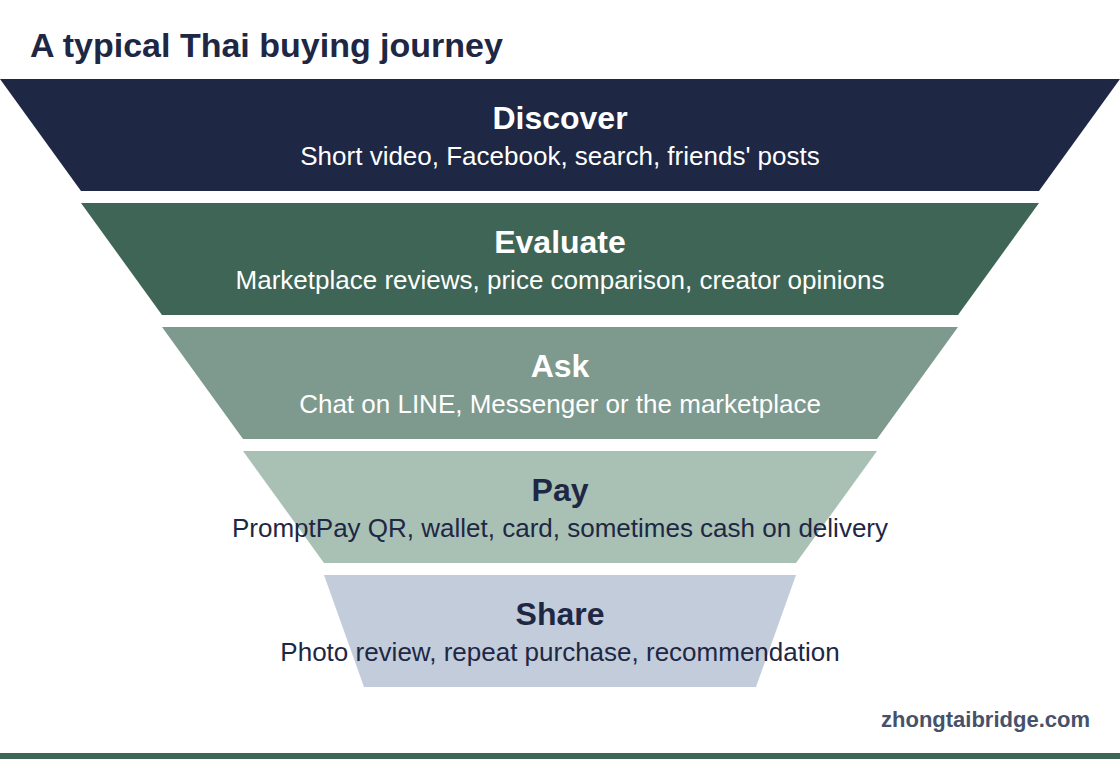
A typical Thai buying journey
Funnel diagram. 1. Discover: Short video, Facebook, search, friends' posts. 2. Evaluate: Marketplace reviews, price comparison, creator opinions. 3. Ask: Chat on LINE, Messenger or the marketplace. 4. Pay: PromptPay QR, wallet, card, sometimes cash on delivery. 5. Share: Photo review, repeat purchase, recommendation.
A journey often crosses four surfaces before the order is placed.
Pattern 1: Discovery happens on video and social feeds
Thai social media users spend about two hours and 35 minutes a day on social platforms according to DataReportal, and the country has the second-highest share of monthly TikTok users in the world: more than eight in ten internet users, against about three in ten globally, per We Are Social's July 2025 report. Facebook reaches an estimated 61.6 million accounts. For a new brand, this means that the first meeting with your product probably happens in a video or a feed post, not on a search results page.
Action: build a content system that produces many short, Thai-language clips per product, test several hooks, and keep a library of proof such as demonstrations, comparisons and customer clips.
Pattern 2: Questions are asked in chat before the order
LINE reaches about 56 million monthly users, equal to 82.6% of internet users, and Messenger about 55.8 million accounts. Many shoppers ask availability, delivery and authenticity questions before paying, and the speed and tone of the reply decide the order. Marketplaces also score sellers on chat responsiveness.
Action: write a library of polite Thai replies to the ten most common questions, set response-time targets and staff the chat channels during campaign days.
Pattern 3: Payments run on local rails
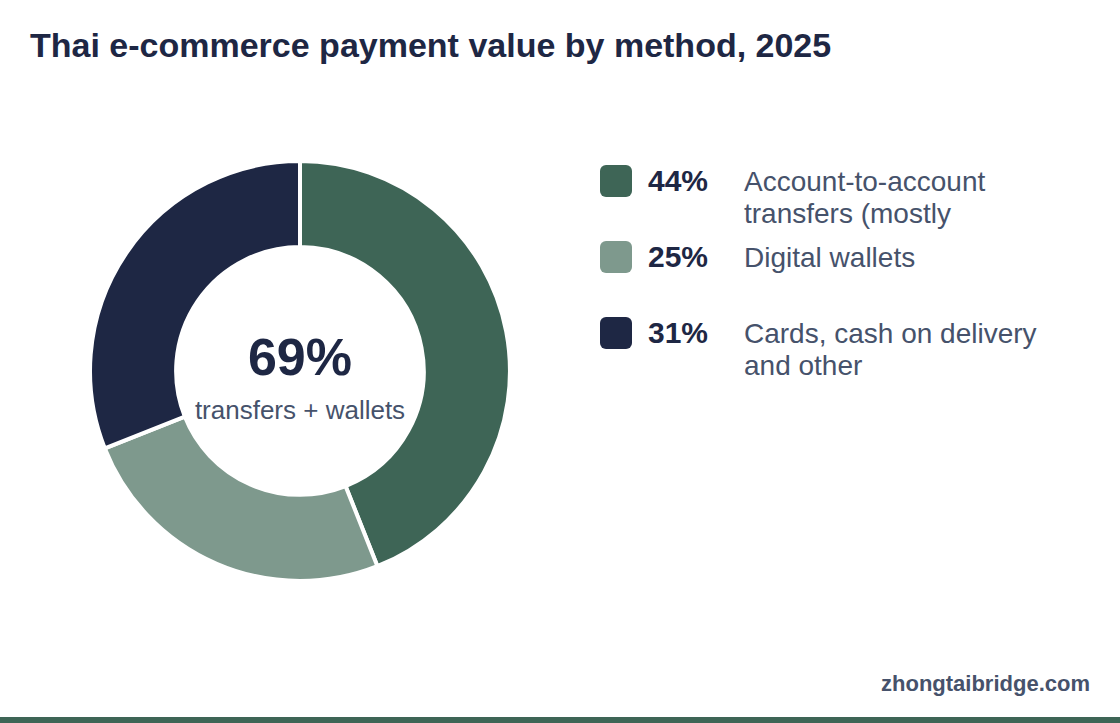
Thai e-commerce payment value by method, 2025
Donut chart. Account-to-account transfers (mostly PromptPay): 44%; Digital wallets: 25%; Cards, cash on delivery and other: 31%
Remainder derived from the two reported shares. Source: Worldpay data via Antom.
PromptPay had over 81 million registrations by March 2025 and processed 2.16 billion transactions in September 2025. About 61.5% of the population used QR codes monthly in 2024. A checkout built for cards alone excludes much of the market, and failed payments translate directly into abandoned carts.
Action: support PromptPay QR and common wallets, show prices in baht with tax clearly stated and test the full payment flow on a phone.
Pattern 4: Campaign days shape purchase timing
Marketplaces run double-date sales such as 9.9, 11.11 and 12.12, and shoppers learn to wait for them. Household liquidity reinforces the habit: average household debt reached about THB 795,000 in 2026, the highest in 17 years, and the debt-to-GDP ratio fell to 85.9% mainly because credit tightened, according to SCB EIC and UTCC. Cautious households concentrate big purchases on days when discounts, vouchers and free shipping line up.
Action: plan stock, ad budgets and prices around the calendar. Use our commercial calendar tool, protect margin with bundles and avoid permanent discounting.
Pattern 5: Reviews, creators and after-sales service carry trust
For unfamiliar brands, ratings, photo reviews and credible creators reduce perceived risk. Academic work points the same way. A 2025 study of Chinese car brands in Thailand found that price positioning was the strongest driver of brand perception (beta 0.49), with quality and after-sales service also exerting significant positive effects. A Mahidol University study of Bangkok customers of Chinese electronics found that brand recognition and customer satisfaction drove loyalty, while product attributes and perceived quality did not. Both studies are small and category-specific, but the message is consistent: buyers reward visible value and reliable service more than specification sheets.
Action: invest early in review generation, creator seeding and a fair, clear returns and warranty policy.
Pattern 6: Thai-language quality signals respect
Natural Thai, correct tone and polite particles show that a brand has done its homework. Stiff or machine-translated copy raises doubts about product quality and support. Thai is written without spaces between words and buyers mix Thai, English and transliterated brand names in search, so language quality also affects findability.
Action: have native editors write product pages and chat scripts, and keep a glossary of approved terms.
Pattern 7: Reach is shifting toward AI answers and platform discovery
Reported adoption of generative AI is high among younger Thais, with one corporate presentation citing about 85% of Gen Z and 80% of Gen Y, and about 50% of Gen X, while a 2025 Thairath poll of its own audience found about 54% used AI. Whatever the exact number, shoppers increasingly ask assistants to compare products and look to YouTube and TikTok for discovery.
Action: publish clear, sourced Thai pages that answer comparison questions and monitor whether assistants mention your brand.
How should you turn patterns into a launch checklist?
From pattern to action
Pattern
What to do before launch
How to measure
Video-led discovery
Produce 10+ Thai short clips per hero product
Watch-through, click-through to listing
Chat before purchase
Reply library and response targets
Response time, chat-to-order rate
Local payments
PromptPay and wallets at checkout
Payment success rate, cart abandonment
Campaign days
Calendar for stock, price and ads
Share of orders on sale days, margin
Trust signals
Review and creator plan, returns policy
Rating, review count, return rate
Language quality
Native editing and glossary
Conversion, bounce rate, support questions
How do you validate behavior in your own category?
Run a two-week insight sprint. Code 100 competitor reviews by theme, interview eight to ten target customers about their last purchase, analyze search queries and chat questions, then summarize the five decision factors and test them in listing and ad copy. A short sprint often reveals more than months of generic research, because it focuses on your customers and your category.
Segment differences you should test, not assume
Behavior varies by age, region and income. Younger audiences use TikTok and short video heavily and respond to creators. Older audiences rely more on Facebook, LINE and recommendations from family and may prefer simpler checkout. Bangkok shoppers see faster delivery and more competition, while shoppers in other provinces may face longer delivery times and different price expectations. Test each assumption with a small split: two creatives, two price points or two delivery messages, and compare conversion and margin.
Segment hypotheses to test
Segment
Hypothesis
Test
Younger, video-first
Responds to creator demos
Two creator clips versus one brand clip
Family decision makers
Wants warranty and service clarity
Add a warranty block and compare conversion
Provincial shoppers
Sensitive to delivery time and cost
Show delivery promise and free-shipping threshold
Price-sensitive shoppers
Waits for campaign days
Offer entry pack and bundles
Key terms explained
Term
Meaning
Why it matters
Consumer behavior
How people discover, evaluate, buy and use products
How people discover, evaluate and buy
Conversion rate
The share of visitors or viewers who place an order
Share of visitors who purchase
Repeat purchase
Customers buying again
Customers buying again
Average order value
Average revenue per order
Revenue per order
Word of mouth
Recommendations and reviews from other buyers
Reviews and recommendations
Customer service
Pre-sale and after-sale support, often by chat
Chat and after-sales support
Plain-language definitions for teams and partners.
From behavior to design: a landing page checklist
Each behavior pattern translates into page design. Because shoppers ask questions before paying, put answers to the top five questions on the page and offer a chat button. Because they compare, show price, specifications and a comparison with typical alternatives. Because trust matters, show ratings, photo reviews, warranty and returns policy near the price. Because payments run on local rails, show PromptPay and wallet options early. Because many shoppers use phones, test the page at small sizes and keep the first screen light. Because language quality signals respect, use natural Thai and consistent terms.
Landing page checklist by behavior
Behavior
Page element
Test
Asks before buying
Top five answers, chat button
Chat-to-order rate
Compares options
Comparison table, clear specs
Time on page, add-to-cart
Needs trust
Ratings, photos, warranty
Conversion after adding proof
Pays by QR or wallet
Local payment icons early
Payment success rate
Uses a phone
Light first screen, large buttons
Mobile conversion
Questions to ask in a customer interview
What did you buy last in this category, and why that product?
Where did you first see it, and where did you check reviews?
What question did you want answered before paying?
What would make you trust a new brand?
What would make you return a product?
Which payment method do you prefer, and why?
What would make you buy again?
Record answers in the customer's own words and use them in titles, descriptions and chat scripts. Repeat the exercise after each major change in product or price.
Cross-cultural pitfalls for Chinese marketing teams
From a China habit to a Thai adaptation
China habit
Thai adaptation
Copy the Douyin script and dub it
Rewrite in spoken Thai, with Thai creators and local references
Rely on WeChat for service
Set up LINE and marketplace chat with Thai-speaking staff
Lead with features and specifications
Lead with the buyer's problem, proof and service
Use aggressive flash sales constantly
Plan campaign days and protect margin with bundles
Assume Chinese payment habits
Support PromptPay, wallets and cards
Treat all provinces as one market
Test Bangkok and provincial demand separately
A worked example: an insight sprint summary
The example is illustrative. A brand reviews 100 competitor reviews for a portable fan. Thirty-two mention noise, twenty-five mention battery life, eighteen mention weak airflow in heat and twelve mention delivery delays. Interviews with eight buyers show that they use the fan on commutes and at outdoor markets, check reviews on a marketplace and ask about battery life in chat before buying. The sprint concludes that the listing should lead with battery life and quietness, show the fan in outdoor use, include a clear battery table and prepare a chat script for battery questions. The brand tests the new listing against the old one, and conversion rises. The example shows how a short sprint produces concrete changes in copy, images and service.
Applying the patterns to three categories
The patterns do not apply equally. For beauty and personal care, video demonstrations, creator reviews and trust signals dominate, so invest in content and reviews and manage claims carefully. For home and kitchen goods, search and comparison matter, so invest in listings, specifications, photos and price discipline, and use video to show use. For consumer electronics accessories, compatibility questions drive chat, so build a compatibility table, a clear warranty and fast replies. In each category, payment and delivery expectations are similar, but the balance between discovery, comparison and reassurance differs. Start by asking which stage of the journey is the weakest for your product, and invest there first.
Three quick tests you can run this week
First, move your three most common customer questions into the top of your product page and compare conversion over a week. Second, add PromptPay and a wallet option to checkout if missing and compare payment success and cart abandonment. Third, replace one translated product title with a title built from Thai search terms and compare impressions and click-through. Each test is small, cheap and reversible, and each connects a behavior pattern to a measurable outcome. Record the baseline, the change and the result, and share the learning with the team.
Frequently asked questions
Are Thai consumers price sensitive?
Promotions are central to marketplace shopping, and household liquidity is tight, but sensitivity varies by category and segment. Price positioning mattered most in studies of Chinese brands, so test price points and show clear value.
Which platform should I prioritize for discovery?
Start where your category already sells and where your audience spends time. For visual, demonstrable products, TikTok is a strong candidate; for search-led products, marketplaces and Google.
Do payment preferences differ by age?
Usage differs across segments, but QR payments are widely adopted, so support PromptPay and wallets for all audiences and keep cards for travel and premium goods.
How reliable are the academic studies?
They are small, category-specific and dated, so use them as signals, not as proof. Combine them with your own tests.
A practical Thailand market research method: the four lenses, reliable data sources, Thai-language techniques, survey design, report structure and mistakes to avoid.
A six-stage guide for Chinese companies entering Thailand, with 2026 market data, a China-to-Thailand translation table, a 90-day plan and a launch checklist.