
Thailand Digital Market 2026: Key Statistics for Chinese Businesses
Sourced 2026 statistics on Thai internet, social, TikTok, LINE, PromptPay, e-commerce and Chinese investment, with notes on how to use each figure.
Read article →Consumer Insights

Photo: Unsplash
Short answer
Good Thailand market research uses four lenses: demand, customers, competitors and channels. Start with dated secondary data, validate it with Thai-language sources and marketplace signals, add interviews where decisions are costly, and end every report with a recommendation.
Four lenses that turn data into a decision
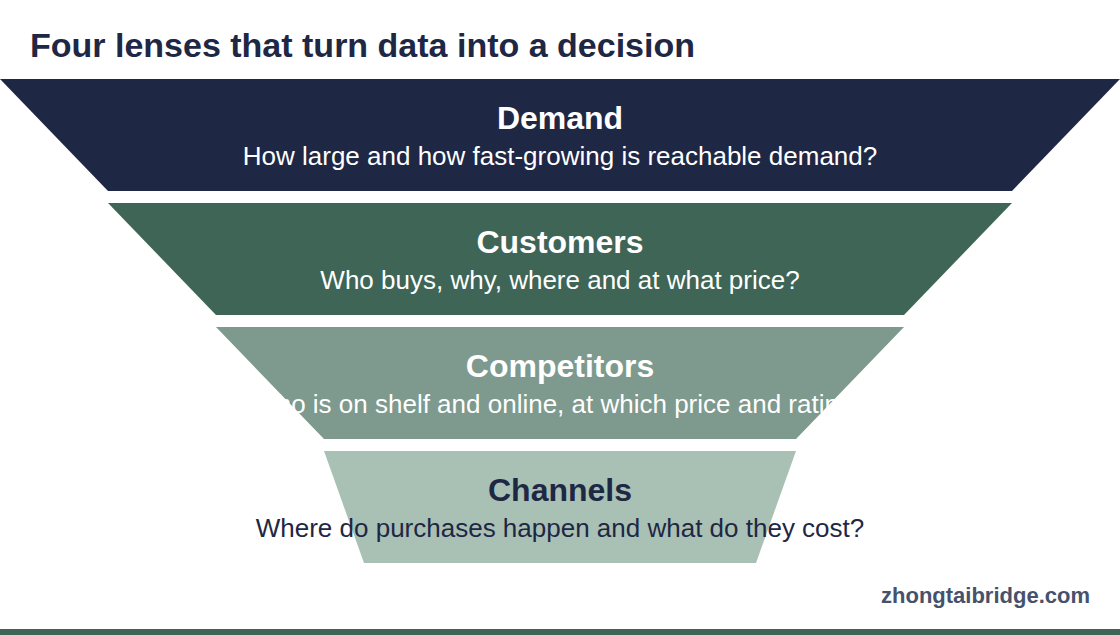
Funnel diagram. 1. Demand: How large and how fast-growing is reachable demand?. 2. Customers: Who buys, why, where and at what price?. 3. Competitors: Who is on shelf and online, at which price and rating?. 4. Channels: Where do purchases happen and what do they cost?.
The test of a research project is whether it changes a decision. Write the decision first, for example whether to launch, at which price or on which channel, then list the five to ten questions that decide it. Everything else is background.
Source map for Thailand research
| Question | Source | Watch out for |
|---|---|---|
| Audience size and reach | DataReportal, NapoleonCat, platform ad tools | Accounts are not unique people |
| E-commerce value and share | Momentum Works, e-Conomy SEA | Scopes and years differ |
| Search demand | Google Keyword Planner, Trends, Search Console | Thai spelling variants split volume |
| Price and demand signals | Shopee, Lazada, TikTok Shop best-seller pages | Promotions inflate sold counts |
| Population and households | National Statistical Office, Bank of Thailand | Registered vs estimated population |
| Company data | Department of Business Development | Check filing dates |
| Language and objections | Reviews, Pantip, Facebook groups, chat logs | Not representative samples |
Record the year, scope and method next to every figure. When two credible sources disagree, show both. For example, the Thai population is 65.8 million on the registry basis but about 71.6 million in UN-based estimates, a gap of nearly 6 million that changes any per-capita model.
Most useful evidence is written in Thai. Search the way a Thai shopper does, including Thai spellings of brand names, English product terms and colloquial phrases. Google handles about 99.5% of Thai web searches, so Google tools describe real demand, while marketplace search suggestions reveal product-level vocabulary. Read at least 100 reviews of the leading competitors and code the themes: quality, price, delivery, service and fit. The complaints are a list of opportunities.
Community spaces such as Pantip and Facebook groups show how people talk about problems before they ask for products. Treat them as qualitative evidence, not as statistics.
Marketplaces are the largest public dataset on Thai buying behavior. Sort a category by best seller, then note price bands, number of sellers, review counts, rating distribution and the share of listings with video. Compare several sellers across several weeks. Sold counts and rankings are influenced by promotions, so they indicate demand but not profit. A category crowded with sellers at the lowest price tier may still hold space in a design-led tier, which is exactly the kind of insight that changes a plan.
Use interviews or short surveys when the decision is costly: a new product, a premium price, a large inventory order. Write questions in Thai first and back-check with a second native speaker. Recruit people who match the target segment, not colleagues. Ask about recent behavior, such as what they bought last and why, rather than hypothetical intentions. Even eight to ten good interviews reveal objections and vocabulary that desk research misses.
Begin with an executive summary and a recommendation, then present evidence in the order a decision maker needs it: market size and growth, customers, competitors, channels, pricing and risks. Every number carries a source and year. Charts support the argument, and an appendix lists data sources and method so that another analyst could reproduce the work. State what the research cannot answer and propose the cheapest test that would settle it.
The example is illustrative. A Chinese brand considers launching a pet water fountain. The decision is whether to launch and at which price. The team lists the key questions: how large is Thai demand, which price tiers are crowded, what do buyers complain about, which channels sell the category and what does it cost to compete. Desk research collects Thai search volume, marketplace best sellers by price tier and review themes. The team finds many sellers at the lowest tier, recurring complaints about noise and filter replacement, and fewer options in a mid-tier with quiet operation. Five buyer interviews confirm that noise matters and that replacement filters need clear availability.
The report recommends a mid-tier launch with a quiet pump, an easy-to-find filter subscription and a content plan around noise tests. It also lists what remains uncertain and proposes a two-week pilot to test conversion. The research changed the product and price decision, which is the purpose.
How do we know research is good enough to decide? When it answers the decision questions, shows sources and dates and states what remains uncertain.
Should we trust paid market reports? Use them as inputs, check their methods and combine them with your own marketplace and search evidence.
How do we research a category with little data? Use proxies such as adjacent categories, interview buyers and run a small test listing.
What is the best first investment? A competitor and price audit with Thai search demand, then buyer interviews if the decision is costly.
A desk-based report typically takes two to four weeks. Adding interviews or a survey extends the timeline by two to three weeks.
Yes, for a first pass. The main limits are access to Thai-language sources and the time needed to interpret them.
A competitor and price audit, Thai search demand for your main terms, a landed-cost check and at least a few buyer interviews.
Review key numbers quarterly and refresh fully when you change products, price tiers or channels.
Sources
Understand who buys, what they pay and who you will compete with.
 Consumer Insights
Sourced 2026 statistics on Thai internet, social, TikTok, LINE, PromptPay, e-commerce and Chinese investment, with notes on how to use each figure.
Read article → Consumer Insights
Seven evidence-based patterns in how Thai consumers discover, evaluate and pay, using data on TikTok, LINE, PromptPay, campaign days and academic studies.
Read article → Market Entry
A six-stage guide for Chinese companies entering Thailand, with 2026 market data, a China-to-Thailand translation table, a 90-day plan and a launch checklist.
Read article →Tell us about your business and goals.
We'll reply within 1–2 business days with next steps.