Thai Content Strategy for B2B Brands: Topic Clusters and Thought Leadership
By ZhongTai Bridge Editorial · Last reviewed October 2026 · 5 min read
Photo: Unsplash
Short answer
B2B content in Thailand works when it answers decision-makers' questions in Thai with evidence. Build clusters around a few core topics, publish original data, put named experts behind it, and measure qualified enquiries and share of voice, not only traffic.
Who are you writing for?
B2B buying groups include technical evaluators, procurement, finance and senior executives. Each asks different questions: Does it work? What does it cost over time? What is the risk? Who else uses it? Map questions by role and by stage, from awareness to evaluation to decision, then create content to answer them.
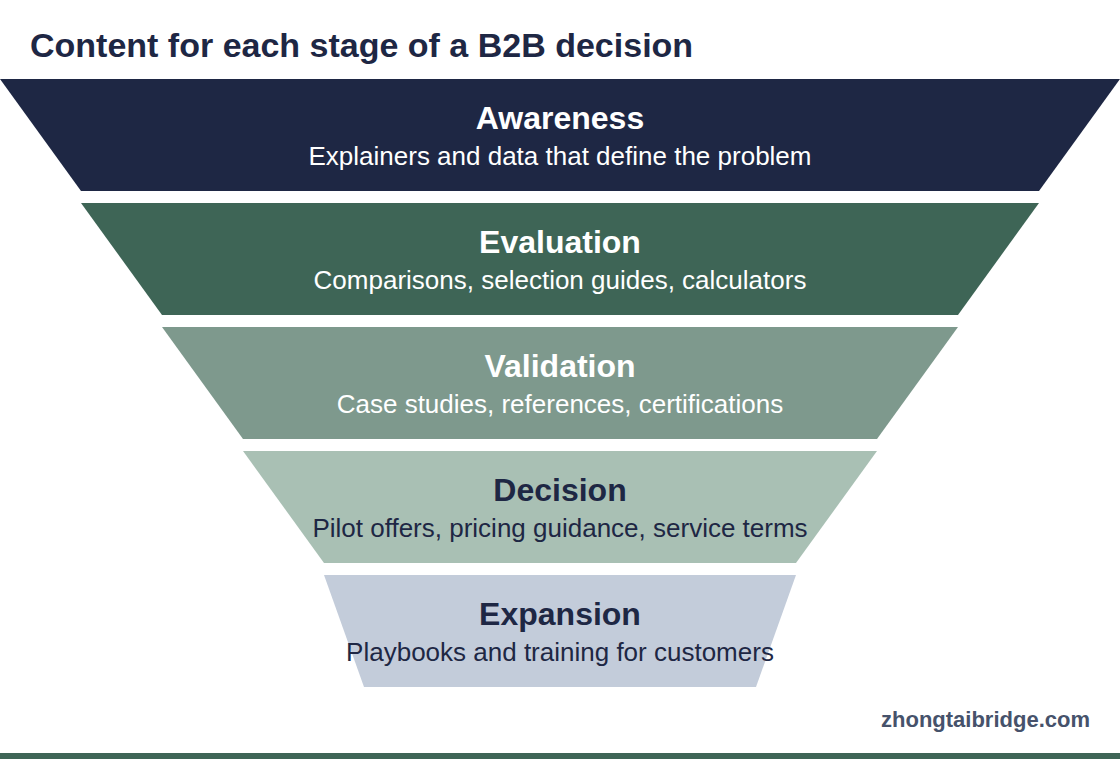
Content for each stage of a B2B decision
Funnel diagram. 1. Awareness: Explainers and data that define the problem. 2. Evaluation: Comparisons, selection guides, calculators. 3. Validation: Case studies, references, certifications. 4. Decision: Pilot offers, pricing guidance, service terms. 5. Expansion: Playbooks and training for customers.
How do you choose topics?
Interview customers and sales teams for real questions.
Research Thai search queries and community discussions.
Identify three to five core topics tied to your offer.
For each, define a pillar page and eight to twelve supporting pieces.
Prioritize topics where you can add original evidence.
What content types perform in B2B?
Guides and explainers that define a problem and a method.
Comparison and selection content: how to choose a supplier, standards or technology.
Original data: surveys, benchmarks and calculators.
Case studies with measurable results, once you have them.
Technical documentation and FAQs optimized for search and AI assistants.
Webinars and short video for executive audiences.
Content types and their jobs
Type
Job
Measure
Guides and explainers
Win search and trust
Impressions, time on page
Comparisons
Support evaluation
Enquiries, AI citations
Original data and tools
Earn links and mentions
Referring domains, press pickups
Case studies
Reduce risk
Sales conversations influenced
Webinars and video
Reach executives
Registrations, meetings
How do you build thought leadership?
Put named experts behind your content with credentials and clear viewpoints. Publish opinion pieces on industry trends, pitch commentary to Thai business media, and speak at events. In Thailand, credibility often follows relationships, so combine content with introductions and partner endorsements. Keep a consistent publication rhythm.
How should content be written in Thai?
Use precise, professional Thai, with a native editor.
Keep technical terms consistent through a glossary.
Use direct answers at the top and question-style headings.
Provide Chinese and English versions where your audience requires them.
Add structured data and clear author and organization information.
How do you measure B2B content?
Qualified enquiries and meetings sourced by content.
Branded search and direct traffic growth.
Rankings and impressions for target queries.
Citations in AI answers for your key questions.
Sales cycle length and win rate for content-influenced deals.
A sample cluster for a Chinese industrial equipment supplier
Pillar: how to choose industrial equipment suppliers in Thailand.
Support: total cost of ownership calculator, maintenance planning guide, certification overview, financing options, case summaries and a glossary of technical terms in Thai and English.
Distribution: LinkedIn posts for executives, email to distributors, a webinar in Thai and an article pitched to trade media.
Measurement: qualified enquiries, meetings and pilot requests.
Editorial workflow
Interview a subject-matter expert and record the session.
Draft in the source language and have a Thai specialist rewrite, not translate.
Fact-check with the expert.
Add sources, structured data and internal links.
Publish, share and review performance after 30 days.
Twelve article titles for a B2B launch calendar
A content calendar turns strategy into output. For an industrial or technology firm entering Thailand, a plausible first-year set would cover: how to choose a supplier in your category; total cost of ownership explained with a calculator; a buyer's checklist for certifications; common failure modes and how to avoid them; maintenance planning for the Thai climate; a guide to financing options; a comparison of local and imported options; a glossary of technical terms in Thai and English; a market snapshot with sourced data; a customer story once available; a guide to working with Chinese and Thai teams; and an annual outlook. Publish one pillar piece and one supporting piece each month, update the pillar when facts change and share each piece with distributors and partners.
A worked example: a Chinese energy-storage supplier's first six months
The example is illustrative. The supplier wants to reach Thai factory managers and energy consultants. It interviews three customers and its sales engineers to list the questions buyers ask, such as payback period, safety certification, maintenance and grid integration. It publishes a pillar guide on how to evaluate energy storage for a factory, supported by a total cost calculator, a safety and certification explainer and a case study from a Chinese-owned plant in Thailand. Each piece has a Thai answer-first summary, sources and an FAQ. The team shares the pillar guide with distributors and pitches commentary to a trade publication.
After six months, the team reviews enquiries by source, finds that the calculator produced most qualified leads and plans a second calculator for a related use case. The example shows that useful tools and sourced explanations beat generic company news.
Editorial standards for B2B content
Every claim has a source, a date or a clear basis in your own data.
Every article names its author or expert reviewer and shows a last-reviewed date.
Thai text is written or edited by a native speaker with sector knowledge.
Technical terms are consistent with a glossary.
Pages link to related guides and to a clear next step.
Executive questions on B2B content
How do we justify content spend to finance? Link content to qualified enquiries, meeting rates and sales cycle effects, and show assisted conversions in addition to last-touch results.
Should the content be gated? Gate only high-value assets such as calculators or benchmark reports, and keep guides open so that search and AI systems can read them.
How many articles do we need? A pillar and eight to twelve supporting pieces per topic is a workable starting point, and quality matters more than count.
Who should review technical accuracy? A subject-matter expert on your team, plus a native Thai editor for language and terminology.
Frequently asked questions
How much content do I need?
Start with one pillar page and a handful of supporting pieces on your most important topic, then expand based on data.
Should B2B content be in English or Thai?
Both, depending on the audience. Thai content reaches local decision-makers, and English serves regional and international stakeholders.
Need help with seo & search visibility?
Get found by Thai customers where they actually search, including in AI answers.
A complete Thai SEO guide: Google's 99.5% share, Thai keyword research, site architecture, content, technical checks, local signals, AI search and a 90-day roadmap.
A step-by-step Thai keyword research method: seed terms, segmentation, transliteration, intent mapping, marketplace suggestions, templates and a worked example.
A practical GEO guide for Thailand: AI adoption data, how assistants choose sources, answer-first pages, entity signals, prompt testing and a 90-day plan.