How Thai Retail Gatekeepers Shape Distribution for Foreign Brands
By ZhongTai Bridge Editorial · Last reviewed October 2026 · 6 min read
Photo: Unsplash
Short answer
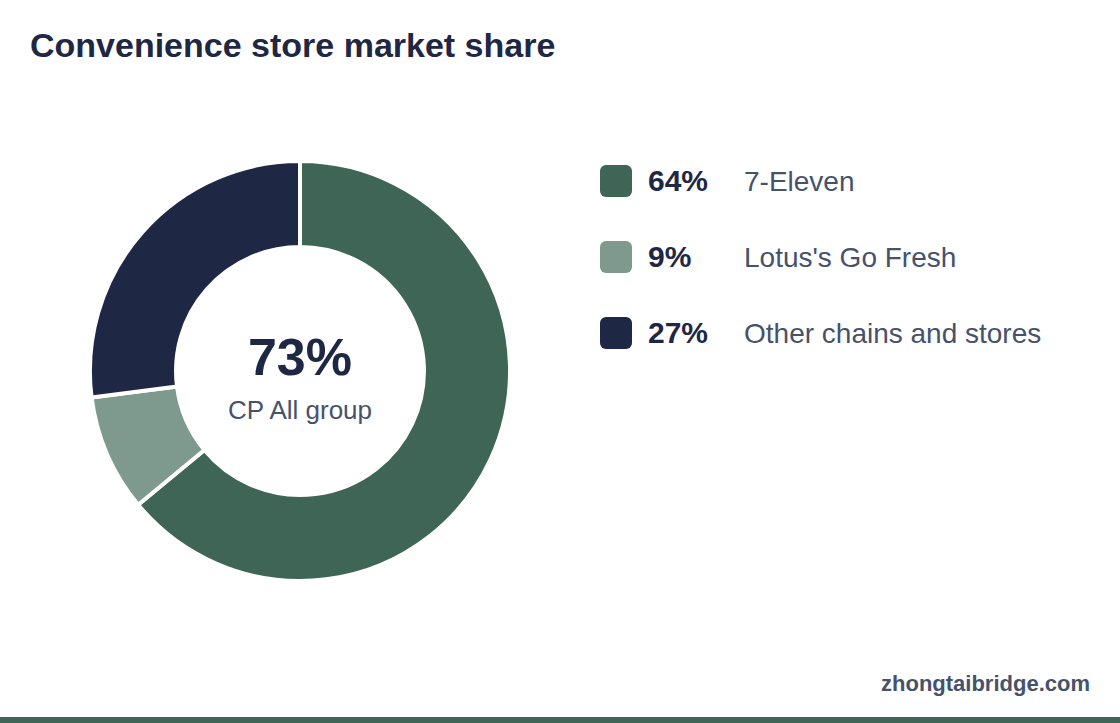
Thai modern retail is concentrated. CP All operated 15,945 7-Eleven stores at the end of 2025 and, with Lotus's Go Fresh, holds about 73% of the convenience segment, while Central Group leads larger formats and provision stores remain a major FMCG channel. Foreign brands need a channel plan that reflects concentration: pilot, prove velocity, then negotiate.
How concentrated is Thai retail?
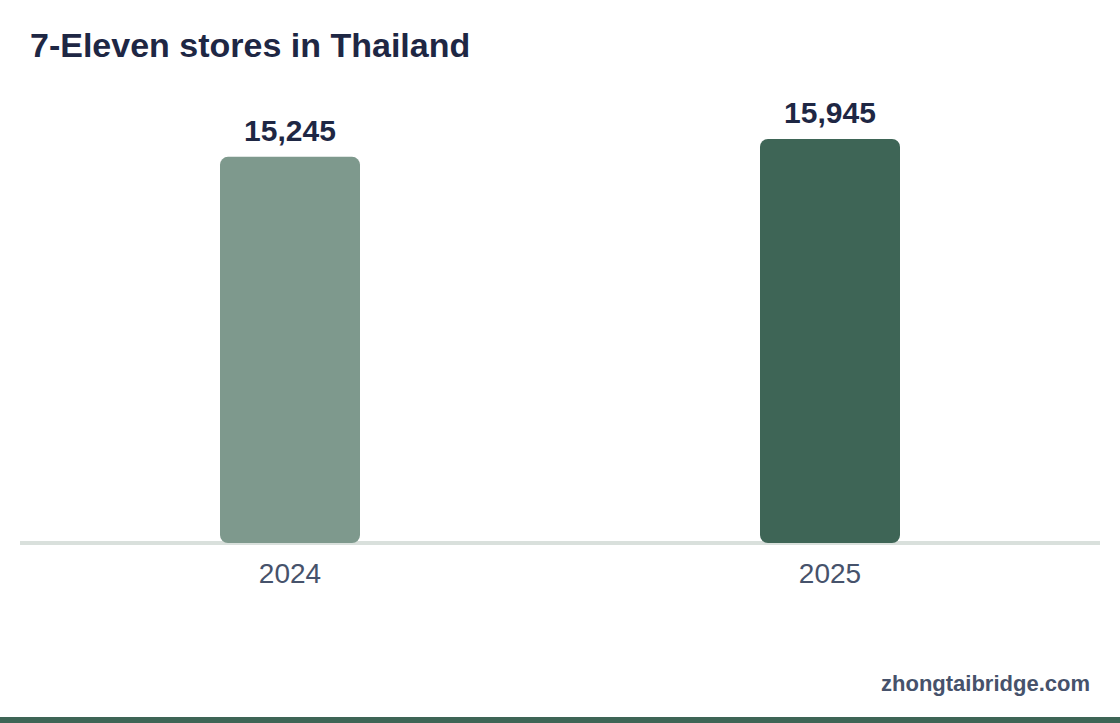
CP All, the retail arm of Charoen Pokphand Group, operated 15,945 7-Eleven stores in Thailand at the end of 2025, up from 15,245 a year earlier, after opening about 700 new stores as planned. A broker analysis put CP All's share of the convenience store market at about 73%, made up of roughly 64% for 7-Eleven and 9% for Lotus's Go Fresh. The group also owns Makro wholesale and Lotus's after the 2021 acquisition. Central Group, founded in 1947 and the owner of Tops, Robinson and Central department stores, leads among medium to large retailers.
Provision stores, the small independent shops found in neighborhoods, remain the leading FMCG sales channel by value according to retail statistics summaries, and they are typically served through distributors and wholesalers rather than direct from brands. A Thai retail plan therefore has three layers: a few large gatekeepers, a distributor-served long tail and platforms.
Convenience store market share
Donut chart. 7-Eleven: 64%; Lotus's Go Fresh: 9%; Other chains and stores: 27%
Broker estimate; shares move over time. Source: Beansprout analysis of CP All.
7-Eleven stores in Thailand
Column chart. 2024: 15,245; 2025: 15,945
About 700 net new stores a year; 15,945 at 31 Dec 2025. Source: CP All H2 2025 earnings summary.
What drives the power of convenience chains?
Reach: thousands of stores in every district, which no brand can replicate.
Format focus: CP All emphasizes ready-to-eat categories, which determines which products receive shelf space and promotion.
Data and digital: the 7App and related online-to-offline services account for about 11% of total sales, giving the chain customer data and campaign tools.
Vertical integration: the group's distribution centers, private label, food production and wholesale reduce dependency on outside suppliers.
A product that does not fit the chain's category plan has little chance of listing. A product that does fit competes with the chain's own capabilities.
How should a foreign brand approach a gatekeeper?
Understand the category plan. Study current assortment, price points, pack sizes and promotions in store, and identify a genuine gap.
Prove velocity elsewhere first. Marketplace sales, social traction and limited regional trials give you evidence that buyers need.
Prepare supply chain readiness. Gatekeepers expect consistent availability, local labeling, compliant documentation and service levels.
Present the commercial model clearly: margin structure, promotion funding, return policy and marketing support.
Start with a defined pilot, such as a region or a set of stores, and agree success metrics in advance.
Expect long cycles and thorough requirements. Many first approaches fail because the product is attractive but the plan for supply and promotion is not.
What are the alternatives to direct listing?
Distributors for traditional trade: access provision stores and regional wholesalers, with margin and control trade-offs.
Specialty retailers and pharmacies: relevant for health, beauty and wellness categories.
Online first: marketplaces and content-led channels to build demand, then use that evidence in retail negotiations.
Food service and B2B channels: for ingredients and equipment.
Channel routes for a foreign brand
Route
Reach
Control
Typical entry
Convenience chains
Very high
Low
After proof of velocity
Supermarkets and hypermarkets
High
Low to medium
Distributor or direct
Provision stores via wholesalers
Very high, fragmented
Low
Distributor
Specialty and pharmacy
Targeted
Medium
Category specialist
Marketplaces and own channels
High, online
High
From day one
What are the negotiation risks?
Margin and funding pressure: promotions, listing support and returns can erode margin.
Private label competition: successful products may attract imitation in the chain's own brand. Protect with differentiation, intellectual property and speed.
Dependence: a single large customer can account for most of your sales, which weakens your bargaining position over time.
Payment terms: confirm terms and model working capital before you commit.
How do you plan the first year?
Quarter 1: validate demand online and refine Thai packaging and messaging.
Quarter 2: sign a distributor or pilot with a regional partner and collect sell-through data.
Quarter 3: approach a gatekeeper with evidence and a concrete proposal.
Quarter 4: review margins, supply performance and customer feedback, and decide on expansion.
A first-year negotiation playbook
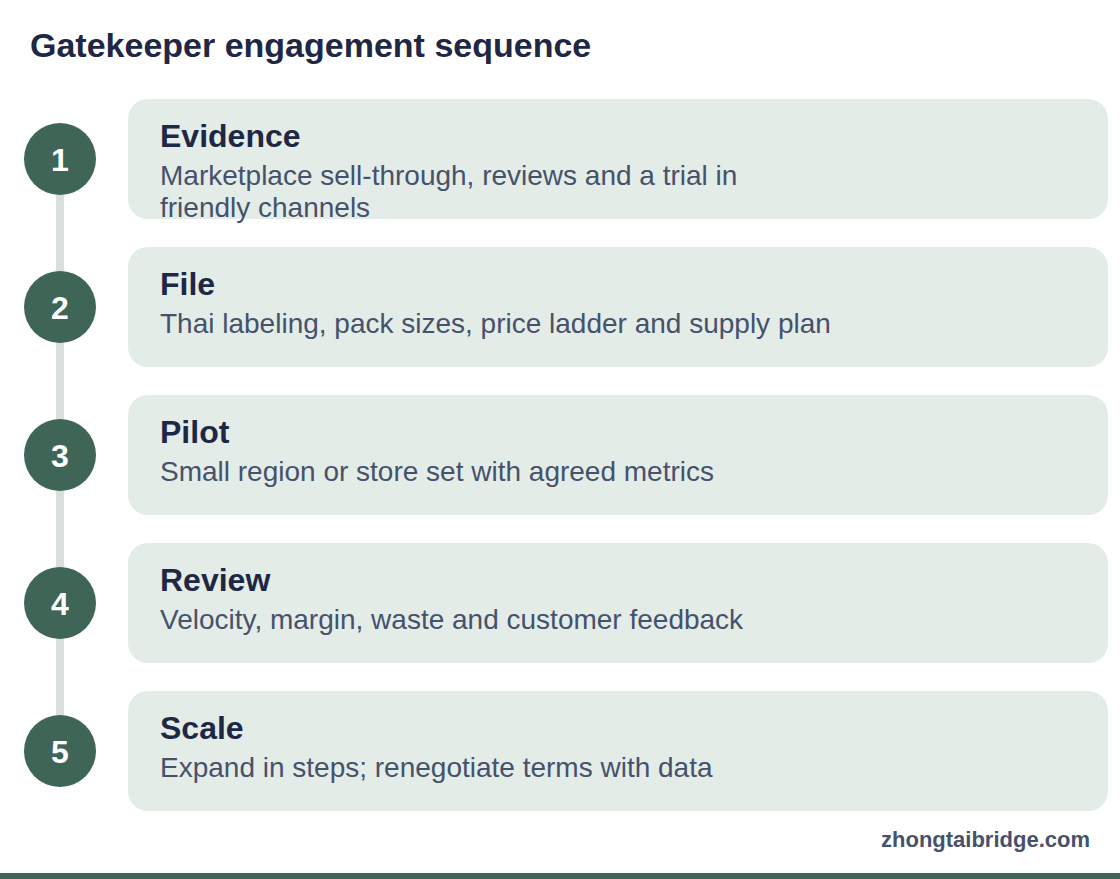
Gatekeepers decide on evidence, so start by building the file they need: sell-through data from marketplaces or regional trials, a Thai-language product and packaging set that meets local labeling expectations, a supply plan with lead times and safety stock, and a promotion proposal with funding. Approach with a pilot that is small enough for the buyer to approve quickly and informative enough to decide expansion: a defined set of stores or a region, a fixed period and agreed metrics for velocity, margin and waste. Negotiate the terms that protect you later: promotion funding limits, return and write-off rules, payment terms, delisting conditions and the use of your sales data. Keep a second route alive, such as marketplaces or a specialty channel, so that you never depend on a single customer's decision.
Gatekeeper engagement sequence
Process diagram. 1. Evidence: Marketplace sell-through, reviews and a trial in friendly channels. 2. File: Thai labeling, pack sizes, price ladder and supply plan. 3. Pilot: Small region or store set with agreed metrics. 4. Review: Velocity, margin, waste and customer feedback. 5. Scale: Expand in steps; renegotiate terms with data.
A worked example: a snack brand's pilot with a convenience chain
The example is illustrative. A Chinese snack brand proves demand on marketplaces, with strong reviews on a savory flavor and a small multipack. It develops a single-serve pack at a convenience-friendly price, with Thai labeling and a shelf life suited to distribution. It approaches a chain with sell-through data, the new pack and a supply plan. The chain agrees to a pilot in selected stores. The brand tracks velocity, waste and margin weekly and adjusts the promotion, then reports results at the end of the pilot. Based on velocity, the chain extends listing to a broader region.
The brand also keeps its marketplace channel and a distributor for provision stores, so that no single customer controls its fate. The case illustrates the sequence: proof, pack, pilot, scale.
Terms to review carefully in a retail agreement
Promotion and listing fees, and who funds discounts.
Return, expiry and write-off rules.
Payment terms and credit exposure.
Exclusivity or category restrictions.
Use of your sales data and private label risk.
Delisting conditions and notice periods.
Executive questions on retail access
Can a small foreign brand get into a major chain? Possibly, with strong evidence, the right pack and price and a reliable supply plan. Regional pilots and distributors are common first steps.
How important is private label risk? Real in successful categories. Differentiate with brand, quality and speed, and avoid sharing more data than necessary.
Should we use one distributor or several? Use one per channel or region with clear boundaries, and avoid overlaps that cause conflict.
What numbers will buyers ask for? Sell-through, margin structure, waste and promotion plans.
Frequently asked questions
Do I need 7-Eleven to succeed in Thai retail?
No. It is a powerful channel for certain categories, but marketplaces, specialty retail and distributors can support strong businesses, depending on the product.
How long does it take to get listed?
It varies widely by category and by the evidence you bring. Plan for months, and begin conversations after you have proof of demand.
Should I sell through a distributor or direct?
Direct gives you control and margin but requires capability. Distributors give reach for traditional trade. Many brands combine both.
Thailand's digital economy is projected at US$56 billion in 2025. Why sources disagree on growth, what drives it and how to model it for your entry plan.
Thailand taxed low-value imports with VAT from February 2025 and duty from 1 baht on 1 January 2026. What changes for Chinese sellers and how to respond.