
How Chinese Companies Can Enter the Thai Market: A Step-by-Step Guide
A six-stage guide for Chinese companies entering Thailand, with 2026 market data, a China-to-Thailand translation table, a 90-day plan and a launch checklist.
Read article →Market Entry

Photo: Unsplash
Short answer
B2B entry in Thailand rests on trust, references and local presence. Choose a small set of target accounts, appoint distributors carefully, use trade shows and industrial estate networks to meet buyers, provide Thai-language materials and service, and plan for sales cycles of months, not weeks.
Buyers value relationships, credibility and after-sales support. References from known customers carry weight, and decisions often involve several people, including technical, finance and senior management. Local presence reduces perceived risk. Chinese firms entering B2B should plan for sales cycles that include site visits, trials, price negotiation and documentation.
A distributor who also sells competing products may lack focus. Verify this before signing.
Industry exhibitions in Bangkok and associations in the eastern industrial provinces connect you with buyers and partners in one place. Prepare Thai-language catalogs, a demonstration, a quote process and a follow-up plan. Many leads fail because follow-up is slow or lacks Thai-language communication. Industrial estate operators and chambers of commerce can also introduce you to tenants.
A B2B sales path for Thailand
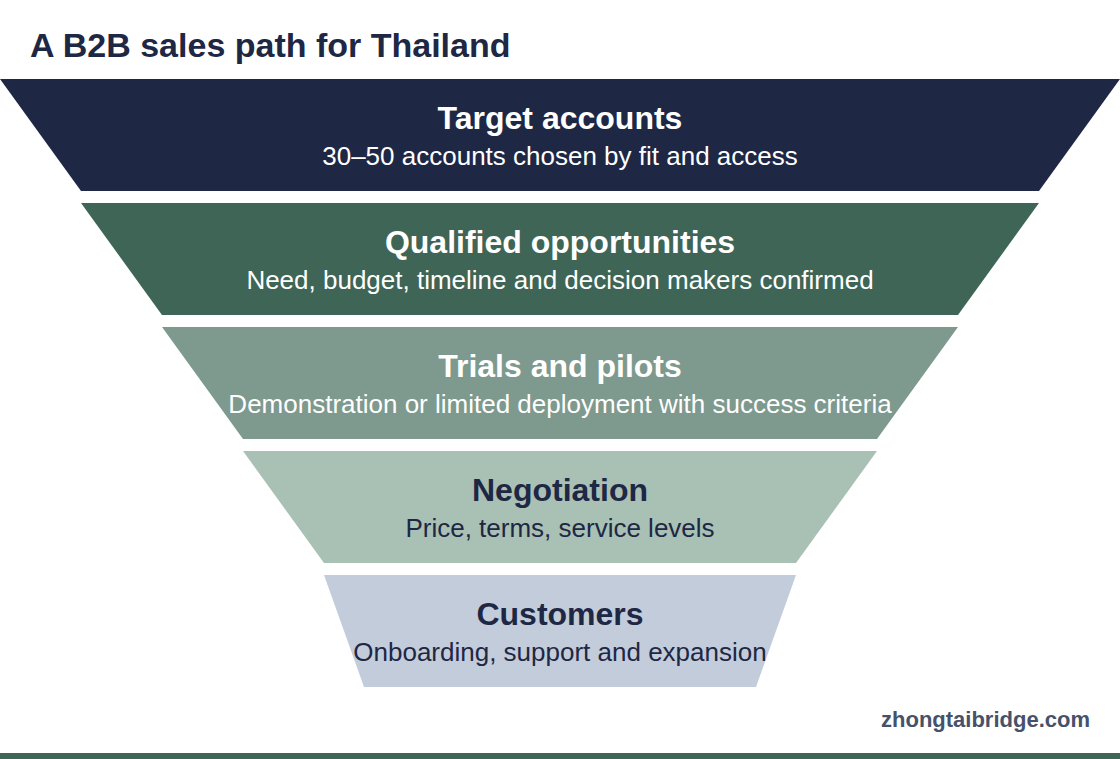
Funnel diagram. 1. Target accounts: 30–50 accounts chosen by fit and access. 2. Qualified opportunities: Need, budget, timeline and decision makers confirmed. 3. Trials and pilots: Demonstration or limited deployment with success criteria. 4. Negotiation: Price, terms, service levels. 5. Customers: Onboarding, support and expansion.
Account-based selling fits Thailand because buying groups are small and relationships matter. In the first 30 days, build the target list from BOI project announcements, industrial estate tenant lists and your existing Chinese customers' Thai plants, and map stakeholders for the top 15 accounts. In days 31 to 60, secure introductions through partners, associations and your distributor, send tailored Thai-language briefs and book technical visits. In days 61 to 90, convert the best two or three conversations into pilots with written success criteria, and prepare references that show results in comparable Thai or Chinese-owned plants. Review account progress weekly with sales, technical and service leads, and drop accounts that show no access after 60 days.
Account plan fields
| Field | Example |
|---|---|
| Account and site | Manufacturer, Rayong |
| Buying group | Plant manager, procurement, quality, finance |
| Pain point | Downtime and slow spare-part delivery |
| Offer and proof | Pilot with service-level agreement and local spares |
| Risks | Credit terms, competing incumbent |
| Next step and date | Site visit, within 14 days |
The example is illustrative. A Chinese sensor manufacturer interviews five Thai distributors. It scores them on customer relationships, technical staff, service capacity, financial health and conflicts with competing lines. Two distributors score highest. The manufacturer offers each a six-month trial in a defined territory, with joint sales calls, product training and a stock plan. At the end of the trial, it compares pipeline, response time, customer feedback and payment behavior and chooses one as the primary distributor, with exclusivity tied to targets and a review after 12 months.
The trial protects both sides. The manufacturer learns how the distributor behaves in practice, and the distributor learns whether the product and support are good enough to commit resources.
Distributors need margin to invest in selling. Set a clear price list, a distributor margin range and rules for project pricing. Avoid selling directly to the distributor's accounts without agreement. Use a deal registration process so that two partners do not compete for the same opportunity. Review prices annually and adjust for exchange rates and costs. Communicate openly about conflicts, because trust with a distributor is built in the first difficult conversation.
How long until we see a first order? Plan for months, since many buyers require site visits, trials and internal approvals. Pilots shorten the path.
Is a distributor mandatory? Not mandatory, but often useful for reach, language and service. Choose carefully and keep brand and data rights.
Which trade shows matter? Choose events where your target buyers exhibit or attend. Verify audience data and dates directly with organizers.
What references do Thai buyers want? Examples from similar plants in Thailand or Chinese-owned factories in the region, with measurable outcomes.
It depends on your model. Many firms begin with a distributor and move to a local entity as volume grows. Seek legal and tax advice.
They vary by product and customer, but plan for months, and longer for capital equipment.
Sources
A practical plan for how, where and when to launch.
 Market Entry
A six-stage guide for Chinese companies entering Thailand, with 2026 market data, a China-to-Thailand translation table, a 90-day plan and a launch checklist.
Read article → Market Entry
What a Thailand feasibility study includes, with a worked landed-cost example, scenario design, a go, adjust or stop rule and the warning signs that kill a plan.
Read article → Market Entry
Compare Thailand's four entry models on speed, margin, control and capital, with a decision matrix, an 18-month sequence and the mistakes to avoid when choosing.
Read article →Tell us about your business and goals.
We'll reply within 1–2 business days with next steps.