
How Chinese Companies Can Enter the Thai Market: A Step-by-Step Guide
A six-stage guide for Chinese companies entering Thailand, with 2026 market data, a China-to-Thailand translation table, a 90-day plan and a launch checklist.
Read article →Market Entry

Photo: Unsplash
Short answer
Large enterprises enter Thailand best through stage gates: evidence before budget, pilots before scale, and explicit exit criteria at each step. Use this checklist to structure governance, decision rights, risk controls and board reporting across six gates, from opportunity screening to scale-up.
Large firms have resources but also internal complexity: several functions, regional headquarters, legal and compliance review, and expectations of predictable returns. The risk is not under-investment but misaligned investment: money spent before the evidence justifies it, or parallel workstreams that do not share assumptions. A stage-gate structure makes decisions visible and keeps spending proportional to proof.
Six gates from idea to scale
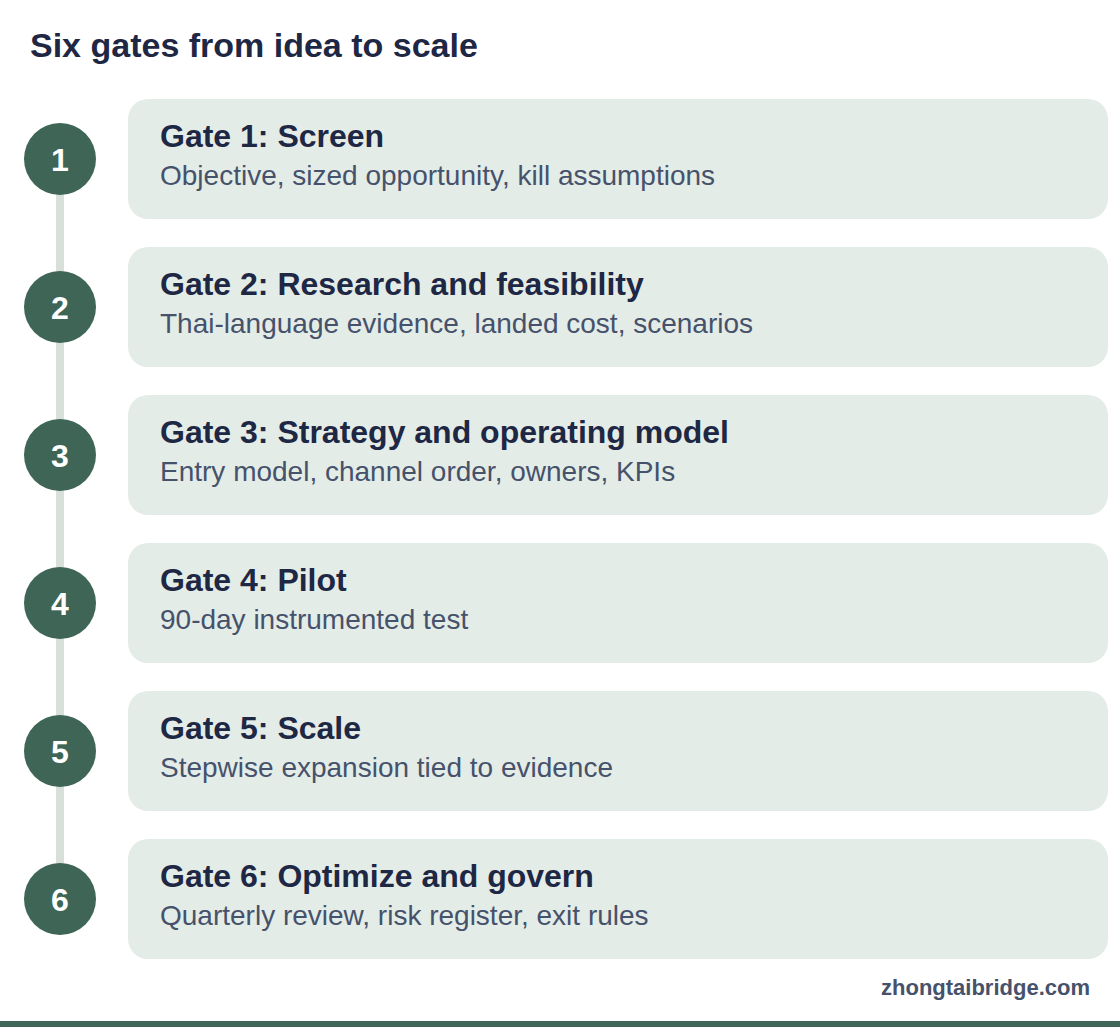
Process diagram. 1. Gate 1: Screen: Objective, sized opportunity, kill assumptions. 2. Gate 2: Research and feasibility: Thai-language evidence, landed cost, scenarios. 3. Gate 3: Strategy and operating model: Entry model, channel order, owners, KPIs. 4. Gate 4: Pilot: 90-day instrumented test. 5. Gate 5: Scale: Stepwise expansion tied to evidence. 6. Gate 6: Optimize and govern: Quarterly review, risk register, exit rules.
Decision: proceed to a pilot only if base-case economics meet the threshold and key risks have owners.
Score each from 1 to 5. Require an average of at least 4 and no score below 3 to pass a gate.
Large organizations stall when nobody owns the Thailand decision. Define decision rights at the start: who approves budget at each gate, who can change prices, who signs partner agreements, who approves Thai-language content and who can stop a campaign. The table below is a starting point to adapt.
Decision rights for a Thailand program
| Decision | Owner | Consulted | Informed |
|---|---|---|---|
| Gate approvals and budget | Executive sponsor | Finance, regional head | Board |
| Pricing and promotions | Country lead | Finance, marketing | Sales |
| Partner selection and contracts | Country lead | Legal, procurement | Executive sponsor |
| Thai-language content approval | Thai brand editor | Marketing, legal | Country lead |
| Crisis response | Crisis team lead | Legal, communications | Executive sponsor |
Review the table every quarter, because decision rights drift as the program grows. A written version prevents the slow decision-making that often costs more than any single wrong decision.
The example is illustrative. A Chinese industrial equipment maker passes Gate 1 with a clear objective to diversify revenue and a sized opportunity among Chinese-owned plants and Thai manufacturers. At Gate 2, research shows that service speed and spare parts matter more than list price, and the feasibility model finds that a local spares depot is required to meet buyers' expectations. At Gate 3 the company chooses a distributor-led entry with a Thai service partner, and sets a 12-month plan. At Gate 4 it runs a pilot with three customers, measuring uptime, response times and repeat orders. At Gate 5 it expands to additional regions and hires a service lead. At Gate 6 it adds a quarterly review.
The gates changed the outcome: they revealed the spares requirement early, saved the cost of a premature launch and aligned executives on evidence.
How do we avoid gate fatigue? Keep gates short and decisions explicit, and give the team authority to proceed when criteria are met.
Who should sit on the steering group? The executive sponsor, finance, the commercial lead, legal or compliance and the country lead.
How do we handle regulatory questions? Log them in the risk register, assign legal counsel and confirm before spending on affected activities.
What if the pilot fails? Document learning, decide whether to adjust or stop and avoid sunk-cost reasoning.
Typically a few weeks for screening and research, a month or two for strategy, and about 90 days for a pilot. Adapt to your category.
A named executive with authority over pricing, partners and budget, supported by local specialists and a cross-functional steering group.
Sources
A practical plan for how, where and when to launch.
 Market Entry
A six-stage guide for Chinese companies entering Thailand, with 2026 market data, a China-to-Thailand translation table, a 90-day plan and a launch checklist.
Read article → Market Entry
What a Thailand feasibility study includes, with a worked landed-cost example, scenario design, a go, adjust or stop rule and the warning signs that kill a plan.
Read article → Market Entry
Compare Thailand's four entry models on speed, margin, control and capital, with a decision matrix, an 18-month sequence and the mistakes to avoid when choosing.
Read article →Tell us about your business and goals.
We'll reply within 1–2 business days with next steps.