
How Chinese Companies Can Enter the Thai Market: A Step-by-Step Guide
A six-stage guide for Chinese companies entering Thailand, with 2026 market data, a China-to-Thailand translation table, a 90-day plan and a launch checklist.
Read article →Market Entry

Photo: Unsplash
Short answer
Price in Thailand is a system, not a number: a ladder of tiers, a promotion calendar, a tax-aware landed cost and a perception strategy. Constrained household liquidity and heavy campaign-day shopping reward clear price ladders and margin discipline over blanket discounts.
Use the landed cost calculator to find your break-even and minimum prices. Remember that VAT is currently charged at a reduced 7% until 30 September 2027, with a statutory rate of 10%, so model the reversion risk if you plan beyond that date.
Where a THB 899 shelf price goes (illustrative)
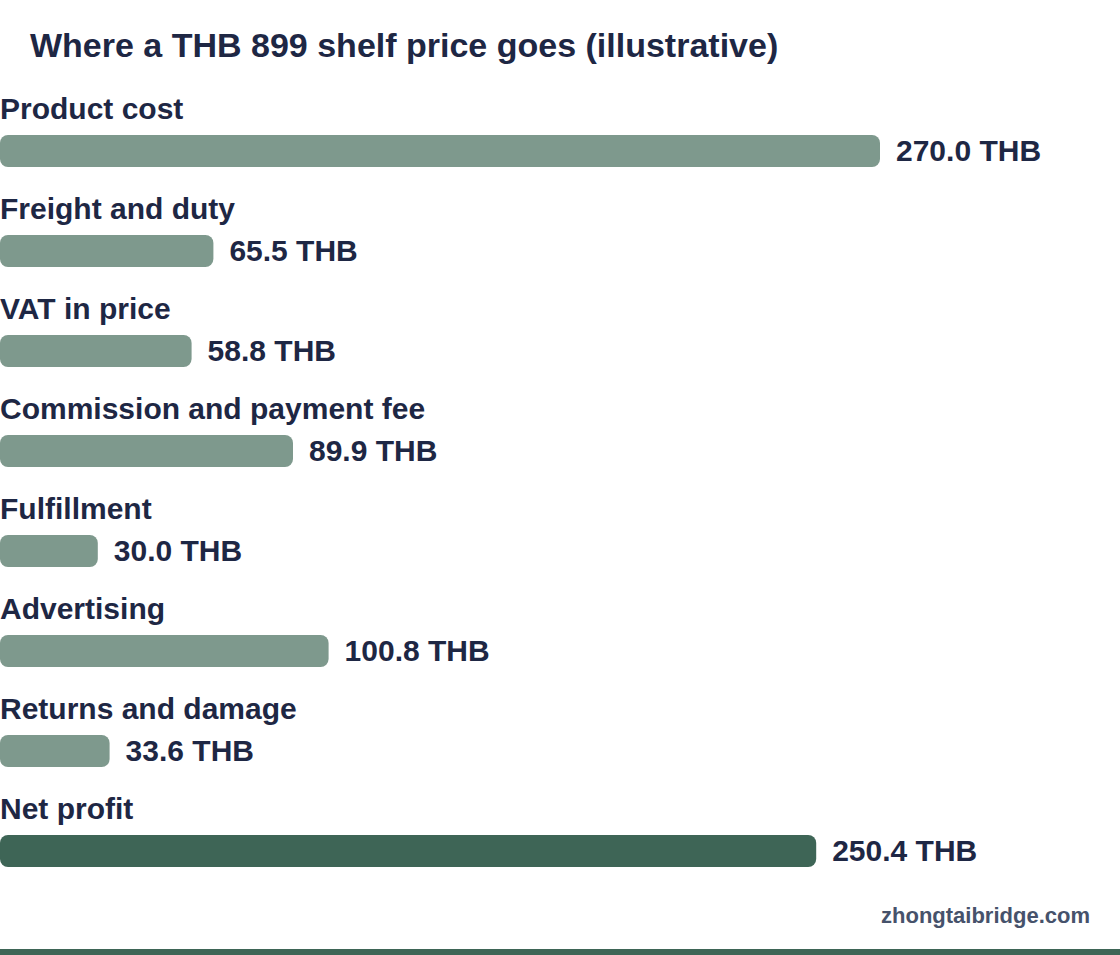
Horizontal bar chart. Product cost: 270.0 THB; Freight and duty: 65.5 THB; VAT in price: 58.8 THB; Commission and payment fee: 89.9 THB; Fulfillment: 30.0 THB; Advertising: 100.8 THB; Returns and damage: 33.6 THB; Net profit: 250.4 THB
Household debt remains high, with average household debt of about THB 795,000, and the lower debt-to-GDP ratio reflects credit restrictions, according to SCB EIC and UTCC. Households are cautious and promotion-driven. This favors visible value, flexible pack sizes and clear justification for premium prices, such as design, quality evidence or service.
Shoppers concentrate purchases on marketplace sale days. If your regular price is too close to your sale price, you earn little margin on those days. If it is too high, shoppers wait. Set a regular price that can fall to the campaign price while preserving your target margin, and limit deep discounts to a few products and days. Align inventory and ad budgets with the plan.
A price ladder with a job for each tier
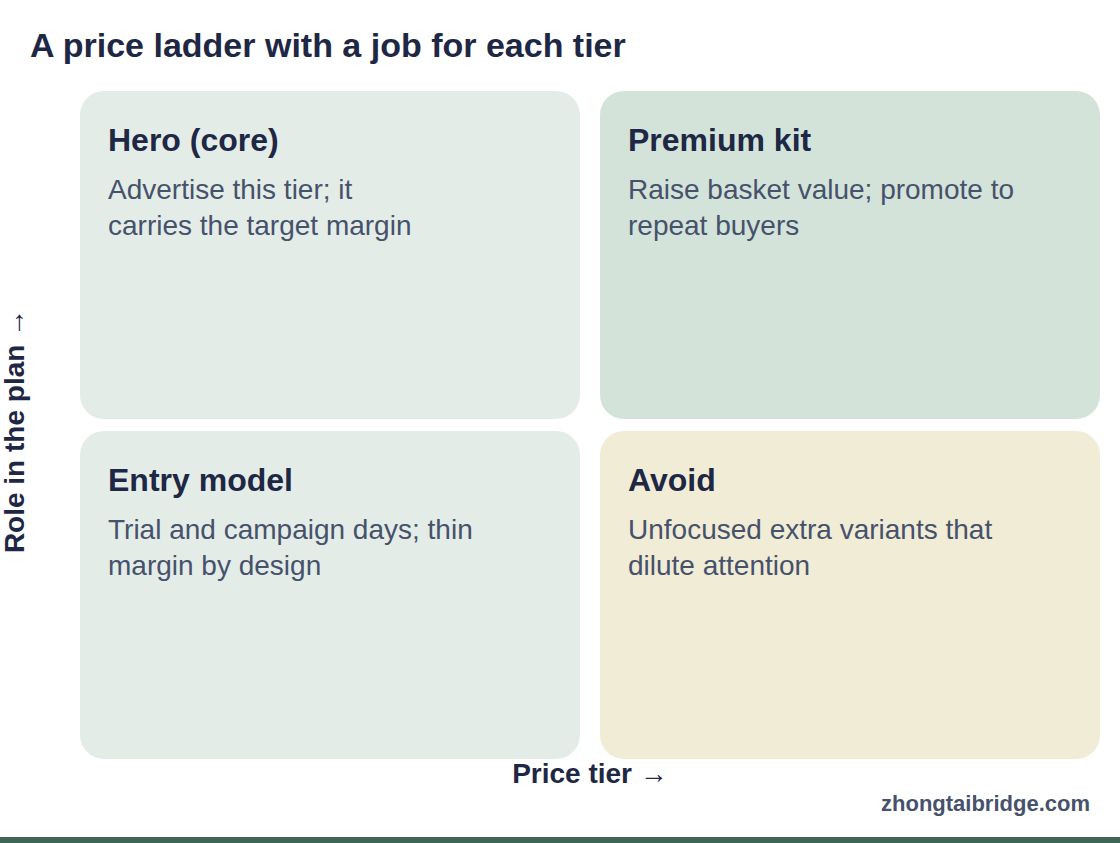
Two-by-two matrix. Horizontal axis: Price tier. Vertical axis: Role in the plan. Hero (core): Advertise this tier; it carries the target margin. Premium kit: Raise basket value; promote to repeat buyers. Entry model: Trial and campaign days; thin margin by design. Avoid: Unfocused extra variants that dilute attention.
The example is illustrative. A brand sells a portable blender. The entry model at THB 599 has a smaller jar and fewer accessories, the core model at THB 899 is the hero, and the premium kit at THB 1,290 adds a second jar and a travel case. The landed-cost calculator shows the entry model has a thin margin but attracts trial, the core model delivers the target margin, and the premium kit has the highest absolute profit. The brand advertises the core model, uses the entry model for campaign days and promotes the premium kit to repeat buyers on LINE.
The point is that each tier has a job. Define the job before you set the price.
Pricing governance prevents panic discounts. Give one person authority to change prices within a band, and require a second approval for moves outside it. Define triggers that justify a review: a change in landed cost of more than 5%, a currency move beyond a set range, a rule change on duty or VAT, a competitor price cut that persists for two weeks and a shift in conversion rate that does not respond to listing fixes. Record every change with the reason and the result.
Tax assumptions deserve a calendar entry. The reduced 7% VAT rate runs until 30 September 2027, after which the statutory 10% applies unless extended, and import duty has applied to online imports since 1 January 2026. Models that assume today's rules forever will be wrong, so keep a scenario for the statutory rate and for tighter duty schedules.
The example is illustrative. A brand sells a small appliance at THB 1,290 on its own site and wants to list on two marketplaces. Marketplace commissions and voucher funding mean that matching the price exactly erodes margin, so the brand creates marketplace-specific bundles that include an accessory, keeping the headline price comparable while raising the value. On campaign days it offers a limited discount on the core model but protects the premium kit. It monitors competitor prices weekly and sets a trigger: if a direct competitor cuts price for two weeks, it reviews bundle value before changing the headline price.
This approach keeps price consistent while using bundles to adapt to channel economics. It also avoids training customers to wait for a discount on the headline model.
Should we price below local competitors to win share? Only if your cost structure supports it and you can survive a response. Otherwise compete on value and service.
How do we handle currency movements? Build a buffer, review prices monthly and set rules for when to adjust.
Do discounts hurt the brand? Frequent, deep discounts can train customers to wait. Use limited, planned promotions and bundles.
Who should own pricing? The country lead with finance input, within agreed bands.
Not by default. Compete on a clear value proposition, and use low-price entry products to attract trial without lowering the price of your core line.
Review monthly, and after any change in costs, exchange rates, taxes or competitor behavior.
Sources
A practical plan for how, where and when to launch.
 Market Entry
A six-stage guide for Chinese companies entering Thailand, with 2026 market data, a China-to-Thailand translation table, a 90-day plan and a launch checklist.
Read article → Market Entry
What a Thailand feasibility study includes, with a worked landed-cost example, scenario design, a go, adjust or stop rule and the warning signs that kill a plan.
Read article → Market Entry
Compare Thailand's four entry models on speed, margin, control and capital, with a decision matrix, an 18-month sequence and the mistakes to avoid when choosing.
Read article →Tell us about your business and goals.
We'll reply within 1–2 business days with next steps.