Chinese Visitor Flows to Thailand as a Demand Signal for Consumer Brands
By ZhongTai Bridge Editorial · Last reviewed October 2026 · 8 min read
Photo: Unsplash
Short answer
Chinese arrivals in Thailand fell from 11.1 million in 2019 to 4.47 million in 2025, and a single social-media-driven safety scare in early 2025 reshaped flows within weeks. China remains Thailand's largest source market in 2026, with 2.54 million arrivals by 20 June. Treat visitor numbers as a volatile, sentiment-driven signal, model them in scenarios, and do not build a business case on a single year.
What happened to Chinese visitor numbers?
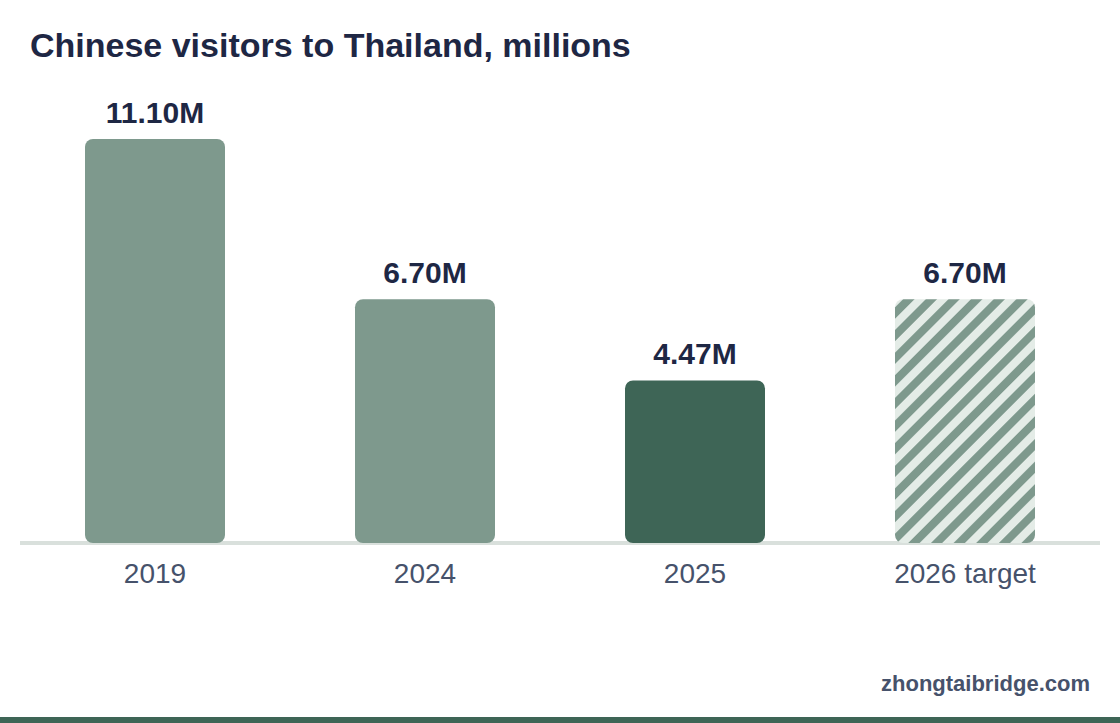
2019: about 11.1 million Chinese visitors, equal to 28% of 39.8 million foreign arrivals.
2024: about 6.7 million Chinese arrivals, according to figures cited in 2026 reporting.
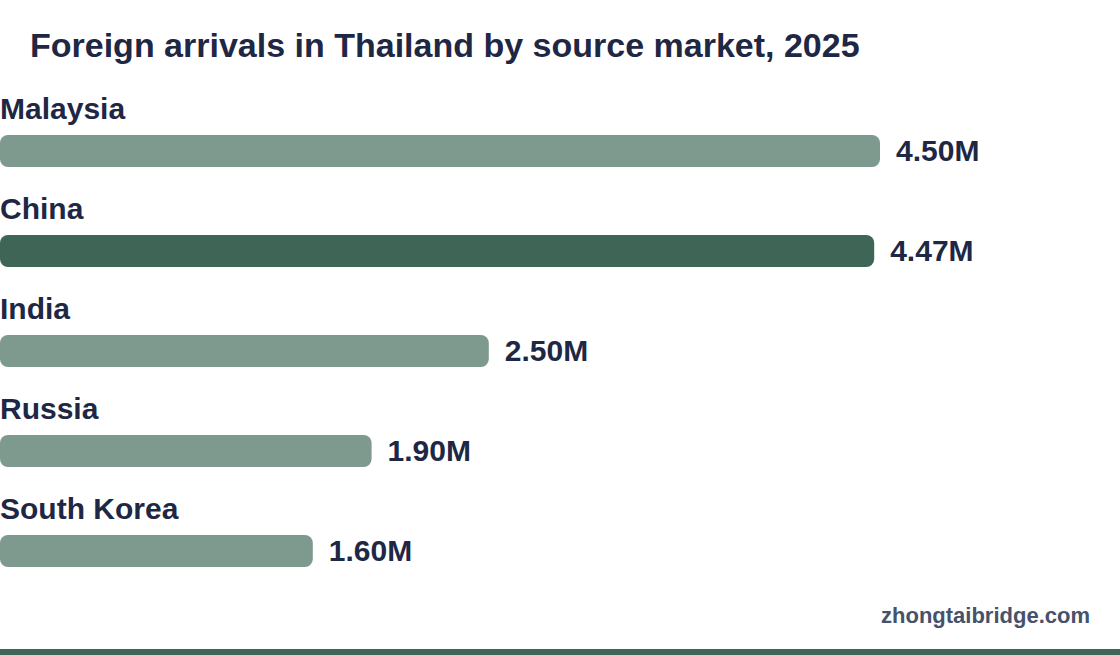
2025: 4.47 million Chinese arrivals, according to Ministry of Tourism and Sports data, placing China second to Malaysia at 4.5 million for the first time in many years.
2025 total: about 33 million foreign visitors, the first decline in years, with foreign visitor revenue of THB 1.5 trillion, down 4.7%.
2026 to date: 15.45 million foreign arrivals between 1 January and 20 June 2026, generating THB 745 billion, with China still the largest source market at 2.54 million, or about 16% of arrivals.
The Tourism Authority of Thailand (TAT) set a 2026 target of 6.7 million Chinese visitors, up at least 40% from an estimated 4.5 million to 4.6 million in 2025. Whether that target is met will be one of the clearest tests of how quickly the market is normalizing.
By 20 June 2026, 2.54 million Chinese visitors had arrived. Source: Ministry of Tourism and Sports; Tourism Authority of Thailand.
Foreign arrivals in Thailand by source market, 2025
Horizontal bar chart. Malaysia: 4.50M; China: 4.47M; India: 2.50M; Russia: 1.90M; South Korea: 1.60M
Source: Ministry of Tourism and Sports, via Free Malaysia Today.
Why did the flows move so fast?
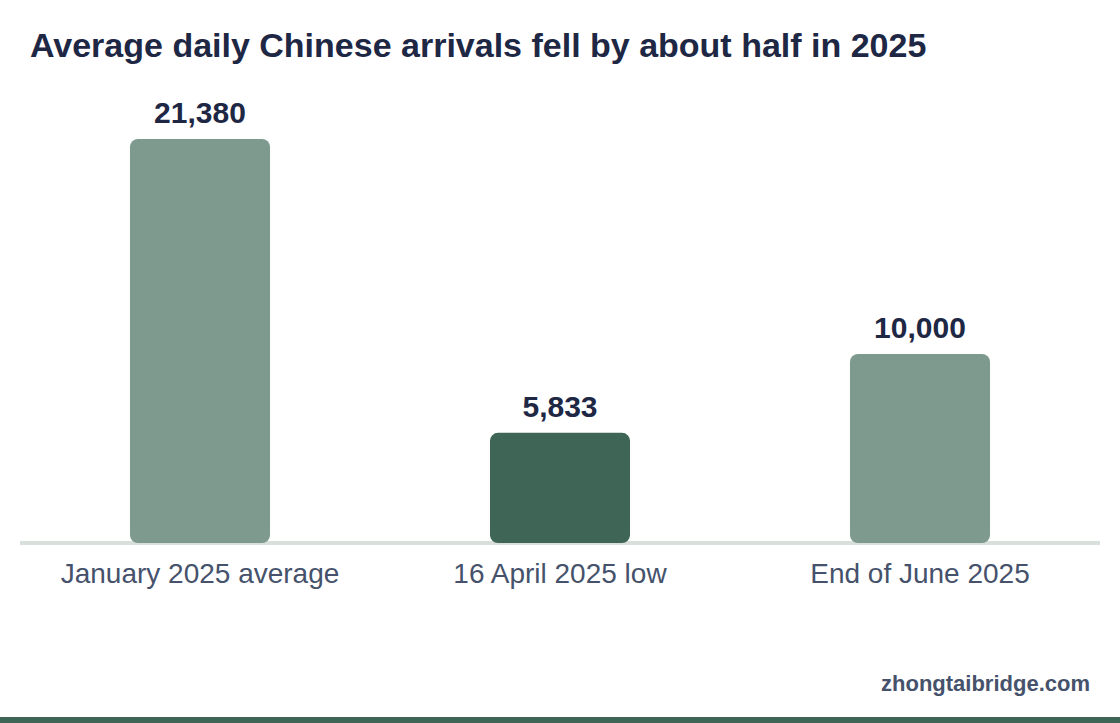
TAT's governor attributed the sharp weakening from late February 2025 to negative sentiment on Chinese social media after the disappearance of a Chinese actor near the Thai border. Arrivals had risen 22% in January 2025. By 16 April, daily Chinese arrivals dropped to about 5,800, the lowest since the visa-free arrangement between the two countries began. In March 2025, roughly 300,000 Chinese tourists visited Thailand, while Vietnam received about 670,000, the first time Vietnam overtook Thailand for Chinese arrivals.
The pattern shows how quickly sentiment on Chinese platforms can change travel behavior. Average daily arrivals fell from about 21,380 in January 2025 to about 10,000 by the end of June. Stimulus campaigns with online travel agencies reduced the decline from about 40% to about 30%, according to TAT, which indicates that marketing can soften but not erase a trust shock.
For brands, the lesson is that Chinese outbound demand is highly responsive to narrative. Trust in destination safety, price perceptions and competition from other destinations all move together, and they move on social platforms where Thailand has limited control.
Average daily Chinese arrivals fell by about half in 2025
Column chart. January 2025 average: 21,380; 16 April 2025 low: 5,833; End of June 2025: 10,000
Sentiment on Chinese social media moved arrivals within weeks. Source: Pattaya Mail; Tourism Authority of Thailand.
Why do Chinese visitors matter to consumer brands in Thailand?
Chinese visitors have historically been high-spending and long-staying, according to the former TAT governor quoted by Pattaya Mail, who estimated that winning back one million Chinese visitors could add THB 40 billion to 50 billion to the economy. That implies roughly THB 40,000 to 50,000 per visitor in total trip spending, an estimate rather than an audited figure.
Several categories depend on visitor flows: beauty and personal care, fashion and accessories, food and beverage, wellness, souvenirs and gifts, and services concentrated in tourist districts. For a Chinese brand, visitors can also act as a bridge: they know the brand from home, and they can be reached with Chinese-language content on platforms such as Xiaohongshu before and during their trip.
How should you model visitor-driven demand?
Avoid a single-year extrapolation. Build the demand estimate from components and test each one.
Arrivals: use low, base and high scenarios. For 2026, a reasonable range runs from the 2025 level of about 4.5 million to TAT's 6.7 million target, with the 2019 level of 11.1 million as an upper bound that is not close.
Visit pattern: share of visitors who go to the districts where you operate, and average length of stay.
Spend per visitor in your category: use your own sales data or partner data, not total trip spend.
Capture rate: the share of visitors who buy from you, driven by awareness, price and convenience.
Seasonality: Chinese holiday periods, such as the Dragon Boat Festival, which lifted arrivals in June 2026, create peaks.
Multiply the components for each scenario and compare. If the plan only works at the high scenario, you do not have a business case, you have a hope.
How should brands position for a volatile source market?
Diversify demand. Balance visitor demand with resident Thai and long-stay customers so that a single shock does not threaten the plan.
Be present before arrival. Content on Xiaohongshu and other Chinese-language platforms shapes where visitors go and what they buy, and it is cheaper than competing at the point of sale.
Invest in trust signals. Clear pricing, reliable service and visible reviews matter more in a market where a single negative story can change flows.
Use local partners. Hotels, travel platforms and tour operators control access to visitors, and a partnership can lower acquisition cost.
Keep flexible cost structures. Short leases, scalable staffing and modular inventory protect you if arrivals swing.
What are the risks of relying on arrivals data?
Arrivals are not spend. Visitor mix, length of stay and budget change over time.
Preliminary figures are revised. Use the latest ministry release and note the date.
Composition changes. Independent travelers behave differently from group tours, and online travel platforms influence both.
Policy shifts, such as the visa-free arrangement or a planned tourism fee, can affect volume and sentiment.
Reports from different sources round numbers differently. Always cite the source and period.
What should you track every week?
The Ministry of Tourism and Sports weekly arrivals by source market.
Flight capacity between China and Thailand and airfare trends.
Sentiment on Chinese social media about Thailand, including safety and price topics.
Your own footfall, sales by customer language and online enquiries from Chinese-speaking users.
Competing destinations' campaigns and visa policies.
These indicators can serve as an early warning. In 2025, a change in sentiment showed up in social media weeks before the full effect appeared in annual statistics.
An illustrative scenario table
The figures below are hypothetical, designed to show the structure of a visitor-driven demand model. Replace each input with your own data.
Low scenario: 4.5 million Chinese arrivals, 12% visit your districts, 3% capture rate, average spend of THB 1,200 with your brand. Revenue potential: about THB 19 million.
Base scenario: 5.5 million arrivals, 12% visit your districts, 4% capture rate, THB 1,200 average spend. Revenue potential: about THB 32 million.
High scenario: 6.7 million arrivals, 14% visit your districts, 5% capture rate, THB 1,300 average spend. Revenue potential: about THB 61 million.
Notice that the high case is more than three times the low case, even though arrivals differ by less than 50%. Small changes in visit pattern and capture rate compound. This is why a plan that depends on the high case is fragile, and why improving capture through content, partnerships and service often moves results more than waiting for arrivals to recover.
Implications by business type
Retail and beauty: concentrate stock and staff in tourist-heavy locations during Chinese holiday peaks, and accept Chinese payment methods where permitted and practical.
Food and beverage: pre-trip awareness on Chinese platforms and clear menus in Chinese reduce friction and wait times.
Wellness and services: partner with hotels and online travel platforms for bookings, and design packages around typical stay lengths.
Brands entering Thailand for the resident market: treat visitor flows as a brand-awareness bonus, not as the base case.
Questions an executive should ask
Which part of our revenue plan would change if arrivals stay at 4.5 million for another year?
Do we know where our Chinese-speaking customers first heard of us?
Which partner controls access to visitors in our location, and what is the cost of that access?
What would a negative story on Chinese social media do to our sales in four weeks, and what is our response plan?
How should you segment Chinese-speaking visitors by trip purpose?
Arrival counts hide different needs. Leisure travelers on group tours buy at stops chosen by operators and respond to partnership offers. Independent travelers research on Chinese platforms before they arrive and choose places from reviews and short videos. Business and exhibition visitors need services that fit tight schedules, and long-stay visitors behave more like residents. Map your category to the segment that buys it and design the offer, language and partners for that segment, not for an average visitor.
Chinese-speaking visitor segments
Segment
How they decide
Best channel
Group tour
Itinerary set by operator
Operator and guide partnerships
Independent traveler
Chinese-language reviews and short video
Xiaohongshu, Douyin, travel platforms
Business traveler
Convenience and reliability
Hotel and concierge partners, WeChat enquiry
Long-stay resident
Price and service continuity
LINE, community groups, delivery
A plan that covers two segments well will usually beat one that spreads effort thinly across four.
Frequently asked questions
Is China still Thailand's largest source of visitors?
In 2026 to date, yes: China was the largest source market with 2.54 million arrivals through 20 June. In full-year 2025, Malaysia narrowly led with about 4.5 million versus 4.47 million from China.
Will Chinese arrivals return to 2019 levels?
Not soon. Analysts quoted in 2025 coverage expected a recovery to 70% to 80% of pre-pandemic levels by the end of 2026 at best, and the 2026 target of 6.7 million is well below 11.1 million.
How can a consumer brand reach Chinese visitors before they arrive?
Through Chinese-language content on platforms such as Xiaohongshu, partnerships with online travel platforms and consistent information on pricing, location and payment options.
Thailand's digital economy is projected at US$56 billion in 2025. Why sources disagree on growth, what drives it and how to model it for your entry plan.
Thailand taxed low-value imports with VAT from February 2025 and duty from 1 baht on 1 January 2026. What changes for Chinese sellers and how to respond.