Measuring Brand Visibility in ChatGPT, Gemini and Perplexity: A Repeatable Method
By ZhongTai Bridge Editorial · Last reviewed October 2026 · 5 min read
Photo: Unsplash
Short answer
Measure AI visibility with a fixed prompt set in Thai, English and Chinese, run on a schedule, scored with a simple rubric and logged in one sheet. The goal is trend, not precision: answers vary, so repeat runs and track movement against competitors.
Why does AI visibility need its own measurement?
Traditional rank tracking does not show whether an assistant mentions or recommends your brand. Because assistants generate answers that vary by wording, location and session, you need a method that accepts variation and looks for patterns.
How do you design the prompt set?
Choose three groups: category questions, comparison and selection questions, and brand questions.
Write 30 to 40 prompts reflecting how real customers ask, including long and short forms.
Create Thai, English and Chinese versions of the important prompts.
Include competitor names in some prompts to see how you are compared.
Freeze the set for three months so that trends are meaningful.
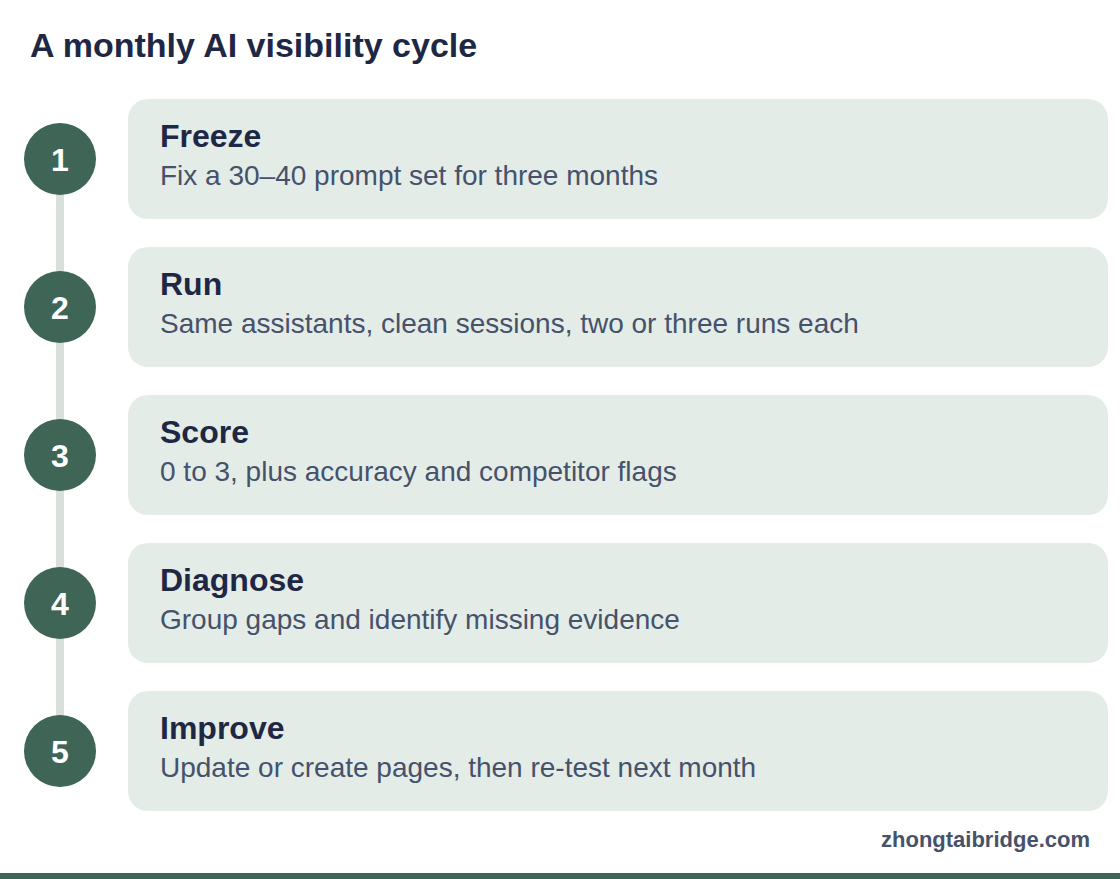
A monthly AI visibility cycle
Process diagram. 1. Freeze: Fix a 30–40 prompt set for three months. 2. Run: Same assistants, clean sessions, two or three runs each. 3. Score: 0 to 3, plus accuracy and competitor flags. 4. Diagnose: Group gaps and identify missing evidence. 5. Improve: Update or create pages, then re-test next month.
How do you run the test consistently?
Use the same assistants each month and note the version or mode.
Use clean sessions without personalization where possible.
Run each prompt two or three times to capture variation.
Record the date, assistant, prompt, response and cited sources.
Have two people score to reduce bias.
What should the scoring rubric look like?
0: brand not mentioned.
1: brand mentioned without a link or recommendation.
2: brand cited with a link or described accurately as an option.
3: brand recommended or listed first with accurate description.
Accuracy flag: mark any incorrect statement about your brand.
Competitor flag: note which competitors appear.
Scoring rubric
Score
Meaning
0
Brand not mentioned
1
Mentioned without link or recommendation
2
Cited with a link or described accurately as an option
3
Recommended or listed first, described accurately
How do you turn results into action?
Group prompts where you score 0 and identify the missing page or evidence.
Check which sources assistants cite and whether you can appear there.
Correct inaccurate statements by updating your pages and profiles.
Create or improve pages for gap topics.
Re-test after changes and record the effect.
How do you report to leadership?
Average visibility score and the share of prompts with a citation.
Trend over time and by language.
Top competitors in AI answers.
Actions taken and planned.
Business indicators: branded search and qualified enquiries.
Explain that results are directional and that the aim is steady improvement.
Summary tab: average score by assistant and language, trend lines and top gaps.
Action log: gap, hypothesis, content change, date and re-test result.
Interpreting noisy results
Single answers can vary widely, so look for stable patterns: a prompt where you appear in most runs, a source that is cited repeatedly or a competitor that dominates a group of questions. If results change after you publish or update content, note the date and the change, but avoid claiming causation from one data point. Over several months, correlation with content actions becomes more convincing.
Dashboard fields and formulas
Keep one sheet with a row per prompt run. Columns: date, assistant, language, prompt group, prompt, run number, score, accuracy flag, competitors mentioned, sources cited and notes. Summary formulas: average score by assistant and language, share of prompts with a score of 2 or more, the number of distinct sources cited that belong to you and the top five competitors by frequency. Add a gap list of prompts that score zero in two consecutive months, with an owner and a planned fix. Report the trend quarterly and annotate it with the content changes you made, so that readers can see the relationship without claiming certainty. Treat variation honestly: if two runs of the same prompt differ, record both.
A worked example: three months of prompt tracking for a market entry advisor
The example is illustrative. A Thailand market-entry advisor builds a set of 36 prompts: twelve category questions such as how a Chinese company can enter the Thai market, twelve selection questions such as what to ask before hiring an agency, and twelve brand and competitor questions. In month one the brand scores zero on most category prompts and mostly appears when its name is typed. The team finds that assistants cite government statistics pages, a handful of consultancies and a few explainers, and none of its pages. It rewrites its pillar guide with an answer-first opening, sourced statistics and an FAQ, publishes a sourced statistics page and earns two third-party mentions.
By month three the brand reaches a score of one or two on several category prompts and is cited on two selection prompts. The team does not claim that the changes caused the movement, but it records what changed and when, repeats the test and keeps the gap list. This is what useful measurement looks like in a field with noisy outputs.
Sampling choices that make results more reliable
Use the same wording for each prompt and keep a second set of paraphrases for robustness checks.
Test at similar times of day and from a Thai network or location setting where possible.
Log the assistant version or mode, since behavior changes.
Run each prompt two or three times and record the range.
Have two reviewers score a sample to check consistency.
Archive full answers so that you can review later what the assistant actually said.
Executive questions on AI visibility metrics
Which assistants should we test? Those your buyers use. Start with the most used general assistants in Thailand and add search-integrated assistants as relevant.
How do we compare with competitors? Include competitor names in some prompts and log which brands appear, then track share of mentions over time.
Is it worth paying a tool vendor? Evaluate their method, language coverage and transparency. A manual log may be enough for the first quarter.
What is a good target? Move key prompts from zero to a mention, then to a citation. Targets should be set from your baseline.
Frequently asked questions
How many prompts are enough?
Thirty to forty well-chosen prompts give a useful picture. Add more only if you can maintain consistency.
Can tools automate this?
Some tools help, but verify their methods. A manual log is often enough at the start.
A complete Thai SEO guide: Google's 99.5% share, Thai keyword research, site architecture, content, technical checks, local signals, AI search and a 90-day roadmap.
A step-by-step Thai keyword research method: seed terms, segmentation, transliteration, intent mapping, marketplace suggestions, templates and a worked example.
A practical GEO guide for Thailand: AI adoption data, how assistants choose sources, answer-first pages, entity signals, prompt testing and a 90-day plan.