PR in Thailand for Foreign Brands: How to Earn Credible Coverage
By ZhongTai Bridge Editorial · Last reviewed October 2026 · 5 min read
Photo: Unsplash
Short answer
Earned coverage in Thai media builds trust that advertising cannot, and it supports search and AI visibility. Start with a genuinely newsworthy angle, write natural Thai, target the right outlets and journalists, prepare spokespeople and measure branded search, referrals and message pull-through.
Why does PR matter for a foreign brand in Thailand?
Coverage from credible outlets gives a new brand third-party validation. It also helps search and AI visibility, because credible mentions help machines and people trust a brand. Thai audiences read news on mobile and social platforms, and 56.6 million social media identities mean that articles travel quickly beyond the outlet. For Chinese brands facing scrutiny about imports, pricing and competition, a record of constructive, factual coverage also supports reputation in difficult moments.
What makes a launch newsworthy?
Turning a launch into a news angle
Angle
Example
Evidence editors want
Investment and jobs
A service center or plant opens
Amount, jobs, local suppliers
New technology for a local problem
A product solves a Thai pain point
Data, demonstration, independent test
Consumer benefit
Lower prices or new choice
Price comparison, availability
Partnership
Collaboration with a respected Thai organization
Named partner, quote, scope
Original research
A market survey or index
Method, sample, downloadable data
Editors rarely cover a launch for its own sake. They cover something that matters to readers. Translate your announcement into one of these angles and present evidence that can be checked.
How do you write a Thai press release?
Write in natural Thai with the key news in the first paragraph, a quote from a named spokesperson, facts that can be checked and a clear contact reachable during Thai hours. Add images with captions and a one-page fact sheet. Provide Chinese and English versions for your own team, but have the Thai written by a native writer, not translated. Avoid unprovable superlatives such as best or first.
How do you target the right media?
Build a list by category: business news, technology, lifestyle, trade media and online outlets, in Thai and English. Thai-language business outlets and general news reach local executives and consumers, English-language outlets such as Bangkok Post, The Nation Thailand and Khaosod English reach foreign communities and regional readers, and marketing trade media reach brand and agency audiences. Read each journalist's recent work before you pitch and personalize the angle. Verify each outlet's audience, since formats and editorial focus change.
How should spokespeople prepare?
Prepare three key messages, answers to difficult questions and a short Thai-language introduction. Practice with a native Thai speaker, decide when to use an interpreter and agree how quotes will be reviewed. Choose a senior spokesperson who can speak about Thailand-specific commitments such as jobs, suppliers and customer service, since journalists look for local relevance.
What does a launch PR timeline look like?
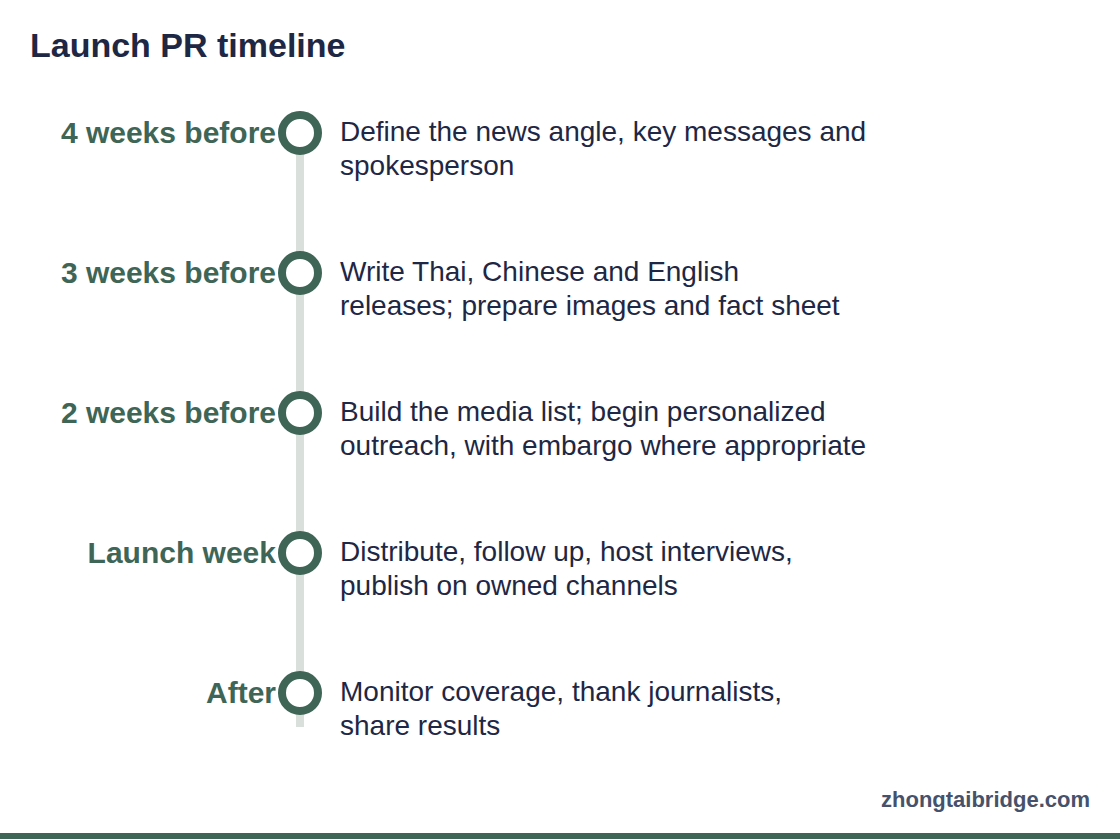
Launch PR timeline
Timeline. 4 weeks before: Define the news angle, key messages and spokesperson. 3 weeks before: Write Thai, Chinese and English releases; prepare images and fact sheet. 2 weeks before: Build the media list; begin personalized outreach, with embargo where appropriate. Launch week: Distribute, follow up, host interviews, publish on owned channels. After: Monitor coverage, thank journalists, share results.
How does PR support search and AI visibility?
Mentions in credible Thai outlets provide independent evidence that your brand exists and does what it claims. Assistants and search systems favor facts that several sources corroborate. Link press coverage from your site, keep company descriptions consistent across channels, and reuse original data in later articles. A July 2025 poll found about 54% of respondents using AI, and a presentation reported 75% of consumers, so the audience for those answers is large.
How do you measure PR?
Quality: tier of outlet, prominence and tone.
Message pull-through: how many of your key messages appear.
Referral traffic and branded search growth.
Share of voice against two or three competitors.
Inbound requests from partners, customers and media.
Label paid placements clearly and keep them separate from earned coverage.
A worked example: a Chinese manufacturer opens a Thai service center
The example is illustrative. The company wants coverage that signals long-term commitment. The team chooses an angle around local training and service: the service center will train a group of Thai technicians, source spare parts from local suppliers and offer response times that match Thai customers' expectations. It prepares a fact sheet with the number of jobs, the investment amount and certifications, a quote from a senior executive in Thai and an offer of a site visit. It gives one business outlet an embargoed preview and then distributes to others at the launch. A trade publication receives a separate technical angle.
Coverage appears in business and trade outlets and is shared on LinkedIn and Thai social media. The company links the articles from its website, which helps search and AI visibility and builds credibility with prospects.
Crisis-aware PR hygiene
Strong PR depends on facts that stand up to scrutiny. Check every number, name and claim before release, confirm that quotes are approved and make sure the company's website and social profiles support the story. Keep a list of difficult questions, such as pricing, competition with local firms and employment practices, and prepare honest answers. A company that has prepared for tough questions is more trusted when it gets them.
Executive questions on PR
How do we measure PR when sales are the goal? Track referral traffic, branded search, enquiries that cite coverage and partner approaches, and compare them with a baseline period.
Should we announce before or after launch? Announce when you have something concrete to show, such as a site, a product or a partner, and avoid vague teasers.
What if coverage is critical? Respond factually and promptly, correct errors politely and avoid public arguments. Offer data and access to resolve concerns.
How much budget is needed? It depends on scope. Start with a launch moment and a small set of targeted outlets before scaling.
Frequently asked questions
Is paid coverage the same as PR?
No. Paid placements are advertising and should be labeled. Earned coverage depends on newsworthiness.
How long does PR take?
A launch campaign typically takes a few weeks to prepare, while relationships and results build over months.
Do I need Thai-language releases?
Yes. Thai journalists and readers expect Thai-language materials.
How much coverage should I expect?
It depends on news value, timing and relationships. Plan for quality over quantity.
How to prepare for reputational crises in Thailand: risk mapping, response protocols, tone, Thai-language statements and lessons from Chinese visitor and EV cases.
How to build executive visibility in Thai media: outlet types, pitching, language, commentary, speaking and measuring influence beyond coverage counts.
A six-stage guide for Chinese companies entering Thailand, with 2026 market data, a China-to-Thailand translation table, a 90-day plan and a launch checklist.