Thailand's Aging Population and the Next Consumer Segments
By ZhongTai Bridge Editorial · Last reviewed October 2026 · 5 min read
Photo: Unsplash
Short answer
More than 20% of Thailand's population is now aged 60 or over, the registered population fell to 65.8 million in 2025, and the median age is about 42. Growth will come from older consumers, their adult children and care-related categories, not from a larger population. Model your market on a shrinking base and target value per customer.
What does the demographic data show?
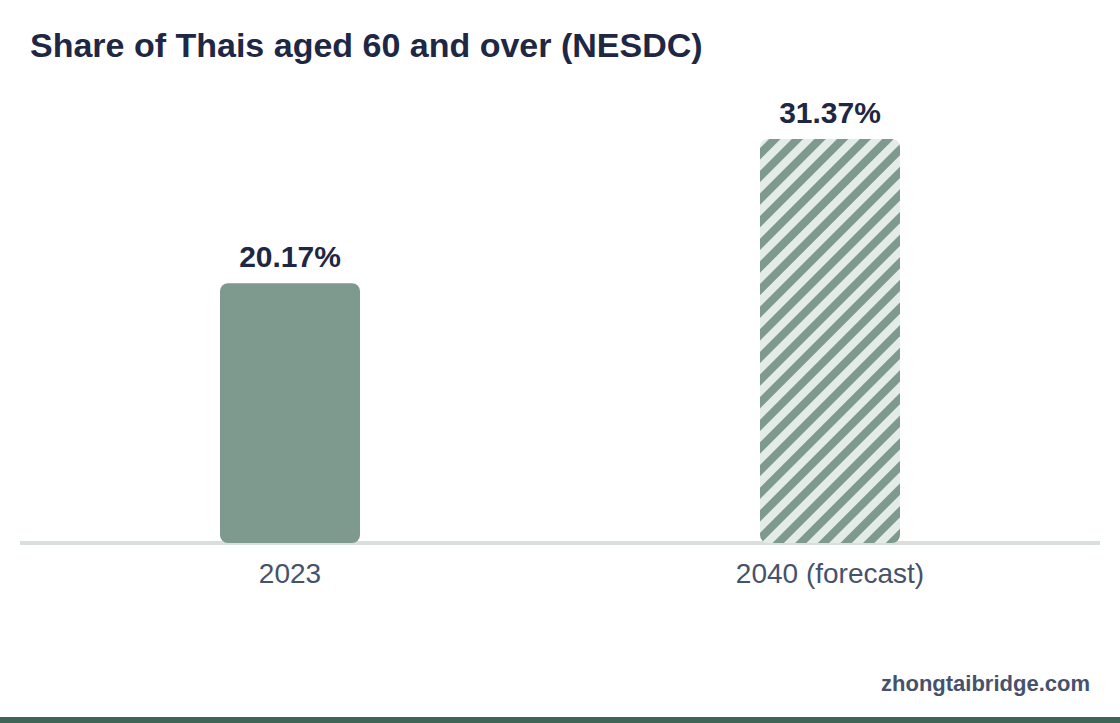
Thailand has aged faster than almost any middle-income country. According to the National Economic and Social Development Council (NESDC), 20.17% of the population was older than 60 in 2023, and the share is forecast to reach 31.37% by 2040. Thailand's Department of Provincial Administration reported a registered population of 65.8 million at the end of 2025, a decline from the previous year, and the Labour Minister noted that more than 20% of the population, around 15 million people, were aged 60 or over.
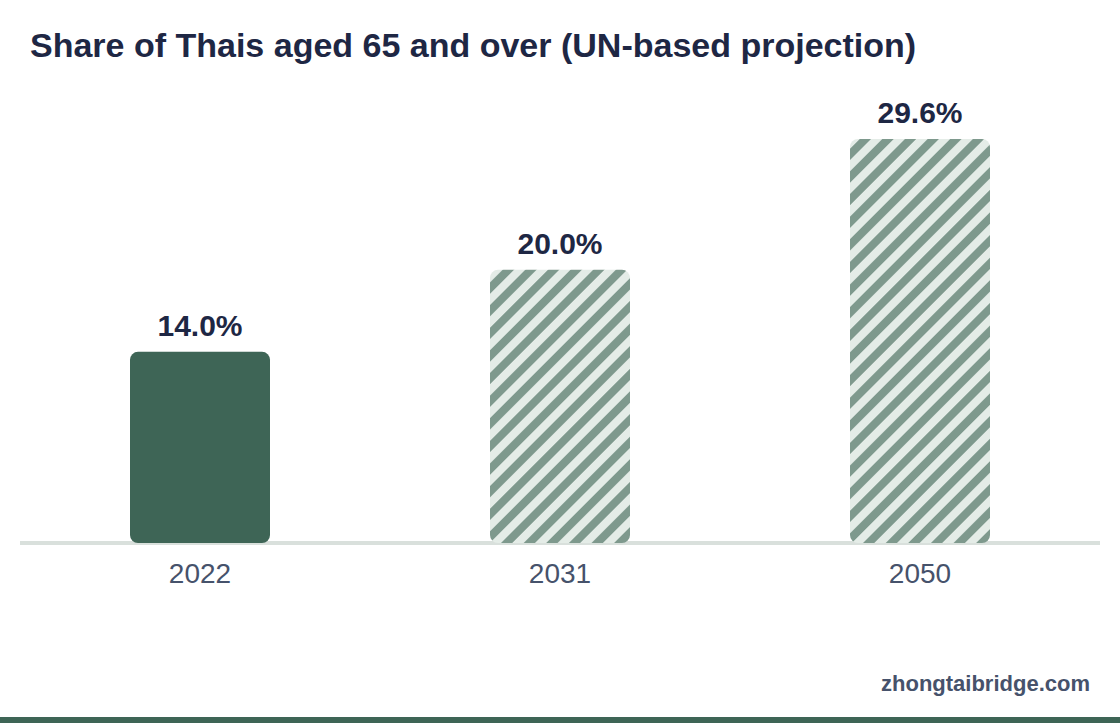
UN-based projections tell the same story with different definitions. They place the median age at about 42 in 2026, show the population peaking in 2022 at roughly 71.7 million, and project the 65-plus share to reach 20% around 2031 and about 29.6% by 2050, with a dependency ratio near 70% by mid-century. Be careful with definitions: 60-plus and 65-plus produce different percentages, and registered population (65.8 million) differs from UN-based estimates (about 71.6 million) because of unregistered residents and methodology. State which base you use in any model.
Share of Thais aged 65 and over (UN-based projection)
Why do two population numbers matter for your business case?
A market-size model that multiplies population by penetration can differ by 9% depending on which base you choose. Registered residents are the right base for consumer products sold through retail and e-commerce, where delivery requires an address, but they exclude some migrant workers and long-stay residents who are customers for certain categories. Use registered population as your conservative case, and test whether your category has meaningful demand among the excluded group before you add it.
Two population bases
65.8M
registered population, Dec 2025 (DOPA)
71.6M
UN-based estimate, Oct 2025
42.0
median age, 2026
2022
year the population peaked, UN-based
Source: DOPA via ASEAN Now; DataReportal; Population Pyramid.
Which consumer segments are growing?
Active older adults: people in their 60s with pensions, savings or family support, interested in health, travel, home comfort and social life.
Adult children as buyers: a generation managing care for parents while raising their own children, who buys on parents' behalf and values reliability and convenience.
Care-dependent older adults: demand for home-care equipment, assistive devices, nutrition and professional care services. The Department of Business Development has noted growth in elderly-care businesses.
Single-person and small households: smaller pack sizes, ready meals and delivery-led convenience.
The common thread is value per customer. A shrinking base rewards brands that earn trust, solve concrete problems and retain customers over many years.
What are the implications by category?
Health, nutrition and personal care: claims and credibility matter most. Evidence, clear instructions and professional endorsement outperform aspirational branding.
Home and mobility products: safety, ease of use and after-sales service are decisive.
Financial and insurance services: older households look for stability and clear communication.
Food and beverage: smaller portions, softer textures, lower sugar and sodium where appropriate, and delivery convenience.
Technology: simple interfaces, LINE-based service and family-managed accounts.
How do you reach older consumers and their families?
Older Thais are online. Chat and video platforms matter, and LINE is the main channel for communication. Younger family members often handle research and payment. A realistic approach is to design for two audiences: the user and the person who researches and buys. Content on search and video explains the product to the family; chat service and clear Thai-language instructions serve the user.
Reported generative AI adoption varies by generation, with one corporate presentation citing about 50% for Gen X compared with 80% to 85% for younger cohorts. Do not assume that older consumers cannot use digital channels, but do not assume that they use the same ones as younger audiences. Test.
What are the opportunities for B2B and technology firms?
Aging affects labor supply, healthcare demand and public finances. For industrial and technology firms, this supports demand for automation, healthcare equipment, telehealth, logistics efficiency and productivity tools. Chinese manufacturers of care equipment, rehabilitation devices and smart-home products can find a receptive market, provided they meet local standards, train channel partners and provide service.
Evaluate demand through hospitals, clinics, care homes and distributors, and plan for long sales cycles and evidence requirements.
How should you adjust your forecast?
Use registered population as the base case and model growth by segment, not by headcount.
Forecast per-customer revenue and retention, since new customer acquisition gets harder as the base shrinks.
Test price sensitivity by age group and household role.
Plan service capacity for the older customer, including phone and chat support in Thai.
Review the forecast every year against NESDC and registry data.
What product and service design principles follow?
Older customers value clarity, reliability and service. Design products with readable labels in Thai, simple operation and strong safety, and offer support by phone and LINE in addition to apps. Price is rarely the only driver, since adult children often research and pay, but trust is decisive: warranty terms, visible certifications and a human contact reduce hesitation. For subscriptions and replenishment, make cancellation easy and communication respectful. For B2B suppliers of care equipment, sell through institutions and distributors with training and maintenance included.
Design principles for an aging market
Principle
What it means in practice
Readable
Large Thai text, high contrast, simple instructions
Phone and LINE service; local repair and spare parts
Family-aware
Content for adult children who research and buy
Respectful
Plain language; no pressure; easy returns
Frequently asked questions
Is Thailand's population really shrinking?
The registered population fell to 65.8 million in 2025 according to the Department of Provincial Administration, and UN-based projections show the population peaking around 2022. Definitions and counting methods differ, so state your source.
Is the share of older people 20% or higher?
About one in five Thais is 60 or older on the 60-plus definition. On the 65-plus definition the share is lower today and is projected to reach 20% around 2031.
Which category benefits most from aging?
Health, care, home safety and convenience categories benefit most, but only brands with credible evidence and service capabilities capture the demand.
Thailand's digital economy is projected at US$56 billion in 2025. Why sources disagree on growth, what drives it and how to model it for your entry plan.
Thailand taxed low-value imports with VAT from February 2025 and duty from 1 baht on 1 January 2026. What changes for Chinese sellers and how to respond.