Thailand's Data Center Boom: Opportunities for Chinese Technology Firms
By ZhongTai Bridge Editorial · Last reviewed October 2026 · 6 min read
Photo: Unsplash
Short answer
Data centers and digital services became Thailand's top-ranked sector by investment value in 2024 at THB 243.3 billion, and data center pledges reached THB 521.2 billion (US$16.1 billion) in the first half of 2025. Chinese operators and cloud providers are part of the build-out. The larger opportunity for Chinese technology firms lies in enterprise demand, power, construction and services around the facilities.
How big is the data center wave?
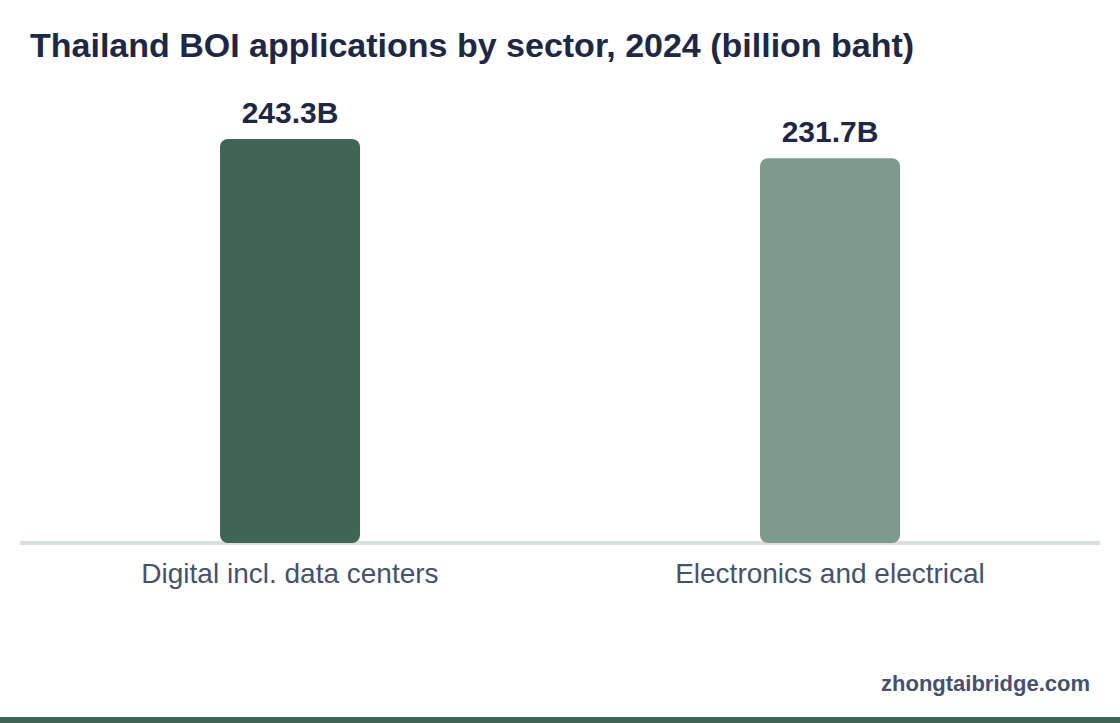
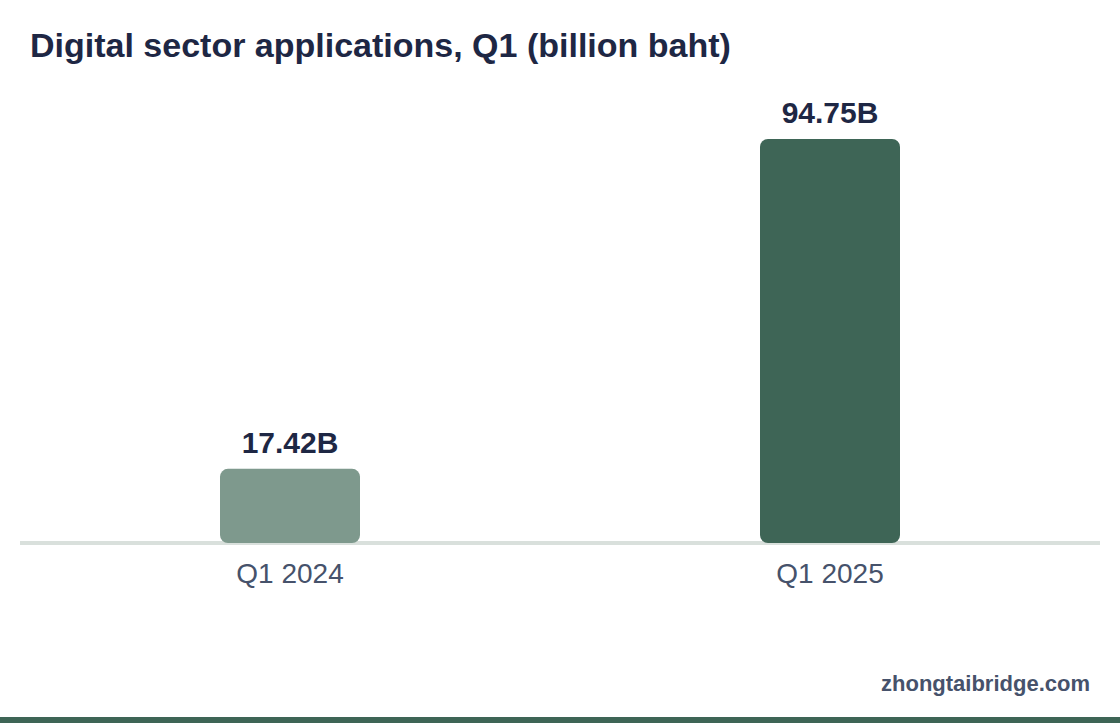
Thailand's Board of Investment reported that the digital sector, including data centers and cloud services, topped its sector rankings for the first time in 2024, with 150 projects worth THB 243.3 billion, ahead of electronics and electrical at THB 231.7 billion. In the first quarter of 2025, digital applications rose more than fivefold to THB 94.75 billion, driven by five data center projects worth THB 94.23 billion. In the first half of 2025, data centers alone attracted THB 521.2 billion (US$16.1 billion) from 28 projects.
Chinese participants appear on several fronts. BOI approved a THB 23.7 billion, 203 MW facility by Stratus Technology, an affiliate of China's ZData Technologies, at the CPGC Industrial Estate in Rayong. Haoyang Data bought land in Rayong for a 300 MW facility, and Alibaba Cloud launched a second data center in Thailand in February 2025. Global providers such as AWS launched a cloud region in January 2025, and companies including TikTok and NTT Data have also invested.
Thailand BOI applications by sector, 2024 (billion baht)
Column chart. Digital incl. data centers: 243.3B; Electronics and electrical: 231.7B
Digital topped BOI's sector ranking for the first time in 2024. Source: Thailand Board of Investment.
Digital sector applications, Q1 (billion baht)
Column chart. Q1 2024: 17.42B; Q1 2025: 94.75B
A more than fivefold rise, driven by five data center projects worth THB 94.23 billion. Source: Thailand Board of Investment.
Data center pledges
THB 521.2B
data center applications, H1 2025 (US$16.1B)
28
data center projects in H1 2025
203 MW
Stratus Technology facility, Rayong
300 MW
Haoyang Data site, Rayong
Source: W.Media; DatacenterDynamics.
What is driving demand?
Cloud adoption by Thai enterprises and government, and regional hubs for multinational customers.
AI workloads, which require dense computing and power.
Digital commerce, payments and media growth, including video, which consumes storage and bandwidth.
Regional connectivity and Thailand's position as a Southeast Asian hub.
Demand drivers are strong, but announced capacity is not the same as occupied capacity. Applications may be delayed, resized or canceled.
Where are the opportunities beyond the facilities themselves?
Power and cooling equipment, electrical systems and monitoring.
Construction, engineering and modular solutions suited to fast deployment.
Network equipment, fiber and edge computing.
Enterprise cloud migration, managed services and cybersecurity for Thai customers.
AI applications for Thai-language customer service, retail, logistics, manufacturing and finance.
Training and talent development for technicians and engineers.
A reported estimate of organizational AI maturity in Thailand of about 10% suggests that most Thai firms are early in their adoption, which creates room for implementation partners with local presence.
Opportunity by layer
Layer
Opportunity
Entry model
Power and cooling
Equipment, monitoring, maintenance
Distributor plus service partner
Construction and fit-out
Modular and fast deployment
Joint bid with Thai contractor
Network and edge
Fiber, switching, edge nodes
Integrator partnership
Cloud and managed services
Migration, security, operations
Thai integrator and local support
AI applications
Thai-language service, retail, logistics, finance
Vertical references and pilots
What constraints should you plan for?
Power: large facilities need secure, affordable, increasingly low-carbon energy, and grid access can be a gating factor.
Water and cooling in a hot climate.
Data governance: Thai personal data and sector rules affect where and how data can be stored and processed. Obtain legal advice for your use case.
Competition from global hyperscalers and established regional operators.
Geopolitics: customers may ask where technology originates, and Chinese vendors should be ready to address security and compliance questions transparently.
How should a Chinese technology firm enter?
Start with a specific customer problem in a vertical where you have proven references.
Partner with a Thai integrator or system builder for local contracts and support.
Localize the product: Thai language, local payment and compliance integrations, and Thai documentation.
Invest in support: a service desk with Thai-speaking engineers builds credibility.
Build evidence: case studies, certifications and independent testing.
What should you monitor?
BOI approvals and realized investment by project.
Power capacity plans and tariff changes.
Cloud region launches and customer wins.
Policy on data localization and AI governance.
Pricing and utilization trends reported by operators.
What does a realistic go-to-market look like for a Chinese technology firm?
Start with a vertical where you already have proven references, because Thai enterprise buyers ask for local evidence. Build a Thai-language solution brief with measurable outcomes, a pilot offer with clear success criteria and a named local support team. Partner with a Thai systems integrator that already sits in the customer's procurement process, and agree on roles for pre-sales, delivery and support. Prepare security and data-handling documents early, because questions about where data is stored and who can access it often decide enterprise deals. Use trade events, industry associations and thought-leadership content to build credibility, and plan sales cycles of months.
A worked example: a Chinese cooling-equipment supplier
The example is illustrative. The supplier wants to sell cooling units to data center builders in the eastern provinces. It maps projects in BOI announcements, identifies the main contractors and operators and prepares a Thai-language brief with efficiency data, certifications and references from other markets. It partners with a Thai mechanical and electrical contractor for installation and a local service company for maintenance, and it sets up a spare parts stock in Thailand. It offers a pilot at a smaller facility with agreed performance metrics. Procurement teams ask about delivery times, support response and compliance documents, so the supplier prepares them in advance.
The example shows that the winning move is not a bigger sales team, but the ability to deliver, install and support in Thailand with local partners.
Risk checklist for technology firms in Thailand
Customer concentration in a few large projects.
Power and grid constraints that delay projects.
Compliance and data governance questions from enterprise buyers.
Currency and price risk on imported equipment.
Local talent availability for installation and maintenance.
Executive questions on digital infrastructure
Is the data center boom a bubble? Pledges are large, but realized capacity depends on power, demand and execution. Track approvals versus built and occupied capacity.
Where is the best opportunity for a mid-size firm? Services and equipment around the facilities and vertical AI solutions with local partners, which are less capital intensive than building capacity.
How do we address security concerns? Prepare transparent documentation on architecture, data handling and certifications, and offer independent audits.
What local partners do we need? Integrators, contractors and service providers with Thai enterprise relationships.
Frequently asked questions
Is Thailand a major data center market?
Investment data suggest it is rapidly becoming one, but realized capacity will depend on power, demand and execution.
Do Chinese firms face restrictions in Thailand's digital sector?
Rules depend on the activity and the sector. Seek local legal advice for your specific case.
What is the best entry point for a mid-size software firm?
A focused vertical solution with a Thai integrator partner and local support is usually more achievable than competing on infrastructure.
Thailand's digital economy is projected at US$56 billion in 2025. Why sources disagree on growth, what drives it and how to model it for your entry plan.
Thailand taxed low-value imports with VAT from February 2025 and duty from 1 baht on 1 January 2026. What changes for Chinese sellers and how to respond.