Thailand's Industrial Corridors and Where Chinese Manufacturers Locate
By ZhongTai Bridge Editorial · Last reviewed October 2026 · 6 min read
Photo: Unsplash
Short answer
Thailand's Board of Investment received US$60.2 billion of applications in 2025, with foreign investment of US$43.65 billion. China ranked third by value for January to September, but BOI notes that Singapore often acts as a gateway for Chinese parent firms, so official country statistics understate Chinese capital. Chinese manufacturers cluster in the eastern provinces, and suppliers follow.
How much investment is coming, and from where?
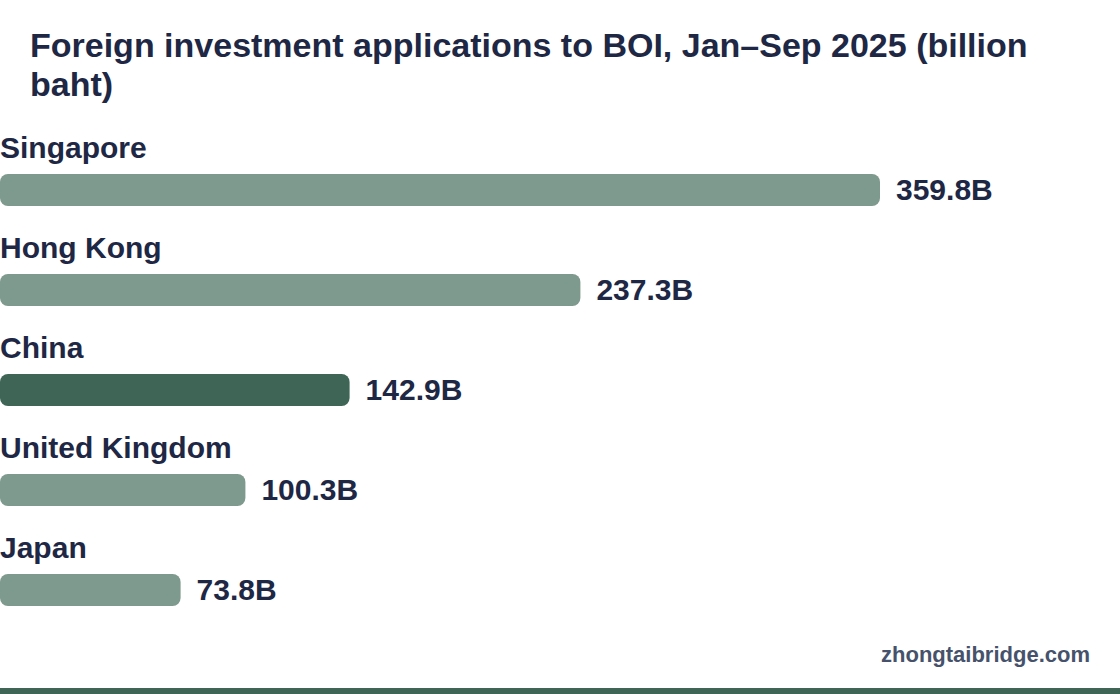
Thailand's Board of Investment (BOI) reported record investment promotion applications of THB 1.876 trillion, about US$60.2 billion, in 2025, the highest since the agency's founding. Foreign direct investment applications were about US$43.65 billion. In the first nine months of 2025, Singapore was the top source by value at THB 359.8 billion, followed by Hong Kong at THB 237.3 billion and China at THB 142.9 billion. For the full year, BOI cites about US$5.5 billion from China.
The headline ranking hides a key point. A Thai government summary notes that Singapore's position is largely explained by its role as a gateway for Chinese and American parent firms. Investment structured through Singapore or Hong Kong is booked under those countries. When you estimate Chinese capital in Thailand, add a portion of investment recorded under intermediary jurisdictions. For a supplier or service provider, the practical consequence is that the Chinese customer base in Thailand is larger than the official country figure suggests.
Foreign investment applications to BOI, Jan–Sep 2025 (billion baht)
Horizontal bar chart. Singapore: 359.8B; Hong Kong: 237.3B; China: 142.9B; United Kingdom: 100.3B; Japan: 73.8B
Source: Thailand Board of Investment.
BOI 2025 headline figures
THB 1.876T
total applications, a record (about US$60.2B)
US$43.65B
foreign direct investment applications
US$5.5B
from China, per BOI full-year summary
8
Chinese automakers producing in Thailand
Source: BOI; Automotive World.
Where do Chinese manufacturers locate?
The Eastern Economic Corridor, covering Chachoengsao, Chonburi and Rayong, is the main cluster for Chinese manufacturing and data infrastructure. Rayong hosts the largest concentration of Chinese electric vehicle plants and several data center projects, including a 203 MW facility by a ZData affiliate at the CPGC Industrial Estate, approved by BOI in 2025. Eight Chinese automakers have set up production in Thailand, and component suppliers have followed them.
For firms evaluating a location, industrial estates differ by infrastructure, power reliability, labor supply, logistics access and the presence of existing Chinese suppliers. Visit sites, speak with current tenants and compare total cost, not only land price.
What is the supplier ecosystem effect?
When an anchor manufacturer commits, its tier-one suppliers follow, and then tier-two suppliers, logistics providers, packaging firms, maintenance contractors and professional services. This creates demand for local content, industrial services and workforce training. Chinese suppliers that arrive early can secure long-term contracts, while those that arrive late face crowded competition and shortages of skilled labor.
Thai incentive programs, particularly in electric vehicles, tie benefits to local production, which pulls the supply chain into the country. The experience of second-tier EV brands shows that anchor players can also struggle, which affects the suppliers that depend on them. Diversify your customer base.
What should a B2B firm check before committing?
Customer concentration: how much of your revenue depends on one anchor customer?
Local content expectations: what share of materials or services must be sourced locally under your customer's incentives?
Labor: availability and cost of technicians and engineers, and training needs.
Utilities: power, water and waste capacity at your chosen site.
Logistics: distance to ports and highways, and customs handling.
Partners: availability of Thai or international partners for sales, service and compliance.
Exit options: lease terms and the resale or reuse value of your investment.
Site selection scorecard for a supplier
Criterion
Questions to ask
Customers nearby
Which anchor plants are within a day's drive?
Labor
Technician supply, wages, training partners
Utilities
Power reliability, water, waste handling
Logistics
Distance to ports and highways, customs handling
Incentives
BOI eligibility and conditions
Ecosystem
Chinese and Thai suppliers, service providers
Flexibility
Lease terms, expansion options, resale value
How do you reach Chinese manufacturers already in Thailand?
Chinese-owned factories in Thailand often prefer suppliers and service providers who speak Chinese and understand their standards, but they also need Thai-language compliance, labor and community relations support. Content in Chinese and Thai, presence at trade shows in Bangkok and the eastern provinces, and partnerships with industrial estate operators are effective channels. A bilingual presentation of your capabilities and references reduces friction.
What are the risks?
Policy shifts, such as changes in local-content or import rules.
Overcapacity and price competition in popular sectors.
Dependence on one sector, such as autos.
Environmental and community expectations around industrial estates.
Treat investment data as direction, not certainty: applications are not all realized, and timing varies.
How to read the 'gateway' effect when you size Chinese demand
Official country rankings place China third in 2025 applications, but the Thai government itself notes that Singapore's lead is largely explained by its role as a gateway for Chinese and American parent firms. If you are a supplier or service provider sizing Chinese-owned customers in Thailand, do not use the China row alone. Combine BOI project lists, industrial estate tenant directories, Chinese chambers and association memberships and customer interviews to build a bottom-up list of target accounts, then rank them by project size, procurement behavior and location. This account-based method is slower than a statistics table but far more useful for sales planning.
A worked example: a component supplier choosing a first site
The example is illustrative. A Chinese supplier of plastic components wants to serve automotive customers. It lists target plants within a day's drive, checks power and water capacity at three industrial estates, compares labor availability and visits tenants to ask about logistics and service providers. It also checks BOI conditions that may apply and speaks to Thai and Chinese suppliers about subcontracting. It decides to start with a leased unit in an estate close to the anchor plants, with an option to expand, instead of buying land.
The choice reduces capital at risk and allows the supplier to learn the Thai operating environment before it commits to a larger facility. The example highlights the value of flexibility, especially in sectors that are changing rapidly.
Partnering with Thai suppliers and training providers
Thai suppliers can help with local content, logistics and relationships. Offer clear quality standards, technical support and payment terms that work for smaller firms. Training providers and technical colleges can supply technicians if you share requirements early. A visible local partnership also supports your reputation and can help you meet local content expectations from customers.
Executive questions on locating in Thailand
Is it better to lease or buy? Leasing preserves flexibility while you learn local conditions, and buying may suit proven long-term plans. Compare total cost and risk.
Do BOI incentives apply to us? Eligibility depends on activity and investment. Consult BOI and advisers early.
How do we find local suppliers? Through industrial estates, associations, trade shows and anchor customers' supplier programs.
What is the main non-financial risk? Labor availability and skills, followed by utilities and community relations.
Frequently asked questions
Is China the largest foreign investor in Thailand?
Not in official application statistics by country, where Singapore and Hong Kong rank higher, but BOI and others note that Chinese capital often flows through those jurisdictions.
Where is the Chinese manufacturing cluster?
Mainly in the Eastern Economic Corridor, especially Rayong and Chonburi.
How reliable are BOI application figures?
They show intent and approval pipelines, not completed investment. Use them as a leading indicator.
Thailand's digital economy is projected at US$56 billion in 2025. Why sources disagree on growth, what drives it and how to model it for your entry plan.
Thailand taxed low-value imports with VAT from February 2025 and duty from 1 baht on 1 January 2026. What changes for Chinese sellers and how to respond.